
ICE uses a wide and growing arsenal of surveillance technology to track, identify, and arrest immigrants across the United States — including in cities and states that have explicitly passed laws banning cooperation with federal immigration authorities. The agency's toolkit includes AI-powered license plate readers operated by local police, a proprietary facial recognition app called Mobile Fortify, and cell-phone tracking devices known as stingrays. Together, these systems give ICE something close to a real-time map of who is where, what they look like, and where they've been. And critically, much of this access happens without the knowledge or consent of the communities being surveilled.
How Does ICE Use Surveillance to Track Immigrants?
The short answer is: through a network of tools that were never specifically designed for immigration enforcement, but have been quietly repurposed for it. ICE taps into local police license plate databases, uses facial recognition on the street without consent, deploys cell-signal interceptors at protests, and increasingly automates the investigative work that used to require significant personnel. The result is an agency that can, in many cases, figure out where a person lives, works, and travels without ever knocking on a door.
And with Congress recently approving $75 billion in additional funding for the agency — nearly tripling its annual budget over the next few years — the scope of these tools is only going to grow. What follows is a breakdown of each major surveillance system currently in use, how it works, and why it matters far beyond the immigration debate.
What Is Flock Safety and How Do Police Use It?
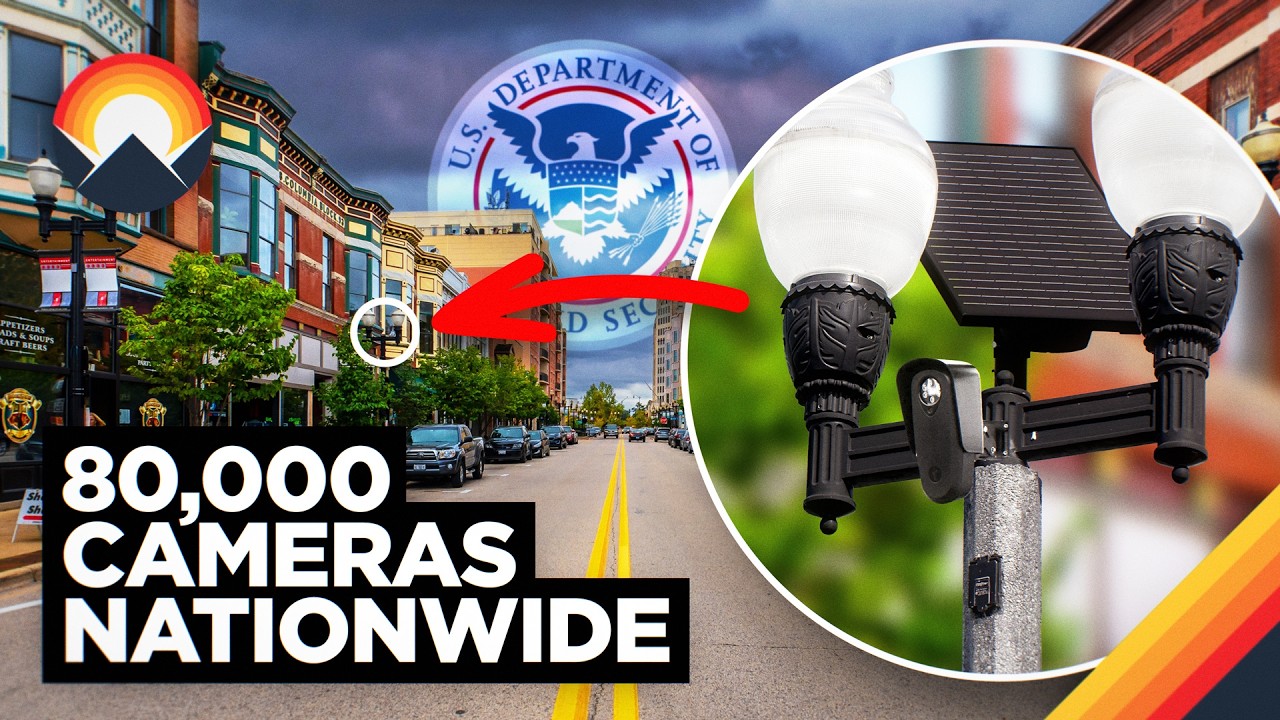
Flock Safety is a fast-growing, venture capital-backed startup that manufactures and operates AI-enabled license plate reading surveillance cameras. Police departments don't own these cameras outright — they pay an annual licensing fee to access the data they collect. A small city like Glenwood Springs, Colorado, for example, pays $375,000 per year for access to Flock's software suite, which allows officers to search where and when a particular vehicle passed through town, or add a plate to a hot list to trigger an alert the moment that car appears again.
The system is genuinely useful for local law enforcement. Internal logs from Glenwood PD show officers using it daily to investigate assaults, stalking, sex offenses, and more. It helped them arrest a gang member from California driving a stolen vehicle, a wanted felon suspected of elder abuse, and a predator who had lured a child to the town from Oregon.
But what makes Flock Safety so powerful — and so controversial — is the data-sharing network baked into the platform. With a few button clicks, police departments can opt into agreements that let other departments search their camera data, and vice versa. Glenwood agreed to share its data because Interstate 70 runs directly through the town, meaning thousands of vehicles pass through every day. Any fugitive fleeing from anywhere in the country might have driven past one of Glenwood's cameras. That's a valuable resource — and one that outside agencies have taken full advantage of.
Can ICE Get License Plate Data Even in Sanctuary States?
Yes — and this is where it gets complicated. Colorado passed a state law explicitly prohibiting local police from sharing data or cooperating with federal immigration authorities. Glenwood Springs voted two-to-one for Kamala Harris in 2024 and has a large immigrant population. And yet, in January 2025 alone, internal logs show that outside agencies accessed Glenwood's Flock data 516,892 times. Among those agencies were police departments that actively cooperate with ICE — and logs explicitly show ICE's investigative arm, Homeland Security Investigations, conducting searches using Glenwood's data.
When local residents found out, they pressured the city council, which then restricted access to agencies outside Colorado. Then logs revealed two in-state departments were illegally passing data to ICE anyway. So Glenwood shut off all outside access entirely. But there was still a problem: the city's own attorney admitted that the terms of the contract with Flock meant the city couldn't fully control what Flock itself does with the data. Denver terminated its Flock contract after discovering its data had been shared with federal immigration authorities without its knowledge as part of a pilot program.
And then there's the backdoor that can't be closed. The local Lowe's home improvement store in Glenwood Springs has its own Flock Safety cameras at the entrance to its parking lot. Unlike a police department, Lowe's publishes no logs, discloses no data-sharing agreements, and answers to no constituents. It is collecting a database of every vehicle that enters its lot and telling the public nothing about what it does with that information. Lowe's is not alone — there are thousands of Flock Safety cameras nationwide operated by private businesses, meaning ICE could potentially access local surveillance data through commercial partners even where public agencies have been fully locked down.
What Is the Mobile Fortify Facial Recognition App ICE Uses?
In countless videos of ICE arrests and confrontations, agents can be seen holding a phone up to a person's face. That's not a camera. It's a proprietary app called Mobile Fortify, developed specifically for use by federal immigration agents. A successful scan returns the individual's name, date of birth, nationality, immigration status, and whether a judge has already ruled they should be deported — potentially giving the agent immediate probable cause for an arrest.
Mobile Fortify pulls imagery primarily from Customs and Border Protection, which has dramatically expanded its use of biometric data in recent years. An increasing number of US airports now use biometric gates that scan faces when boarding international flights. While US citizens' photos from these gates are supposed to be deleted within 12 hours, non-citizens' photos are kept for up to 75 years and fed into a database accessible to Mobile Fortify. The app also taps into ICE's own case management system and the FBI's National Crime Information Center.
Crucially, one internal document states that ICE does not provide individuals the opportunity to decline or consent to the collection and use of their biometric data. Agents are permitted to use the app on anyone, anywhere, at any time, for any reason.
How Accurate Is ICE's Facial Recognition in the Field?
Not very — at least not in the chaotic real-world conditions where agents are actually using it. A deposition from a lawsuit related to an ICE raid in Woodburn, Oregon — an agricultural town with a large immigrant population — offers a disturbing window into how Mobile Fortify actually works in the field.
An officer scanned a detained woman's face and the app returned a match for someone named Maria. He called out the name; she didn't respond. He scanned her again. This time, the app matched her to an entirely different person. When asked in the deposition what his probable cause was for arresting her, the officer said it was two things: she spoke Spanish, and she was a "possible match" on his facial recognition system. Courts have consistently ruled that speaking a particular language is not sufficient probable cause for an arrest. That left the faulty app as the core legal justification — an app the officer himself admitted had already misidentified the woman at least once.
This isn't surprising given the conditions. Lighting is inconsistent. The phone camera is unstable. People move their heads to avoid being scanned. These are exactly the circumstances where facial recognition struggles most. And yet ICE agents are using it as the basis for arrests across the country.
Is ICE Using Facial Recognition on Protesters?
There is strong circumstantial evidence that the answer is yes. Agents have been observed holding their phones up and scanning the faces of protesters in a manner consistent with Mobile Fortify use — even at protests in places like Minneapolis, where the demonstrators were overwhelmingly white, English-speaking Americans with no plausible immigration status issue. Why would immigration agents be running facial recognition on people they have no reason to suspect are undocumented?
Here's the likely answer: an internal document reveals that images captured by Mobile Fortify are retained for up to 15 years — even if the person photographed is a US citizen. Every time an agent uses the app, an "encounter log" is created that ties the individual's photo to the time, location, and circumstances of the scan. Scan someone at a protest, and ICE has a 15-year electronic record that that person was there.
There's already at least one documented case of apparent retaliation. A woman acting as a legal observer, following DHS vehicles and documenting their actions in Minnesota, was addressed by name by an agent who she had never identified herself to — and was warned that the agency had facial recognition. Three days later, her TSA PreCheck status, held for 14 years, was revoked. It may be an isolated incident, but it suggests that facial recognition data is flowing across DHS and potentially being used to track political dissent.
What Are Stingrays and Does ICE Use Them?
Stingrays are vehicle-based devices that spoof cell tower signals. Because phones automatically connect to the strongest nearby signal, any phone near a stingray will connect to it. The device then captures the phone's IMSI number — a unique identifier tied to a carrier account. With a subpoena or warrant, ICE can link that IMSI to a specific person's identity.
ICE policy is supposed to require a warrant for stingray use, limiting it to targeted searches for specific individuals. There is, however, an entire Inspector General report dedicated to documenting how frequently the agency ignores this policy and uses stingrays without warrants. And there's evidence of something even more alarming: mass, non-targeted surveillance. Analysis of cellular signals at an anti-ICE protest in Seattle on July 4th, 2025, found anomalies consistent with IMSI capture — suggesting agents may have been logging the identity of every phone, and therefore every person, present at the demonstration.
Is the US Becoming a Surveillance State?
The honest answer, based on what's documented here, is that it already is one — at least in meaningful part. License plate readers creating a nationwide searchable database of vehicle movements. Facial recognition deployed without consent on anyone an agent chooses. Cell-signal interceptors potentially logging the identities of everyone at a political protest. And an agency with a well-documented history of ignoring its own policies, hiding its methods from the public, and facing little accountability when it oversteps.
The tools themselves are often unreliable — high error rates, inconsistent standards for logging searches, and rampant misuse by individual officers. But that unreliability doesn't make ICE less dangerous. It makes the agency more dangerous, because flawed tools get used as pretexts for arrests that wouldn't otherwise pass constitutional muster. Detain first, investigate residency status second. With no serious institutional pressure to do otherwise, it works.
Americans have historically been among the most skeptical of domestic government surveillance in the world. The Fourth Amendment's protections against unreasonable search and seizure exist precisely because the country's founders understood what it looked like when a government could surveil its population at will. The tools that are currently being deployed primarily against immigrants and protesters are not tools that will stay narrowly targeted forever. The infrastructure being built now is available to whoever holds power next. That's not a hypothetical concern. It's how surveillance states have always worked.