
What Happened at the LA ICE Raid Protests?
Los Angeles exploded into some of the most intense street protests the city has seen since 2020 after ICE officials carried out a series of immigration raids across the city. Within days, thousands of demonstrators flooded the streets surrounding the federal building and nearby detention centers, facing down rows of riot-geared LAPD officers and freshly deployed National Guard troops. Cars were burned, intersections were seized, bricks were hurled at police vehicles, and the 110 freeway was ultimately taken over by protesters before the night was out. This was not a quiet candlelight vigil — this was LA on the edge.
The demonstrations were fueled by deep anger in immigrant communities who felt the raids were indiscriminate, sweeping up hardworking residents rather than dangerous criminals. Protesters arrived waving flags from Mexico, Honduras, and other Latin American nations, carrying signs reading "Free Them All" and "Stolen People on Stolen Land." The energy on the ground was raw, emotional, and at times, extremely volatile.
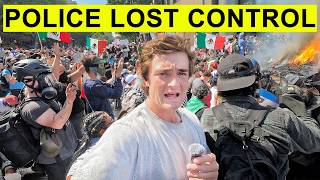 00:45
Protesters outside the LA federal building with National Guard troops holding a line
Watch at 00:45 →
00:45
Protesters outside the LA federal building with National Guard troops holding a line
Watch at 00:45 →
Why Was the National Guard Deployed in LA?
President Trump authorized the deployment of approximately 2,000 National Guard troops to Los Angeles in response to the growing unrest surrounding the ICE raids. Groups of roughly 300 troops were positioned at various points across the city, with a heavy concentration outside the federal building and the nearby immigration detention center.
Local and state officials pushed back hard against the federal intervention. California Governor Gavin Newsom has consistently maintained that state law prohibits local law enforcement from assisting federal immigration operations, putting him in direct conflict with the Trump administration. Many protesters echoed this sentiment on the ground, with several directly telling reporters that LAPD had no business helping ICE and that the National Guard had no place in their city.
One demonstrator put it bluntly: "They got sent because we don't have a president that can lead." Others took a more measured approach, asking the Guard members themselves whether they would follow orders if told to open fire — with at least one soldier reportedly shaking his head and saying no after a long pause.
Are ICE Deportations Targeting Criminals or Everyone?
One of the loudest debates on the streets — and one that cuts to the heart of the entire protest — is whether ICE is actually going after dangerous criminals as the federal government claims, or whether agents are sweeping up everyday community members indiscriminately.
04:20
National Guard troops deployed in groups of 300 around the city
Watch at 04:20 →
Multiple protesters on the ground described scenes that contradicted the official narrative. One resident who lives near a Home Depot described watching ICE agents pull men off the street who were simply waiting to pick up day labor work. Others pointed to reports of raids at school graduations and job sites, arguing these locations do not represent the "worst of the worst" that federal officials promise they are targeting.
"They're raiding school graduations. They're raiding workplaces. Those are employees. Those are people contributing to their communities," one protester said. "That's a lie that's been fed to you."
To be fair, some protesters acknowledged nuance. One man with a Honduran flag said he could agree with deporting people convicted of serious crimes like murder, but drew a sharp line at going after hardworking residents with no criminal history. The question of where that line gets drawn — and whether due process is being respected in either direction — remained a defining tension throughout the day.
What Did Protesters Do to Police During the LA Unrest?
The clashes between protesters and law enforcement escalated dramatically over the course of the day. What began as a loud but largely stationary demonstration outside the federal building evolved into a running confrontation across multiple city blocks.
09:15
Protesters surrounding police vehicles and refusing to let them leave
Watch at 09:15 →
Among the most striking moments: protesters surrounded police vehicles and refused to let them leave even when officers were actively trying to withdraw. Water bottles rained down on squad cars, a windshield was smashed, and on at least one occasion, bricks were thrown directly at police officers and their vehicles. When police finally moved to push back, they deployed rubber bullets and what appeared to be pepper spray or tear gas, sending demonstrators scrambling.
Fireworks were set off in the crowd — an extremely dangerous move in a packed urban environment. Several people reported being struck by rubber bullets at close range, with one young man describing the hit as a 10 out of 10 on the pain scale, acknowledging that his girlfriend had thrown water at the officer just before he was shot.
By evening, protesters had moved onto the 110 freeway, fully shutting it down — a dramatic escalation that capped an already chaotic day.
Is Being Undocumented in the US Actually a Crime?
One of the most debated legal points raised throughout the protests was whether being undocumented in the United States is actually a criminal offense. Several protesters and at least one observer interviewed on the ground were firm on this point: it is not.
15:30
Rubber bullet casings on the ground after police opened fire on the crowd
Watch at 15:30 →
Under current U.S. law, being present in the country without authorization is generally a civil violation, not a criminal one — meaning it is handled through immigration courts rather than the criminal justice system. Illegal entry itself (crossing the border without inspection) can be prosecuted as a misdemeanor for a first offense, but simply residing in the country undocumented does not make someone a criminal in the traditional sense.
This distinction matters enormously to communities affected by the raids, because it shapes the argument around due process. As one protester noted, "Innocent until proven guilty — they can't just drag people off the street because they think they're guilty." Others argued that even individuals who entered the country illegally deserve due process rights before being deported.
Who Are the Green Hat Lawyers at Protests?
Scattered throughout the crowd were individuals wearing bright green hats — a familiar sight at large-scale American protests. These are members of the National Lawyers Guild, a legal organization that deploys trained observers to demonstrations to monitor law enforcement conduct.
Their role is straightforward: they are neutral third-party legal observers who document any instances of potential police misconduct. If a protester is detained, the green hat observers collect names and contact information so that legal representation can be arranged quickly. They are not protest organizers, and they do not coordinate with demonstrators.
The organization is a legitimate, long-standing legal group, though questions about its funding sources — including speculation about outside organizations — circulate frequently on social media whenever they appear at high-profile demonstrations.
What Did LA Officially Declare During the Protests?
As the situation deteriorated, the Los Angeles Police Department officially declared a tactical alert for the city. Under a tactical alert, all LAPD personnel are required to remain on duty regardless of shift length, ensuring maximum manpower is available to respond to the unrest. It is a significant operational escalation that signals the department views the situation as a genuine public safety emergency.
The declaration came as clashes intensified near the federal building, with police and National Guard working to push protesters back from the intersection and re-establish a perimeter. By that point, tear gas canisters had been deployed, rubber bullets were in the air, and the streets were littered with bottles, bricks, and spent shell casings.
Whether the protests will continue to escalate — or whether negotiations between federal and state officials will ease the tension that ignited them — remains to be seen. But one thing is clear from the ground in Los Angeles: this city is not done making its voice heard.