
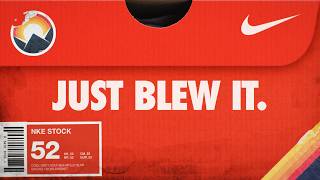
Nike is losing market share — and not just a little. The brand that once controlled 42% of all athletic shoe sales in the US has watched that number erode as upstarts like Hoka, On Running, New Balance, and Brooks have outpaced it in nearly every growth category. In specialty running shops, where the most committed shoe buyers spend their money, Nike commands less than 5% of sales. Meanwhile, it reported an 11.5% year-over-year revenue drop in fall 2025 and saw its stock fall 20% in a single day in 2024. For a company that invented so many of the trends it is now chasing, that's a stunning fall from grace.
 00:45
Nike's Beaverton, Oregon campus — 400 acres where the brand manages design and marketing but manufactures nothing
Watch at 00:45 →
00:45
Nike's Beaverton, Oregon campus — 400 acres where the brand manages design and marketing but manufactures nothing
Watch at 00:45 →
Why Is Nike Losing Market Share to Smaller Brands?
The simple answer: Nike stopped innovating and started coasting. The more complicated answer involves a decade of leadership missteps, PR crises, a catastrophic pivot away from wholesale retail, and a failure to anticipate the cultural moments that Nike, of all companies, should have seen coming.
In the specialty running segment — stores staffed by experts selling shoes to actual runners — Brooks and Hoka together account for nearly half of all sales. On Running, New Balance, and Saucony make up another substantial chunk. Nike, a brand that once defined what a running shoe could be, is a rounding error in that space. It had deprioritized running, pulled back from in-store partnerships, and leaned into a direct-to-consumer digital strategy right as brick-and-mortar shopping roared back after the pandemic. When consumers returned to stores, Nike wasn't on the shelves.
The speed category — where Nike's Vaporfly once stood alone as the world's fastest road racing shoe — tells a similar story. Adidas has caught up. Puma, in the lab, has passed them. In cushioning and comfort, the categories Nike essentially invented for running shoes, Hoka and Brooks have taken the lead. And in bold, eye-catching design, a Swiss brand called On Running has managed to look more distinctly Nike than Nike itself.
What Is Nike's Actual Business Model (It's Not Shoes)
Here's something most people don't realize: Nike doesn't make shoes. There is no Nike-owned factory anywhere in the world. The company's SEC filings don't even classify it as a footwear manufacturer. Instead, they identify the Nike brand and the Swoosh design trademark as the company's most valuable assets. Nike's actual business is design, development, and worldwide marketing — it is a tastemaker, not a shoemaker.
04:12
Steve Prefontaine, the face of early Nike, racing at the University of Oregon under coach Bill Bowerman
Watch at 04:12 →
That distinction matters enormously. When you're in the taste business, your product is cultural relevance. You're not selling rubber and foam. You're selling an identity, a story, a feeling. Research from the University of Kansas found that people can accurately guess a stranger's age, income, personality, and even political leanings just from their shoes. We already knew this intuitively — shoes are one of the clearest signals of who we are or who we want to be. Nike's genius was understanding this decades before anyone else and building a brand machine designed to sit at the center of that signal.
The problem with being in the taste business is that taste changes — and when you stop being the one setting the taste, you're just another brand trying to keep up.
How Did Nike Actually Become the World's Biggest Shoe Brand?
Nike's rise is inseparable from one of the most compelling underdog stories in American sports: Steve Prefontaine. Before Nike was a household name, it was a scrappy importer of Japanese running shoes co-founded by Phil Knight and coach Bill Bowerman. Pre — a cocky, working-class kid from coastal Oregon who appeared on the cover of Sports Illustrated at 19 and ran like he had something to prove — became the face of a brand that hadn't yet earned a face.
Pre wore Nike while setting American records, competing at the 1972 Munich Olympics, and running clinics at high schools and colleges across the country. His death in a 1975 car crash, before he could wear his own signature shoe, made him a martyr for the movement. Meanwhile, Nike's Waffle Trainer and Cortez were genuinely changing what running shoes could do — lightweight, cushioned, grippy — right as 25 million Americans were taking up running for the first time.
07:30
The original Air Jordan 1 — the shoe Nike designed to break NBA uniform rules and pay the fine anyway
Watch at 07:30 →
Nike identified the cultural momentum, found the person who embodied it, and amplified both. That formula became the company's blueprint. In the 1980s, it was Michael Jordan and basketball — including the audacious decision to put Jordan in a colorful shoe that intentionally violated NBA rules, pay the $5,000 fine, and market the Jordan 1 as a shoe so radical it was banned from the game. It sold out immediately and generated $126 million in its first year. In the '90s, it was Tiger Woods and golf. In the 2000s, Ronaldo and soccer, Serena Williams and tennis. Nike built an empire by backing the mold-breakers and acting like it was still the underdog.
What Is Gorpcore and Why Did Nike Miss the Trend It Created?
Gorpcore is the fashion movement built around outdoor performance gear — trail shoes, Gore-Tex jackets, technical fabrics — worn in urban, everyday contexts. Brands like Salomon and Hoka have ridden this wave into mainstream fashion. Gen Z in New York City is wearing rugged mountain running shoes to brunch. Hospital workers are wearing maximally cushioned trail shoes on twelve-hour shifts. This isn't fringe anymore; it's a major commercial trend.
Here is what makes this particularly painful for Nike: they invented this category. Nike launched its first trail shoe in 1984. In 1988, it launched ACG — All Conditions Gear — a line that blended performance trail technology with Nike's signature boldness: the color, the prints, the visual attitude the outdoor world had never seen before. Nike didn't just participate in what would become gorpcore, it helped write the playbook. And then, in the 2000s, it let ACG wither and essentially walked away from the category entirely.
12:55
Nike's market share chart: 42% in 2000 vs. 36% in 2022, with aggressive competitors closing fast
Watch at 12:55 →
By the time trail running and outdoor fashion exploded into a mainstream trend, Nike was late. Salomon, Hoka, and a rebuilt Arc'teryx had already claimed the cultural real estate Nike had staked out and abandoned. Nike is only now relaunching ACG in 2026 — decades after it had built a head start nobody could have caught.
Why Did Nike Stock Crash 20% in a Single Day in 2024?
The 2024 single-day stock collapse was the moment the market finally priced in what had been building for years. Under CEO John Donahoe — brought in from outside the company in 2020 with a mandate to build Nike's digital presence — the brand made a series of compounding strategic errors. Donahoe leaned aggressively into direct-to-consumer digital sales, pulling back from wholesale partnerships with major retailers. When in-person shopping rebounded post-pandemic, Nike had far less shelf space than its competitors. Relationships with key retail partners had soured, and they were slow to recover.
Meanwhile, Donahoe played it safe creatively, leaning on legacy products — Air Jordans, Air Force 1s — rather than launching the next generation of footwear innovation. Sales spiked briefly during the pandemic, boosted by the Michael Jordan documentary The Last Dance and a cultural nostalgia moment for retro Nike silhouettes. But that momentum masked a deeper problem: the innovation pipeline had gone dry, and the brand story had gone stale. The stock crash wasn't a shock. It was a reckoning.
Who Is Elliott Hill and Can He Save Nike?
Elliott Hill is, in many ways, the anti-Donahoe. He started at Nike in 1988 as an intern and spent decades inside the company before retiring in 2020. When Donahoe stepped down in 2024, Nike went back to one of its own. Hill knows the company's story not as a case study but as lived experience — he understands what Nike was at its best and what it needs to become again.
Early indicators offer cautious optimism. Hill has moved to repair Nike's damaged wholesale relationships, hitting the road personally to meet with retail and sports partners. The relaunch of ACG has been a genuine shot in the arm, giving the brand a credible entry point into the gorpcore moment it helped create. And there is a renewed sense inside the company that storytelling — the thing Nike has always done better than anyone — needs to be the foundation of the comeback, not a quarterly sales strategy.
Whether that's enough remains to be seen. The brands that have gained on Nike are not standing still. Hoka, On, Brooks, and New Balance are not flukes — they have loyal customers, strong innovation pipelines, and genuine cultural momentum. Nike's path back is real, but it is not guaranteed. The scrappy underdog that disrupted an industry may need to remember what it felt like to have everything to prove and nothing to lose.