
The cruise industry survived the 2008 recession not by waiting it out — but by fundamentally changing what a cruise was. When the financial crisis hit, Royal Caribbean, Carnival, and Norwegian faced a brutal reality: discretionary travel spending had collapsed, their ships needed 90 to 100 percent occupancy just to stay solvent, and fuel costs had doubled in a single year. The industry's answer was radical. Rather than trim, they bet big — launching the largest passenger ships ever built and turning the boat itself into the destination. It worked, and the cruise industry hasn't looked back since.
How Did the Cruise Industry Survive the 2008 Recession?
When the Great Recession hit, Carnival's stock was trading at roughly half its prior value — around $16 a share — while Royal Caribbean had cratered from the mid-$30s down to just $7. The headline at the time was blunt: go buy the trip, short the stock.
 02:14
Carnival and Royal Caribbean stock prices during the 2008 financial crisis — showing just how far the industry had fallen
Watch at 02:14 →
02:14
Carnival and Royal Caribbean stock prices during the 2008 financial crisis — showing just how far the industry had fallen
Watch at 02:14 →
The cruise lines responded with everything they had. Room rates were slashed. Onboard credits of $200 were handed out. Two-for-one airfare deals sweetened the pot. Norwegian went further than anyone, offering full refunds to passengers who could prove they'd lost their job before departure. It was a remarkable, if desperate, act of customer goodwill.
The aggressive discounting kept occupancy rates high enough to keep the ships sailing. But it raised serious long-term concerns. Would customers expect rock-bottom prices forever? And more pressingly — how were these companies going to fill the enormous new ships already under construction and scheduled for delivery in the next few years?
The big three — Royal Caribbean, Carnival, and Norwegian — didn't see it as an existential crisis. They saw it as a pivot point. Each acknowledged the downturn plainly. It was the first line in Carnival's annual report and the opening theme of Royal Caribbean's. But rather than retreating, they pointed to the very ships being built as proof that the future was bright — if they could just get through the storm.
What Made the Oasis of the Seas a Game Changer?
The clearest expression of the industry's new strategy launched in 2009: the Oasis of the Seas, at the time the largest passenger ship ever built. But its size was almost secondary to what Royal Caribbean stuffed inside it.
The ship was organized into seven distinct neighborhoods. A youth zone ran crayon classes for small children and teen-only events for older kids. Entertainment Place housed nightclubs and live music venues. The pool and sports zone included basketball courts and zip lines. A full spa offered 29 treatment rooms. And then there were Central Park, the Boardwalk, and the Royal Promenade — a physical simulation of a city streetscape, floating in the middle of the ocean.
08:45
The Oasis of the Seas departs Finland — Royal Caribbean's bet on turning the ship itself into the destination
Watch at 08:45 →
The Oasis wasn't just a bigger boat. It was a different product entirely. It had something for a grandparent, something for a teenager, something for a toddler. A three-generation family vacation no longer meant compromise — it meant everyone had their own corner of the ship pulling them in.
Royal Caribbean's press materials at the time underscored just how thoroughly the strategy had shifted. One press release about the ship's maiden voyage from Finland to Florida ran through amenities in exhaustive detail — and never once mentioned where the ship was actually going to sail. That wasn't an oversight. It was a deliberate signal: the boat was the destination.
Why Are Cruise Ships Getting Bigger Every Year?
The Oasis of the Seas triggered what can only be called a big boat bonanza. In the decade that followed, Royal Caribbean doubled down on its Oasis class with two additional ships and launched an entirely new class on top of that. Norwegian and Carnival each added two new ship classes and seven new vessels apiece between 2009 and 2019.
The expansion wasn't vanity — it was strategy. Bigger ships allowed each brand to develop a distinct identity and deepen its niche:
- Carnival leaned into affordable, family-friendly fun. Accessible ports, drivable departures, no pretense.
- Norwegian refined its freestyle concept — eat when you want, do what you want, on your schedule — appealing to younger adults and couples.
- Royal Caribbean went big on experiences. Groundbreaking onboard firsts, higher price points, something for everyone in the family.
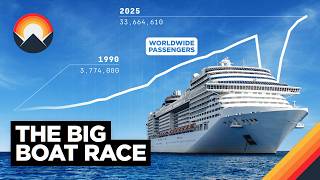
The bet paid off. 18 million global cruise passengers in 2009 grew to nearly 30 million by 2019. The fears that enormous ships would sink the industry proved unfounded. Instead, bigger ships broke the market into new tiers and brought in passengers who had never cruised before.
14:22
Royal Caribbean's itinerary map evolution from early 2000s variety to near-total Caribbean dominance by 2024
Watch at 14:22 →
Why Do Almost All Cruises Go to the Caribbean Now?
Look at Royal Caribbean's annual itineraries from the early 2000s and you'll see a wide spread — West Coast sailings, East Coast ports of departure, European routes, Canadian experiences, Alaska. Look at 2024 and it's overwhelmingly Caribbean, with ships departing from ports increasingly close to the islands themselves.
Part of this is practical. Alaska, Canada, and Europe are seasonal. The Caribbean runs year-round. And the mega-ships — like the Oasis class — are simply too large to clear certain infrastructure, like the Chesapeake Bay Bridge into Baltimore.
But a bigger driver is economics. Caribbean routing means dramatically shorter distances, which means dramatically lower fuel consumption. Fuel accounts for roughly 10 percent of total operating expenses at Royal Caribbean, nearly matching the cost of payroll. When crude oil more than doubled in price in 2008, the industry felt it viscerally. The short-term fix was to cut stops and slow ships. The long-term fix was to make the ship — not the destination — the point of the trip, and route that ship as efficiently as possible.
There's also a revenue angle. All three major cruise lines have developed their own private island resorts in the Caribbean. Rather than passengers spending money in local port communities, they're spending it within the cruise company's own extended ecosystem. It's fuel savings and increased revenue in one elegant move.
20:10
The Ritz Carlton Evrima — 298 guests, Mediterranean routes, and a service model built on hotel loyalty
Watch at 20:10 →
Is the Ritz Carlton Really Launching a Cruise Ship?
Yes — and it doesn't want you to call it that. The Ritz Carlton's first vessel, the Evrima, holds just 298 guests in an industry where 1,000 passengers qualifies as boutique. It books week-long itineraries across the Mediterranean in summer and the Caribbean in winter, and it was positioned explicitly to fill the ultra-luxury void between traditional cruising and private super yachts.
What makes the Ritz model compelling is that it doesn't require the company to reinvent itself. The same loyalty mechanics that define its hotels — staff trained to greet guests at 10 feet, make eye contact at 5, remember names, and spend up to $2,000 to resolve a guest issue without management approval — transfer directly onto the water. The dining experience was designed by the head chef at the Ritz Carlton Wolfsburg. The exposed wood grain and warm aesthetic make the ship look unmistakably like a Ritz property.
In the Evrima's first year of operation, half of all guests had never taken a cruise before. That's not a coincidence. The Ritz is pulling luxury travelers who wouldn't touch a traditional cruise into the water. Four Seasons and Orient Express are both set to launch their own vessels in 2026, with Aman following in 2027.
How Does Disney Cruise Line Actually Compete?
Disney doesn't compete on size or price — it competes on trust. The company began expanding its cruise presence in earnest in the early 2010s, but the key to understanding Disney Cruises is its corporate structure. It sits inside Disney Experiences, the same division that runs the theme parks. It isn't outsourced or siloed. It's informed by seven decades of operating parks and hotels.
The result is a cruise experience built on the same mechanics that make Disney parks work. Themed ship environments delight kids. Staff are trained to accommodate food allergies and replace a dropped ice cream cone without hesitation. Shows and entertainment work across generations. And Disney intersperses genuinely distinctive itineraries — often passing through its own Castaway Cay or Lookout Key private island destinations — within its Caribbean-heavy schedule.
Disney holds about 2.2 percent of the cruise market. It launched a new ship in 2025 and has two more due in 2026 and 2027, all from its flagship Wish class. It's not setting the pace in the industry — but in an industry growing this fast, keeping up is an achievement in itself.
What Does the Future of the Cruise Industry Look Like?
Fifty new ships are set to hit the water between 2026 and 2030. Some will carry 5,000 to 6,000 passengers. The race for bigger boats shows no signs of slowing.
But the industry's next evolution isn't just about scale — it's about extreme experiences. Cruise executives don't describe their competition as other cruise lines. They describe it as land-based travel. Luxury hotels are launching super yachts. Theme park companies are building floating versions of their parks. The competition for the vacation dollar is intensifying across every category.
What gives the cruise industry confidence is the same thing that got it through 2008 and through the pandemic: flexibility. A hotel can renovate. A cruise line can rebuild its ships from the ground up. A hotel is fixed to a location. A ship moves — away from high fuel costs, away from unstable destinations, toward whatever the market wants next.
The reputation problem — that cruises are for the newly wed and nearly dead, that they're boring or unsophisticated — hasn't fully disappeared. But it's fading. Shorter itineraries designed for PTO-constrained millennials are bringing in younger passengers. Private island resorts are replacing generic port stops. Luxury brands are reframing the entire category.
The industry that analysts wanted to short in 2008 is, by almost any measure, winning.