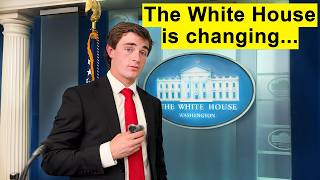
What is it like inside the White House in 2025? The short answer: chaotic, surprisingly open, and nothing like what you imagine from watching it on TV. In Trump's second term, the White House has cracked open its doors to independent creators and new media in a way that has never happened before. A YouTuber was recently granted access on two separate days — touring the Eisenhower Executive Office Building, walking the grounds, sitting inside a live Oval Office meeting between President Trump and El Salvador's President Nayib Bukele, and even managing to get a question answered directly by the president. Here is everything that happened.
 02:15
First look at the White House grounds and the Eisenhower Executive Office Building on day one of the visit
Watch at 02:15 →
02:15
First look at the White House grounds and the Eisenhower Executive Office Building on day one of the visit
Watch at 02:15 →
What Is It Really Like Inside the White House in 2025?
Getting into the White House is not as simple as showing up with a camera. Before setting foot on the grounds, every visitor must be vetted by the Secret Service in advance. From there, you pass through multiple layers of security checkpoints. Armed guards, badge checks, and strict rules about where cameras are allowed greet you at every turn.
The White House complex itself is divided into three main sections: the West Wing, where all major presidential business happens; the Residency, where the president and his family actually live; and the East Wing. All the windows throughout the building are bulletproof — and reportedly bomb-proof. In 2011, someone fired shots at the White House from a nearby street and Secret Service did not even realize the windows had been hit, that is how reinforced they are.
Outside, a 13-foot fence surrounds the perimeter. It is ram-proof and climb-proof, with poles driven deep into concrete so that no vehicle could break through. Infrared lasers scan the lawn around the clock, feeding data to Secret Service agents who monitor every inch of the grounds. Snipers are positioned on the roof. The Secret Service employs upwards of 8,000 agents total, and inside the White House, you cannot walk more than a few feet without encountering one.
The pace inside the building under Trump is best described by the deputy press secretary in one phrase: all gas and no breaks. The team spent four years preparing for this moment, and from day one of the second term, they have been moving fast.
08:40
The 13-foot ram-proof and climb-proof fence surrounding the White House perimeter
Watch at 08:40 →
What Happened at the Trump-Bukele Oval Office Meeting?
The second day of White House access came with full press credentials and a much bigger opportunity: being in the room for a live Oval Office meeting between President Donald Trump and Nayib Bukele, the president of El Salvador.
The reason for the meeting centered on immigration enforcement. With hundreds of thousands of migrants having entered the United States over the past several years — including documented gang members — the Trump administration struck a deal with El Salvador to house certain deported prisoners in CECOT, El Salvador's maximum-security mega-prison. The meeting was partly to discuss the logistics of that arrangement and to publicly thank Bukele for his cooperation.
Inside the Oval Office, the room held JD Vance, Marco Rubio, Bukele, and Trump. Within the first few minutes, Trump spoke bluntly about the Biden administration's border policies, calling it a sin what was allowed to happen. Bukele nodded along. Trump then pivoted to border crossing numbers — citing a 99.1% reduction — and immediately called out CNN, who had a reporter in the room, for not covering those figures.
15:22
President Trump and Nayib Bukele seated in the Oval Office with JD Vance and Marco Rubio present
Watch at 15:22 →
What happened next was unlike anything a scripted press conference would produce. Trump opened the floor to questions from anyone in the room. No hands raised. No assigned order. Whoever could speak the loudest got their question heard. It turned into a rolling back-and-forth, particularly between Trump and a CNN reporter seated nearby, over the case of a man the administration had deported to El Salvador who was reportedly a member of MS-13.
Attorney General Pam Bondi stepped in to clarify that two courts had ruled the man was an MS-13 member and that he had been in the country illegally. Marco Rubio added that the man is a citizen of El Salvador, and therefore questions about his custody legally belong to Bukele, not to Washington. Trump and the CNN reporter went back and forth several times, with Trump at one point saying directly: "That's why nobody watches you anymore. You have no credibility."
How Does Trump Handle Press Questions in the Oval Office?
If you have ever watched a White House press exchange on TV and wondered whether it is staged or scripted, the answer — at least in this setting — appears to be no. The Oval Office session during the Bukele visit had zero structure. There was no moderator, no pre-approved question list, and no handler telling reporters what they could or could not ask.
21:05
Trump clashes with CNN reporter over deportation case during the live Oval Office press session
Watch at 21:05 →
Our reporter on the ground managed to squeeze in a question asking whether Trump believed more world leaders should take a hard stance on crime. Trump answered directly, agreeing and pointing to Bukele as a model. The moment the question was out, Trump moved on and the room erupted again into competing voices.
Multiple reporters on the White House beat confirmed that this is simply how it works. Questions are never vetted in advance. Reporters are never told what to ask or what not to publish afterward. As one veteran White House correspondent put it: "As soon as she's up there talking, it's ready to go. Nothing gets cut. I've never seen anything get cut."
What Is the Eisenhower Building Like Inside?
Before getting into the West Wing, visitors are often taken through the Eisenhower Executive Office Building, which sits directly on the White House grounds. Built during the Eisenhower administration, this building houses staff for the president, vice president, and their supporting offices. Most documents and paperwork that eventually reach the Oval Office pass through here first.
Inside, the architecture is stunning and surprisingly ornate. Walls mix purple, gold, and turquoise with marble finishes. Ceilings are elaborately detailed. Massive spiral staircases wind through the interior. Notable rooms include the Indian Treaty Room, used for swearing-in ceremonies and press events, as well as exhibits featuring the first televised inaugural podium and the president's barber chair.
06:30
Inside the Eisenhower Building: the Indian Treaty Room and its ornate architecture
Watch at 06:30 →
One hidden gem: there is a bowling alley in the basement of the Eisenhower Building. It became so popular that a second bowling alley was eventually built inside the White House itself.
The building also now features the official 47th-term portraits of Trump and JD Vance prominently displayed near the entrance — serious, formal, and impossible to miss.
Is the Trump White House More Transparent Than Biden's?
According to the deputy press secretary, the answer is unequivocally yes — and the numbers back it up. The Biden administration revoked over 400 press credentials during its tenure, effectively cutting out hundreds of journalists from White House access. On day one of Trump's second term, all 400-plus press badges were reinstated.
The administration has also made a deliberate decision to include independent creators and new media alongside traditional outlets like Fox News and CNN. The stated reasoning is straightforward: more Americans are tuning out mainstream media and turning to independent voices for news. Ignoring that shift would mean losing a direct line to a huge portion of the public.
The deputy press secretary described the current approach as giving the American people unfettered access to the president. Press briefings happen daily. The president does interviews constantly. And as this visit demonstrated, even a solo YouTuber can end up standing in the Oval Office asking the president of the United States a live question.
Just How Secure Is the White House?
Beyond the fence, the infrared lasers, and the bulletproof windows already mentioned, the White House security apparatus runs deep. Secret Service agents are stationed everywhere — outside, inside, at every door. Snipers hold positions on the roof at all times. The entire 13-foot perimeter fence is engineered specifically to stop both climbers and vehicle ramming attacks.
One popular rumor that has circulated for years: the Oval Office contains a button originally intended for emergency nuclear communication. According to well-traveled White House lore, Trump had it repurposed to order Diet Coke on demand. Whether that is true or not is unconfirmed — but it has taken on a life of its own online.
How Is New Media Getting White House Access Now?
The shift in White House media policy is real and it is significant. Under press secretary Caroline Levitt, alongside communications leadership from Taylor Budowich and Steven Cheung, the White House has made a conscious effort to credential and welcome independent media figures who were historically shut out of these spaces.
The reasoning is not complicated. Trust in legacy media is at historic lows. Millions of Americans get their news from YouTube, podcasts, and social media rather than from network television or print outlets. The Trump administration has recognized this and is meeting those audiences where they already are.
For independent creators, the process still requires Secret Service vetting and credentialing — it is not a free-for-all. But once credentialed, the access is genuine. No pre-approved questions. No handlers. No editing. What you see is what is actually happening inside one of the most important buildings in the world.
Walking out of the White House after two days of access, the overwhelming takeaway is this: whatever your politics, the level of transparency being offered right now is historically unusual. The fights you see on TV between Trump and reporters are real and unscripted. The access being extended to new media is real. And the pace inside that building — all gas and no breaks — is very, very real.