


Red Bull's marketing strategy is deceptively simple: spend one full dollar of every $3 can on convincing you to buy the next one. But the way they spend that money is unlike anything else in the beverage world — or really any industry. Instead of running TV commercials with fictional narratives, Red Bull manufactures real-world moments of peak human performance and plasters their logo all over them. It's a strategy that transformed a reformulated Thai energy drink into the world's most dominant energy brand, and it all started with a $10,000 sponsorship deal at a Formula 1 race in 1985.
How Does Red Bull's Marketing Strategy Actually Work?
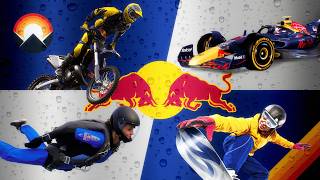
At its core, Red Bull's marketing strategy is built on a single powerful idea: associate the product with human performance at its absolute peak. Every time a high-performance athlete is photographed or filmed with a Red Bull logo nearby, the subconscious of everyone who sees that image begins to link Red Bull with excellence, adrenaline, and pushing limits.
 00:45
Red Bull's surprisingly small headquarters in the Austrian mountain town of Fuschl am See
Watch at 00:45 →
00:45
Red Bull's surprisingly small headquarters in the Austrian mountain town of Fuschl am See
Watch at 00:45 →
When those people need to perform — whether it's pulling an all-nighter, hitting the gym, or just surviving a long drive — they remember that Red Bull is what the professionals use. Then they buy a can. Red Bull earns $3. And one dollar of that goes right back into repeating the cycle.
What makes this strategy so effective is that Red Bull didn't just sponsor sports — they built entire sports ecosystems around their brand. In disciplines that lacked official governing bodies or world championships, Red Bull stepped in, funded the best events, offered the biggest prize money, and essentially became the institution that defined the sport. Cliff diving has the Red Bull Cliff Diving World Series. Freeride mountain biking has Red Bull Rampage. Big air kiteboarding has Red Bull King of the Air. In each case, the most talented athletes in the world are taking their biggest risks and producing their most spectacular moments directly in front of a Red Bull logo.
This is the genius of the approach: Red Bull didn't just buy advertising space. They manufactured the content that the world wanted to watch — and then owned the backdrop.
Why Is Red Bull So Much More Successful Than Competitors?
Compare Red Bull to its closest competitor, Monster Energy. Monster sells roughly 150 different product variants at any given time — seasonal flavors, co-branded editions, regional specials. Red Bull sells 17. That simplicity is intentional, and it extends across every part of the business.
04:10
Dietrich Mateschitz's original $10,000 sponsorship deal with Formula 1 driver Gerhard Berger in 1985
Watch at 04:10 →
Because Red Bull doesn't manufacture its own product, doesn't run a sprawling corporate headquarters, and keeps its product line ruthlessly lean, it can redirect an extraordinary share of its revenue toward the one thing that actually drives growth: marketing. The result is a brand so deeply embedded in the culture of performance and extreme sports that many people — athletes and fans alike — don't think of Red Bull as an energy drink company at all. They think of it as an institution.
That institutionality is extraordinarily hard to compete with. Monster can copy the product. It cannot copy decades of cultural legitimacy built through thousands of genuine athlete relationships and hundreds of world-class sporting events.
How Did Red Bull Get Started? The Origin Story
The story of Red Bull begins with a bored marketing manager and a Newsweek article. Dietrich Mateschitz was working at consumer goods company Blendax in the 1980s, managing a toothpaste line, when frequent business trips to Asia introduced him to a world where energy drinks were already everywhere.
According to the well-worn fable, Mateschitz was sitting at the bar of the Mandarin Oriental in Hong Kong when he flipped to an article revealing that Japan's single largest taxpayer was an energy drink manufacturer called Lipovitan. Something clicked. He tracked down TC Pharmaceutical Industries in Thailand, the makers of a drink called Krating Daeng — or in English, Red Bull.
08:55
Red Bull Rampage, one of the company's owned events that defines the sport of freeride mountain biking
Watch at 08:55 →
Mateschitz struck a deal: he and the Thai manufacturer would each invest $500,000 into a new company, Red Bull GmbH, and reformulate the product for Western consumers. The original Krating Daeng was a small glass bottle consumed more like a medicinal shot. Mateschitz spent years transforming it into something people would actually want to sip — adding carbonation, reducing sweetness, introducing acidity, and expanding it into the now-iconic 250ml can.
On April 1st, 1987, Red Bull hit Austrian store shelves. In its first full year, it sold 1.2 million cans. Expansion into the rest of Europe accelerated dramatically after January 1993, when the EU's single market meant that a product approved in one member country was generally approved across all of them.
How Does Red Bull Choose and Support Its Athletes?
From the very beginning, Red Bull focused on sponsoring individual athletes rather than teams, leagues, or events. The logic is straightforward: individual athletes are walking, talking billboards. A team sponsorship dilutes the message across a roster; an individual sponsorship concentrates it.
11:30
Red Bull's manufacturing setup in Ludweis, Austria, co-located with the Ball Corporation can factory
Watch at 11:30 →
But Red Bull doesn't just sign any athlete. They look for a specific profile: the absolute best in whatever they do, particularly in visually spectacular, adrenaline-driven disciplines. Jessica Fox, the world's preeminent canoe slalomist with three Olympic gold medals. Robbie Madison, the freestyle motocross rider who broke the motorcycle jump world record in 2007 with a 322-foot landing. Tom Pidcock, the cyclist who is elite in both road racing and mountain biking — an almost unheard-of combination that earns him outsized attention relative to his individual rankings in either discipline.
Crucially, Red Bull backs its athletes with genuine resources. Signing with Red Bull doesn't just mean a logo on your helmet. It means access to a network of elite coaches, sports scientists, nutritionists, and rehabilitation specialists housed in world-class training centers in Austria and Los Angeles. In many niche sports, the level of support Red Bull provides is dramatically above what athletes could access anywhere else. That's why the brand earns genuine loyalty, not just contractual compliance.
How Does Red Bull Make Money on a $3 Can?
The economics of a single can of Red Bull are a masterclass in brand-driven margin. Of the roughly $3 you pay at a convenience store, approximately 9 cents covers the actual cost of producing the liquid inside. The rest covers everything else — distribution, retail margins, corporate overhead, and most significantly, marketing.
That marketing dollar is the engine of the entire machine. It funds athlete contracts, event production, the Formula 1 team, training centers, and the content operation that generates billions of views. Every dollar spent on a cliff diving world series or an F1 championship run comes back multiplied through brand awareness and the premium pricing power that awareness creates.
Red Bull also benefits from a remarkably focused product line. With only 17 SKUs compared to Monster's estimated 150, Red Bull's supply chain, retail negotiations, and production planning are far simpler, freeing up resources and management attention for what actually drives the business.
Where Is Red Bull's Headquarters and Why Is It So Small?
For one of the world's most recognizable brands, Red Bull's global headquarters is startlingly modest. It's located not in Vienna, not in a major European financial hub, but in Fuschl am See — a small Austrian mountain town with one supermarket, two coffee shops, and one bank.
The property itself takes about three minutes to walk across. It's bordered by an insurance broker, residential homes, and a small hotel. There are no walls, no fences, no gatehouses. The public can stroll through the gardens. The reason is simple and entirely personal: co-founder Dietrich Mateschitz liked Fuschl. He valued the privacy, the access to the outdoors, and he wanted to live there. So that's where the company lives, too.
How Does Red Bull Actually Manufacture Its Drinks?
Red Bull doesn't make Red Bull. The company has never owned its own production facilities. Instead, it contracts Austrian fruit juice company Rauch to manufacture the product on its behalf — a relationship that traces back to Mateschitz's personal connections within Austria's small business community in the company's early days.
Today, most of the world's Red Bull is still made in the shadow of the Alps. The largest production site is in Ludweis, Austria, co-located with a Ball Corporation factory that makes Red Bull's bespoke cans — cans not used for any other beverage. A nearly identical setup exists just across the border in Switzerland. Both sites benefit from direct rail and highway access for distribution logistics.
Until 2021, every single can of Red Bull sold anywhere in the world came from one of those two sites. Then, to better serve its largest market, the company replicated the model a third time on the outskirts of Phoenix, Arizona: a Rauch factory, a Ball Corporation plant, rail access, highway access. The same formula, a continent away.
It's a reminder that underneath the extreme sports empire and the Formula 1 glory, Red Bull is — at its operational core — a remarkably simple business. Seventeen products. Two manufacturing partners. One very expensive, very effective marketing machine.


