
So many Americans are moving to Mexico City right now that locals have taken to the streets in protest. The answer to why so many Americans are moving to Mexico City comes down to one simple equation: earn US dollars, spend Mexican pesos. Remote workers and digital nomads have discovered they can enjoy a world-class city — incredible food, vibrant culture, perfect weather — at a fraction of what they'd pay back home. But that flood of American cash is reshaping neighborhoods, doubling rents, and pushing working-class Mexicans out of the areas they've called home for generations. Here's the full picture, from both sides of the debate.
Why Are So Many Americans Moving to Mexico City?
Ask an American in Mexico City why they moved there, and you'll hear the same themes over and over: the culture, the people, the food, the energy, and yes — the price tag. One Chicago resident who had been living in Mexico City for 16 years put it plainly: "The energy of the Mexican people is very loving, giving, open. It's a beautiful country."
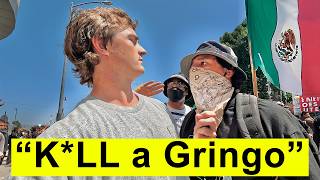 00:45
Protesters in Mexico City smashing windows at American-owned businesses during anti-gentrification demonstrations
Watch at 00:45 →
00:45
Protesters in Mexico City smashing windows at American-owned businesses during anti-gentrification demonstrations
Watch at 00:45 →
But beyond the romance, there's hard economics at work. The rise of remote work has untethered a generation of professionals from their zip codes. If you're pulling a US salary or running an online business, Mexico City offers an extraordinary quality of life for a dramatically lower cost. Suddenly, the so-called American Dream — work hard, own a home, live comfortably — is more achievable south of the border than it is in Chicago, New York, or Los Angeles.
One expat summed it up perfectly: "Here you can dream and do it. In the US, starting your own business is quite difficult with all the laws, rules, and licenses. It's an easier concept to perform here in Mexico." That sentiment is driving a massive wave of relocation, particularly into trendy neighborhoods like La Condesa and Roma.
What Is a Digital Nomad and Why Is Mexico City a Hot Spot?
A digital nomad is someone who works entirely online — freelancers, remote employees, entrepreneurs — and chooses to live wherever their money stretches furthest. Mexico City has become one of the top digital nomad destinations in the world for several key reasons:
03:20
American expat living in Mexico City for 16 years explains why US citizens are drawn to the culture and lifestyle
Watch at 03:20 →
- Proximity to the US: Same or similar time zones make it easy to work with American clients and employers.
- Fast internet and co-working spaces: Mexico City has a thriving tech infrastructure that supports remote work.
- World-class lifestyle: Fine dining, art, nightlife, parks, and culture rival any major global city.
- Low cost of living: A comfortable apartment in a desirable neighborhood can cost a fraction of a comparable US city.
The neighborhoods of Roma and Condesa in particular have transformed into expat hubs, lined with coffee shops full of laptops and English conversations — a reality that has not gone unnoticed by long-time residents.
How Much Does It Cost to Live in Mexico City as an American?
This is where things get complicated. When we hit the streets of La Condesa and Roma, locals told us that a nice apartment in those neighborhoods now runs anywhere from $1,000 to $1,500 USD per month. For an American earning a US salary, that's a bargain. For a Mexican worker earning the country's minimum wage — which sits at roughly $350 USD per month — that's completely out of reach.
Think about that for a second. The rent for a mid-range apartment in these neighborhoods is nearly three to four times the monthly minimum wage in Mexico. Locals who have lived in these areas their entire lives are being priced out, forced to move to less desirable parts of the city or further into the outskirts.
05:10
Local Mexican resident explains how rent has doubled in La Condesa and Roma since Americans started moving in
Watch at 05:10 →
And it's not just rent. Restaurants, cafes, grocery stores, and everyday goods in these neighborhoods have all crept upward in price as businesses cater to the spending power of their new foreign clientele. One local resident told us bluntly: "It cost double now. With all the Americans that came in, has it made our salaries go up? No."
What Is Gentrification Doing to Mexico City Neighborhoods?
Gentrification is the process by which wealthier newcomers move into a neighborhood, raise property values and rents, and gradually displace the lower-income residents who originally made that neighborhood what it is. And it is happening in real time across La Condesa and Roma.
These were already upscale, desirable areas — but the mass arrival of American expats and digital nomads has accelerated the transformation dramatically. Local businesses that served the community for decades are being replaced by trendy coffee shops, boutique gyms, and international restaurants priced for foreign budgets.
01:30
Anti-American protest sign reading 'Pay taxes, learn Spanish, respect my culture' outside a targeted business
Watch at 01:30 →
One local resident acknowledged it clearly: "All of this area is being gentrified. People from the United States and Europe come to live here, it's raising rents and things like that." Even those who aren't angry about it recognize the scale of the change. The character of these neighborhoods is shifting — and not everyone who built that character gets to stay and enjoy what it's becoming.
Why Did Anti-American Protests Erupt in Mexico City?
The tension finally boiled over when anti-American protesters took to the streets of Mexico City, specifically targeting American-owned businesses. Stores like Rip and Dip were vandalized, restaurant windows were smashed, and videos emerged of protesters — some armed with knives — trying to break into buildings while Americans and locals cowered inside.
The protesters weren't shy about their message. One demonstrator stated: "Gentrification is just one more step towards colonization, dispossession, and the exploitation of our resources." Signs read "Pay taxes, learn Spanish, respect my culture" — a pointed message aimed at expats who have moved in without integrating.
Another protester voiced a broader, more existential fear: "Right now it's about the people, but it won't be long before they run out of oil, water, or lithium in other countries and come and take them from us." For many Mexicans, the American migration into their city isn't just an economic inconvenience — it feels like a preview of something larger and more threatening.
What Do Mexicans Actually Think About Americans Moving In?
The response from Mexican locals is far from uniform. When we talked to people on the streets of La Condesa, we got a wide range of opinions:
- Some locals were genuinely unbothered: "I don't have any problem about this."
- Others were frustrated specifically about economic impact: "The problem is everything is more expensive. Apartments, flats — owners want to earn more money, but they are affecting Mexican people."
- Some were curious more than angry, simply asking: "Why are they here? They like it? It's cheaper?"
- One resident pointed out that the neighborhood is already upper-middle class, and the Mexicans who migrate to the US are doing so "in search of jobs and better opportunities they don't have here."
It's a nuanced picture. Many Mexicans understand the economic logic that brings Americans to their city — it's the same logic that sends Mexicans north to the United States. But understanding the logic doesn't make the consequences any easier to live with.
Is the Mexican Dream the New American Dream?
There's a growing conversation about whether the Mexican Dream has replaced the American Dream for a new generation of US expats. The idea is simple: the things Americans used to chase in the US — homeownership, business ownership, a comfortable lifestyle, community, culture — are now more accessible in cities like Mexico City than they are in most American metros.
As one long-time American expat living in Mexico City told us: "The cost of living is less than the US. You can do anything here. There's openness for everything. In the US, starting your own business tends to be quite difficult with all the laws and rules. Here it's an easier concept."
But that same expat had an important message for anyone thinking of making the move: "If you are going to move here, please make an attempt to embrace the culture, speak the language. Don't come down here and assume everyone speaks English."
That may be the crux of the whole debate. Americans moving to Mexico City isn't inherently the problem. The problem is moving in without respect — driving up prices, refusing to integrate, and treating a living, breathing community as a lifestyle backdrop. The protests aren't just about rent. They're about dignity. And that's a lesson worth taking seriously, no matter which side of the border you're on.