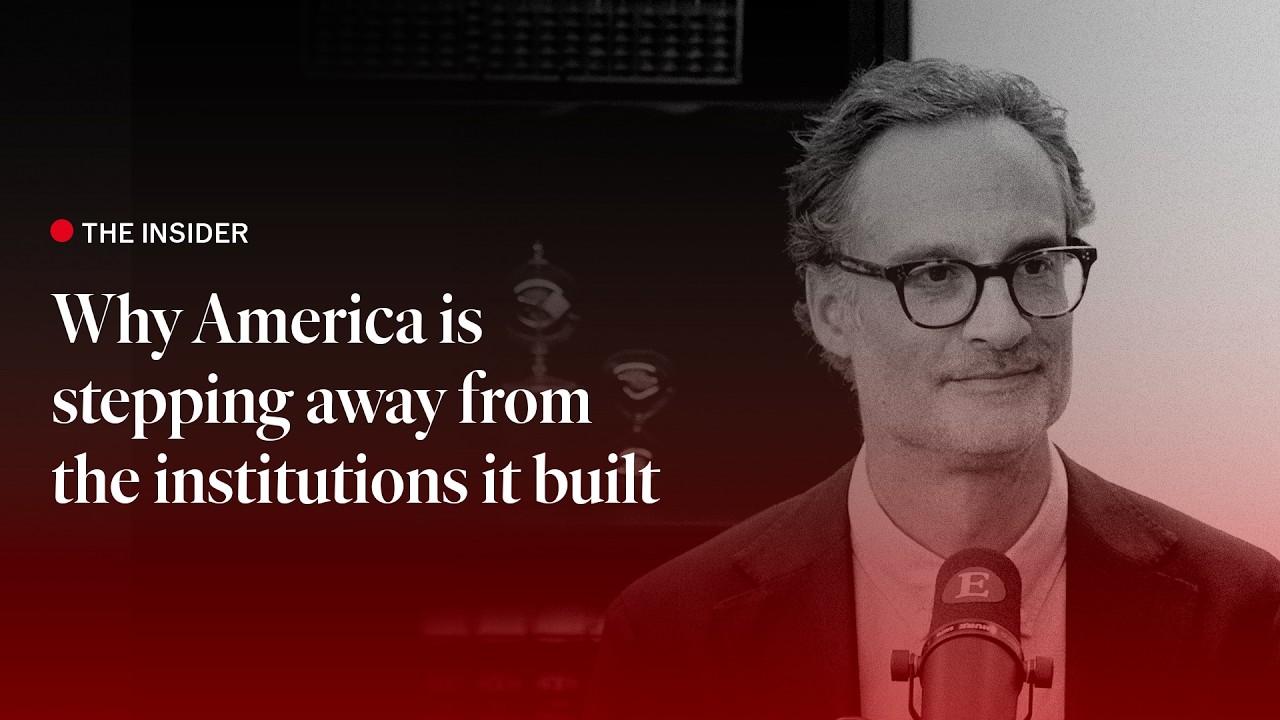

Is America abandoning the post-war world order it spent decades building? According to a growing number of foreign policy analysts, the answer is yes — and the twist is that it's not happening by accident. The United States, the very architect of the UN system, open trade, and transatlantic alliances, is now actively walking away from those structures. What's replacing them is something far more transactional, muscular, and unpredictable. This isn't just a change in tone. Experts are calling it a revolution in American foreign policy.
Is America Abandoning the Post-War World Order?
The post-war world order — built on international institutions, open trade, multilateral alliances, and the spread of democratic values — was largely an American invention. After World War II, the US designed and funded the United Nations, the global trading system, and a web of alliances like NATO to create a world that was safe from communism and fascism, and broadly favorable to American interests and values.
 00:45
Analyst explains why abandoning post-war institutions counts as a revolution, not just a policy shift
Watch at 00:45 →
00:45
Analyst explains why abandoning post-war institutions counts as a revolution, not just a policy shift
Watch at 00:45 →
Now, analysts argue, America is seceding from that very system. The US has withdrawn from dozens of international organizations and UN bodies. It has weaponized trade rather than used it to knit nations together. It has treated long-standing alliances as leverage for short-term gains rather than as pillars of collective security. The shift isn't just structural — it's philosophical. Where the old order was values-based, the new approach is explicitly transactional.
As one analyst put it, recent US interventions like the approach toward Venezuela were not about spreading democracy or liberation — those goals have slipped down the agenda. They were about power and influence. That's a profound departure from the idealism that animated American foreign policy for most of the 20th century.
What Is Trump's Foreign Policy Revolution?
Trump's core argument, going back to 2015, has been simple and powerful: America has been taken for a ride. The people running US foreign policy, he claimed, were altruistic to the point of giving things away for free, being exploited by allies who free-rode on American security guarantees, and pursuing abstract values that ordinary Americans didn't share or benefit from.
03:10
Panel debates whether the cost-benefit calculation of the post-war order actually failed America
Watch at 03:10 →
That pitch resonated. And the policy that followed has been consistent with that worldview. Trade is no longer a tool for building interdependence — it's a weapon. Alliances are not sacred commitments — they're bargaining chips. Military force, when used, is not deployed to spread democracy — it's used to reshape power dynamics in America's favor.
This is why some analysts are calling it a revolution rather than just a shift in emphasis. The United States isn't just adjusting its foreign policy — it's replacing the values that underpinned that policy with an entirely different set of priorities. And crucially, it's doing so while dismantling the very institutions it created to project those old values.
How Has US Foreign Policy Fundamentally Changed?
The changes are sweeping and span multiple domains:
06:22
Discussion of bipartisan American public opinion data on trade and international institutions
Watch at 06:22 →
- International institutions: The US has exited or defunded a large number of UN agencies and multilateral organizations. While some analysts argue the practical impact of leaving certain committees is limited, the symbolic break is enormous.
- Trade: Open trade — once a cornerstone of American global strategy — has been replaced by tariffs and economic nationalism. Trade is now a lever of pressure, not a bridge of cooperation.
- Alliances: NATO and other alliances are increasingly treated as transactional arrangements. Allies are expected to pay more, and American commitment is no longer unconditional.
- Military power: The willingness to use force without seeking UN support or broad international legitimacy marks a sharp departure. But recent events, including the limits exposed in engagements like Iran, suggest that raw force has real constraints.
These changes, taken together, represent what analysts describe as a wrecking ball approach to the architecture America spent 80 years constructing.
Why Did America Turn Against Its Own Institutions?
The critique isn't entirely unfounded. Analysts who are deeply alarmed by the current direction still acknowledge that the post-war order showed signs of strain long before Trump arrived. The key turning point, many argue, was the post-Cold War era.
During the Cold War, the cost-benefit calculation for America was clear: bear the costs of global leadership in exchange for containing Soviet power and keeping the world safe for liberal democracy and capitalism. America won that bet decisively.
But after the Soviet collapse, the ambition of American foreign policy expanded without a commensurate increase in returns. The invasions of Afghanistan and Iraq — products of what one analyst called a hubristic approach — were enormously costly and produced ambiguous results at best. Meanwhile, China thrived under the very trading system America built, growing into a peer competitor while the US bore the lion's share of the costs of maintaining global order. Allies, many Americans felt, were free-riding on American security guarantees without pulling their weight.
The result was a cost-benefit calculation that no longer added up for large swaths of the American public — and that frustration created the political opening that Trump walked through.
Do Americans Actually Support This New Approach?
Strikingly, the shift in American public opinion runs deeper than any single administration. Polls show that approximately six in ten Americans believe the global trading system has not delivered adequate returns for the United States. Support for large-scale foreign military entanglements has collapsed across party lines, a direct legacy of the Iraq and Afghanistan wars.
Perhaps most surprisingly, support for international institutions has actually been rising among Democrats and falling among Republicans — a complete reversal of historical patterns. While Democrats are now more likely to support a strong NATO role, both parties share a growing skepticism about new trade deals, foreign entanglements, and a foreign policy built around altruistic values rather than concrete national interest.
The consensus emerging across the political spectrum is not isolationism exactly — it's a desire to play a different role on the global stage. More muscular, more transactional, less idealistic. That suggests the underlying shift will outlast any single presidency.
Will the Post-War Order Survive the Trump Era?
This is the central question, and the honest answer is: no one knows. But analysts have sketched out what the possible futures look like, and none of them involve a clean return to the pre-Trump status quo.
Even if a future administration wanted to restore the old order, the world has changed. Allies have been rattled and are hedging. China has grown stronger. The credibility of American commitments has been questioned. As one historian noted of the failed European revolutions of 1848 — even when kings came back, the world had shifted in ways that made governing much harder.
What Are the Three Scenarios for America's Future?
Analysts have outlined three possible trajectories, each mapped to a historical revolution:
Scenario 1: The 1776 Revolution Succeeds
America successfully renegotiates the terms of global engagement entirely on its own terms. It achieves a new kind of primacy — more transactional, more dominant, with allies reduced to something closer to vassals. The US gets what it wants without the old obligations. This is the best-case scenario for the MAGA worldview.
Scenario 2: The 1848 Revolutions Fizzle
The revolutionary energy dissipates. American values reassert themselves. A new, adjusted settlement emerges — more transactional than before, but still recognizably connected to the old order. This is the hope of many foreign policy scholars: not a total wrecking of the system, but a renegotiation that preserves its core.
Scenario 3: The French Revolution's Descent
The most alarming scenario. Revolutions, once unleashed, can develop a life of their own. If ambitious leaders around the world observe that borders can be redrawn and nations coerced without serious consequences, the incentives for aggression multiply. Arms races — potentially nuclear ones — could follow. The global system doesn't just change; it starts to unravel in ways that no single leader can control.
That last scenario is not the central prediction of most analysts. But it is, as one put it, the one that has to be borne in mind. The stakes of getting this moment wrong are not abstract. They are, historically speaking, as high as they get.
The post-war world order was an extraordinary achievement — imperfect, costly, sometimes hypocritical, but broadly stabilizing. Whether America is simply renegotiating its role within that order, or genuinely dismantling it, may be the defining geopolitical question of this decade.