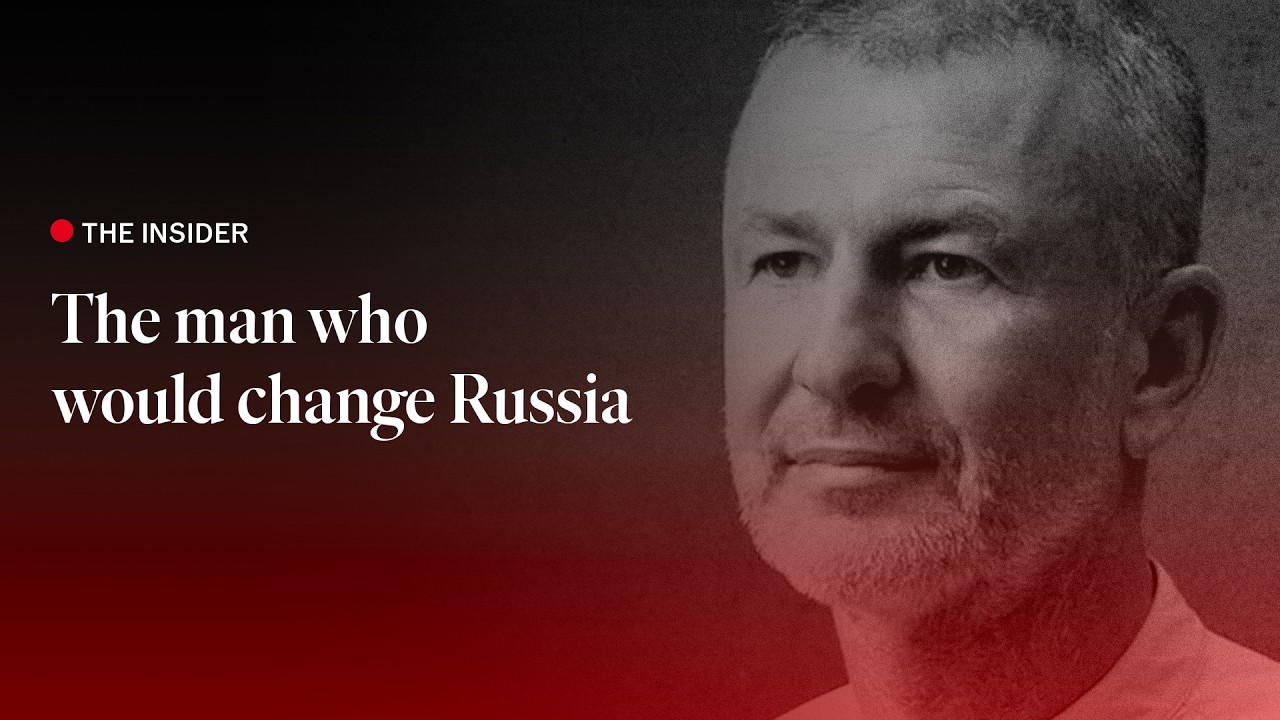

Andrei Melnichenko is one of Russia's wealthiest and most powerful businessmen — and until recently, one of its most silent. A quantum physicist by training and a billionaire by practice, Melnichenko built his fortune through massive investments in Russian industry, making him arguably the single largest private investor in the country. But who is Andrei Melnichenko, really, and why is the world suddenly paying attention to what he has to say? The short answer: because he just broke a two-decade silence to say something no oligarch has dared say out loud — that Russia has a serious problem, and the war in Ukraine is not going the way anyone in the Kremlin wants to admit.
Who Is Andrei Melnichenko, Russia's Richest Oligarch?
Melnichenko belongs to a different generation than the oligarchs most Westerners are familiar with — figures like Boris Berezovsky who became notorious for their entanglement with Kremlin politics in the 1990s. Melnichenko's defining characteristic, by contrast, has been deliberate distance from power. He has lived outside Russia since 2004, treating the country almost as a foreign investor would — flying in occasionally, floating past on his superyacht, then departing again. Observers who have met him describe him as unusually understated for a man of his wealth: tall, slightly awkward in his physicality, but with a mind that is razor-sharp and methodically structured — exactly what you'd expect from someone trained in quantum physics.
His business empire is centered on fertilizers, coal, and chemicals — the unglamorous but strategically vital arteries of the Russian economy. He is not a media oligarch, not a political showman. He is, in the truest sense, an industrialist. And for twenty years, that industrialist chose to stay out of Russian politics entirely.
Why Is Melnichenko Under Western Sanctions?
When Russia launched its full-scale invasion of Ukraine in February 2022, Western governments moved quickly to sanction a broad list of Russian billionaires deemed connected to the Putin regime. Melnichenko was caught in that sweep. His assets in Europe were frozen, his superyacht was seized, and his ability to operate in Western financial markets was severely curtailed. The irony, as observers note, is that Melnichenko had spent decades specifically avoiding the kind of political entanglement that might invite such scrutiny. He wasn't a Kremlin insider. He was, by design, an arms-length investor.
But the sanctions didn't distinguish between political cronies and industrial figures. The result was decisive: cut off from the West, Melnichenko returned to Russia in 2023. A man who had spent nearly two decades treating Russia like a foreign country suddenly found himself living there permanently. And that change of circumstance, it seems, changed his perspective profoundly.
What Did Melnichenko Actually Say About the War?
In what is being described as an extraordinary 60-hour series of conversations — the longest and most candid any Russian oligarch has given since the war began — Melnichenko laid out a striking diagnosis of Russia's situation. His core message can be distilled into three points.
- The business class is back, and the state needs them. Melnichenko is signaling that Russia's oligarchs and industrialists — the people who actually run the productive economy — are no longer willing to be passive spectators. Whatever the state thought it was doing economically is not working, and the people who know how to run factories and industries need to be brought back into a meaningful role.
- The war is creating problems that cannot be ignored. He stops short of calling the war a disaster outright, but the subtext is clear. Ukraine's deep strikes into Russian territory are bringing the conflict home in a way that ordinary Russians can no longer tune out. The psychological distance that allowed people to get on with their lives is collapsing.
- Russia needs a vision of the future. Perhaps most significantly, Melnichenko is arguing that what Russia lacks right now is any coherent picture of where it is going. He envisions a Russia that is more representative, where citizens and businesses have genuine agency. That is a remarkable thing for anyone connected to the Russian establishment to say publicly.
Crucially, analysts are clear that this is not an opposition statement. Melnichenko is not anti-Putin, and he is not anti-war in any ideological sense. His factories have, by some accounts, supported the war economy. What makes his intervention notable is precisely that it comes from a pragmatist, not an idealist. He is not saying the war is morally wrong. He is saying it is practically unsustainable — and that framing may be far more dangerous to the Kremlin than any moral critique.
Are Russian Oligarchs Finally Turning Against Putin?
This is the question that everyone watching Russian politics is asking right now, and the honest answer is: not exactly — but something is shifting. Melnichenko's comments are being read in the context of what analysts describe as multiple "trial balloons" currently floating inside Russia. These are carefully calibrated signals — from various elite figures — testing how different ideas land with the public and with the political class. Some of these balloons are reportedly probing ideas about future leadership scenarios.
Whether Putin himself is aware of or even orchestrating some of these signals is unknown. Russian elite politics has always operated through layers of indirection and ambiguity. What is clear is that the conversation is happening. Figures who spent years in comfortable silence are beginning to speak.
What Do Russian Oligarchs Really Think About the War?
Ukrainian intelligence sources, speaking to journalists just days before Melnichenko's interview became public, described detecting what younger analysts might call a "vibe shift" within Russia's elite. There is a growing sense among the business class that the war's trajectory is unsustainable — that the economic costs, the international isolation, and now the physical reality of Ukrainian strikes on Russian soil are compounding in ways that threaten their interests directly.
But — and this is the critical caveat — Ukrainian intelligence also stresses that no fundamental shift in the power structure has occurred. Putin remains in charge. The power vertical is intact. Whatever conversations are happening at the elite level have not yet translated into any visible change in political control. The dances happening around the edges of Russian power are exactly that: dances.
What Are the 'Trial Balloons' Floating Inside Russia Right Now?
The concept of a trial balloon in authoritarian politics refers to a deliberately leaked idea or public statement designed to test public and elite reaction before any real policy move is made. Russia has a long historical tradition of this kind of signaling, particularly in moments of military stress. Analysts point to the Crimean War, the revolutionary moments of 1905 and 1917, as periods when elite figures began speaking out — not out of moral courage, but because wars going badly created space for previously unspeakable ideas.
Melnichenko's intervention fits this pattern. He is not leading a revolution. He is not organizing opposition. He is floating an idea: that the current course is untenable, that the business class needs to be part of the solution, and that Russia needs a new vision. Whether that balloon rises or gets shot down will tell observers a great deal about where Russian elite sentiment is heading.
Could Russia's Business Elite Push for Peace?
From a Ukrainian perspective, Melnichenko's intervention is viewed with understandable suspicion. Ukraine has enormous stakes in what happens inside Russia's elite, and senior intelligence figures are watching the oligarchic class carefully for any signs of meaningful pressure toward a settlement. But suspicion and interest are not mutually exclusive. Even Ukrainian analysts acknowledge that the statement — coming from someone of Melnichenko's stature — is significant simply because it openly frames the war as unwinnable.
The path from elite frustration to actual political change in Russia is long, winding, and historically treacherous. Russia's business class has shown repeatedly that it will absorb enormous losses before risking confrontation with the state. But history has also shown that when enough powerful voices begin saying the same uncomfortable thing — even quietly, even indirectly — the ground beneath authoritarian systems can shift faster than anyone expects.
Andrei Melnichenko may not be the man who changes Russia. But he may be one of the first to say, clearly and on record, that Russia needs to change. In the context of the current war, that alone makes him worth listening to.