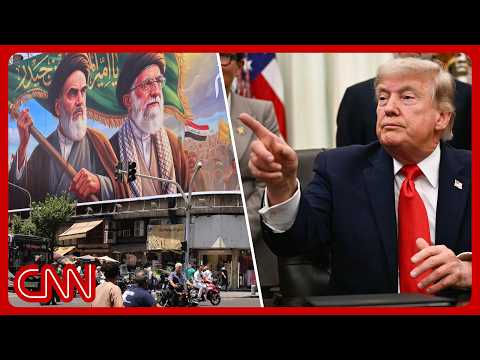
The United States bombed Iran's nuclear sites — three of them — and the question on everyone's lips is the same: why did the US bomb Iran's nuclear sites, and was it even necessary? The strikes, carried out using heavy bunker-buster munitions, targeted Iran's key uranium enrichment facilities. The stated reason was to prevent Iran from reaching weapons-grade nuclear capability. But on the streets of Seattle, not everyone is buying that explanation. Nick Shirley went inside a protest of 100 to 300 demonstrators to get raw, unfiltered reactions from the people who showed up to make their voices heard.
What he found was a crowd that was angry, divided, passionate — and in some cases, willing to say things that would make headlines on their own. Here's a full breakdown of what went down and what it means.
Why Did the US Bomb Iran's Nuclear Sites?
According to protesters and commentators on the ground, the official justification was Iran's rapid uranium enrichment progress. Iran had reportedly reached approximately 60% uranium enrichment — dangerously close to the 90% threshold needed for weapons-grade material. Officials argued that once Iran crossed that line, it could place nuclear warheads on missiles within weeks or months.
The US used bunker-buster bombs specifically because Israel lacked the firepower to destroy the deeply buried facilities on its own. In that sense, the United States acted as the muscle behind an Israeli strategic objective — a point that infuriated many protesters.
One protester put it bluntly: "The state of Iran has not initiated any act of aggression against the United States of America. This is completely unprovoked. It is an act of imperialism."
Others on the ground argued that the strikes had less to do with nuclear safety and more to do with forcing regime change in Tehran — that the nuclear facilities were a pretext, not the real reason.
What Do Americans Really Think About the Iran Strikes?
The protest in Seattle's downtown square drew a cross-section of Americans — from longtime political organizers to people who just happened to be walking by and decided to join. The reactions Nick captured ranged from fiery condemnation to more nuanced criticism of how Trump handled the situation.
- Outright opposition: Several protesters said the US should have done absolutely nothing. "We don't need to be over there. We need to worry about what's going on over here," one woman said.
- Process criticism: Others weren't necessarily against all action but were furious that Trump acted unilaterally without consulting Congress. "Unilaterally, he made a decision that wasn't his to make," one protester said.
- Diplomatic alternative: A number of people believed diplomacy was still on the table. One man insisted Iran was actively negotiating and that Trump "implemented it improperly" — suggesting the groundwork was actually laid by the Biden administration.
- Fringe views: At the more extreme end, one individual said they no longer believed America deserves to exist, and that they would consider moving to China. Another called Trump "an American Hitler."
The signs at the protest reflected the same mix: "No US-Israel War on Iran," "We Won't Let You Drag Us Into Global War," and calls for an arms embargo against Israel.
Should the US Have Stayed Out of the Israel-Iran Conflict?
This was the most hotly debated question on the ground. The core argument from protesters was simple: Iran had not attacked the United States directly, so the US had no business launching military strikes. Several people pointed out that Israel struck Iran first — making the entire chain of events an Israeli-initiated conflict that the US was dragged into.
"We attacked Iran first. Israel attacked Iran first. We shouldn't have messed with it," one protester said.
The counterargument — raised by Nick during interviews — was that Iran was weeks away from nuclear capability, and once that threshold was crossed, the entire geopolitical balance in the Middle East would shift permanently. If Iran were allowed to develop a nuclear weapon, every calculation about regional security changes.
The protesters largely dismissed that concern. "It wasn't coming for us," one woman said when asked if a nuclear-armed Iran would have concerned her. That response drew a sharp follow-up — if Iran had eventually sold or transferred nuclear materials, the risk wouldn't be limited to the Middle East — but many at the protest were unconvinced that US intervention was the answer.
How Close Was Iran to Actually Building a Nuclear Weapon?
This is where the facts get genuinely alarming, regardless of your political position. Iran had reportedly reached 60% uranium enrichment at the time of the strikes. Weapons-grade uranium requires 90% enrichment. Experts have warned that the gap between 60% and 90% is significantly shorter — in time and technical difficulty — than the gap between lower enrichment levels and 60%.
In practical terms, Iran could have crossed the nuclear threshold within a few weeks to a few months had the facilities remained operational. That is not a talking point — it is the technical reality of uranium enrichment timelines.
When Nick raised this with protesters, most acknowledged the numbers but questioned whether it was the US's role to act. "Why are we the ones that have to go in and stop this?" was the recurring refrain.
Did Trump Act Unconstitutionally by Bombing Iran?
Multiple protesters raised serious constitutional concerns about how the strikes were authorized. Under the US War Powers Resolution, the president must notify Congress within 48 hours of committing armed forces to military action, and cannot sustain that action beyond 60 days without congressional approval.
What made Trump's move particularly controversial was his apparent public warning to Iran — saying he would act within two weeks — and then launching strikes just two days later. Critics argued this telegraphed the attack just enough to seem transparent while bypassing any meaningful congressional oversight.
"He told them, 'I'm going to do this in the next two weeks.' And then he did it two days later. Unilaterally," one protester said. "He's a loose cannon."
Others defended the element of surprise as a tactical necessity, arguing that revealing a full timeline would have given Iran the upper hand in preparing defenses or dispersing nuclear materials. The constitutional debate, however, remains unresolved — and it's one that Congress is likely to revisit.
Are There Iranian Sleeper Cells Inside the United States?
Nick asked this question to several protesters, and it sparked some of the most interesting responses of the day. One woman admitted she had been worried about it for a long time but said it wouldn't stop her from being in public. Another protester — a more politically organized activist — dismissed the concern entirely, calling it media fearmongering designed to keep Americans afraid.
"They say the immigrants are dangerous. They say, you know, they just try to make people afraid. That's their war on crime narrative," he said.
This tension — between legitimate national security concerns and the risk of manufactured fear driving policy — is at the heart of how Americans are processing this conflict. The truth is likely somewhere in between: intelligence agencies have long tracked Iranian-linked networks inside the US, but mass civilian attacks are a different category of threat entirely.
Could the US-Iran Conflict Spark World War 3?
This was the fear that loomed over the entire protest. Several people Nick spoke with used the phrase "World War Three" without hesitation. One woman said simply, "I think we could all die in various ways." Another protester warned that escalation could draw in China and other major powers — echoing a geopolitical scenario that defense analysts have been quietly modeling for years.
Iran has not yet formally retaliated as of the time this protest took place, but the threat of a counterstrike — whether through proxies, cyber attacks, or direct military action — remains very real. If Iran retaliates against US assets or allies, the escalation ladder becomes extremely difficult to control.
The protest ended peacefully. Signs were stacked. Drummers packed up. And the crowd dispersed back into downtown Seattle, carrying with them the same unresolved anxiety that, honestly, a lot of America is feeling right now — regardless of where you stand politically.
One thing is certain: the US bombing of Iran's nuclear sites is not the end of this story. It may only be the beginning.