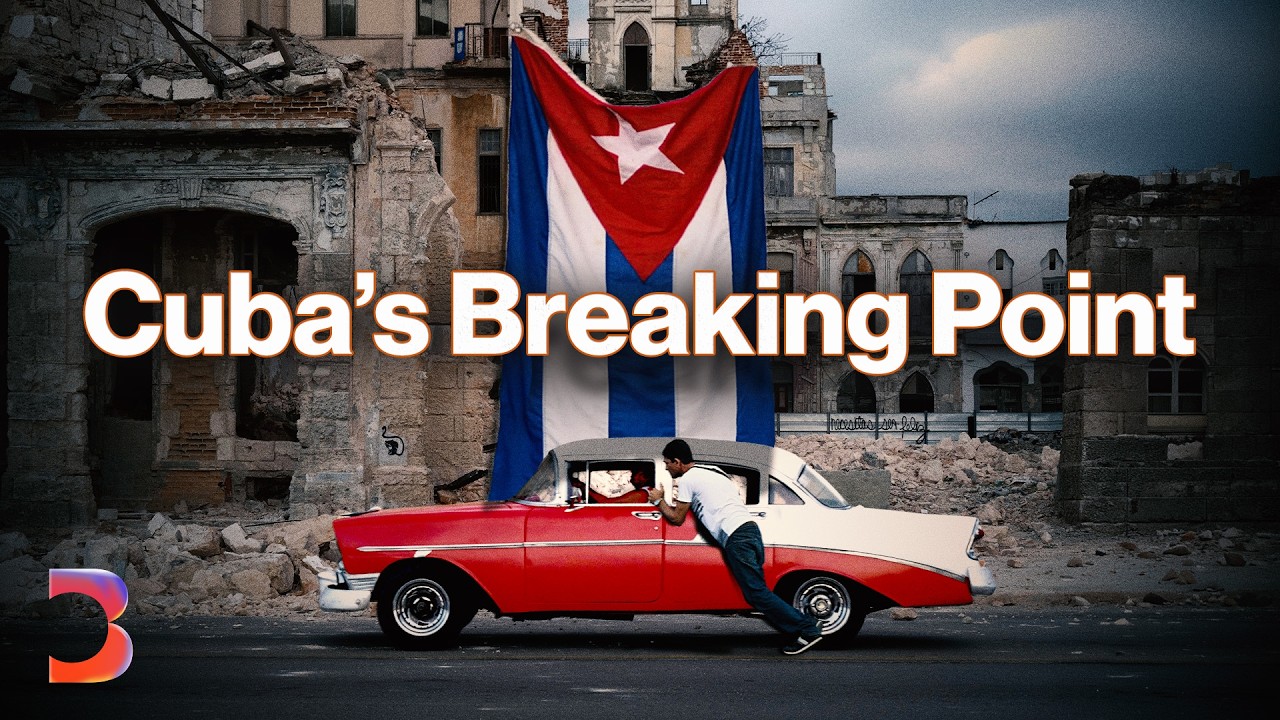

Cuba in 2025 is in freefall. What is happening in Cuba right now is a convergence of crippling fuel shortages, island-wide blackouts, runaway inflation, and an aggressive US sanctions policy designed — by the Trump administration's own logic — to accelerate the collapse of the Cuban government. The humanitarian cost is mounting fast, and the endgame is anything but clear.
This isn't just another chapter in a long Cold War standoff. The conditions on the island today are arguably worse than what Cubans endured after the Soviet Union collapsed in the early 1990s. And unlike that crisis, this one is unfolding in real time with the world watching.
 00:45
Cuba's geographic position — just 90 miles from Florida — has made it a perpetual flashpoint in US foreign policy
Watch at 00:45 →
00:45
Cuba's geographic position — just 90 miles from Florida — has made it a perpetual flashpoint in US foreign policy
Watch at 00:45 →
What Is Actually Happening in Cuba Right Now?
Cuba is experiencing a cascade of interconnected failures. The country is running out of jet fuel, which has forced airlines to cancel flights, crippled the tourism industry, and left hospitals struggling to operate. Blackouts are stretching for hours — sometimes more than 20 hours a day in some regions. The electrical grid, which runs almost entirely on imported oil, is buckling under the shortage.
Inflation hit a staggering 71% during the pandemic and, while officially reported at around 14% in 2025, economists believe the real figure is close to those pandemic peaks. The famous Cuban ration card — a cornerstone of the socialist social contract that guaranteed every citizen a baseline of rice, chicken, and eggs — is breaking down. Goods are technically available in some markets, but most Cubans simply cannot afford them.
Infant mortality is rising. Surgery wait lists are growing. Attempts to bring in humanitarian aid from Mexico and other countries are slowing, and even when supplies arrive, there's often no fuel to distribute them across the island. The people who need help most are the last to receive it.
03:12
Crippling blackouts across Cuba have become a daily reality as the fuel shortage deepens
Watch at 03:12 →
Why Is the US Tightening Sanctions on Cuba in 2025?
The Trump administration has taken what it describes as a hard-line national security stance toward Cuba. In late January 2025, President Trump threatened sanctions against any nation that supplied Cuba with oil — a direct shot across the bow of Mexico, whose President Claudia Sheinbaum had been one of Cuba's few remaining energy lifelines. Sheinbaum decided the risk to Mexico's own economy was too great, and the oil stopped flowing.
The US has maintained a broad trade embargo on Cuba since shortly after the 1959 revolution. But the current moment feels different. The Justice Department unsealed an indictment against former Cuban President Raúl Castro, a move analysts described as a symbolic escalation designed to signal that Washington is serious about pressure — not just posturing. Whether Castro will ever face prosecution is almost beside the point. The message is the strategy.
International voices, including human rights organizations and foreign governments, have called the crackdown inhumane and potentially illegal under international humanitarian law. The US position is that the suffering is the fault of the Cuban government, not the sanctions.
Why Does Cuba Have No Fuel or Electricity?
The roots of Cuba's energy crisis go back decades, but the immediate cause is the near-total collapse of Venezuelan oil shipments. For years, Venezuela under Hugo Chávez — and later Nicolás Maduro — supplied Cuba with subsidized oil in exchange for Cuban medical workers deployed abroad. That arrangement was the backbone of Cuba's energy supply.
05:30
Venezuela's subsidized oil kept Cuba's grid alive for years — that lifeline is now gone
Watch at 05:30 →
When the Trump administration moved against Maduro — a shift described by analysts as a complete game changer for Cuba — Venezuelan oil dried up almost entirely. Cuba produces roughly 40,000 barrels of oil per day domestically, but that is well short of what the country needs to function normally. Russia has supplied some oil historically, and Mexico stepped in periodically, but with Trump's January 2025 sanctions threat, those alternatives have largely evaporated.
The result: no fuel for the electrical grid, no jet fuel for planes, no gasoline to move food and medicine around the island. Cuba's energy infrastructure is Soviet-era and deeply fragile. Without a consistent oil supply, the whole system starts to crack.
What Does Cuba's Economy Actually Look Like Today?
Cuba's economy is a patchwork of communist structures, reluctant market reforms, and informal survival mechanisms. The single largest source of foreign currency for the island is its medical brigade program — at its peak, more than 24,000 Cuban doctors were deployed abroad, bringing in over $4 billion annually. That program has become a geopolitical flashpoint, with critics calling it exploitative and the Cuban government defending it as a lifeline.
Tourism was supposed to be another pillar. When President Obama visited in 2016 as part of an attempt to normalize US-Cuba relations, visitor numbers climbed sharply. But the pandemic devastated that recovery, and 2024 arrivals were the lowest outside the Covid years in two decades. Hotels have closed. Credit card transactions have been suspended. The tourism industry is effectively frozen.
08:45
Tourism arrivals in Cuba peaked after Obama's 2016 visit, then collapsed — and never recovered
Watch at 08:45 →
Inflation has eaten away at purchasing power. The government has approved more than 170 economic reforms and now counts over 9,200 registered small and medium businesses. But as analysts note, doing business in Cuba still means doing business with the state — and there are no legal guarantees protecting private investment, property rights, or profits. As one expert put it bluntly: you would have to be a fool to invest in Cuba under these circumstances.
Why Does Marco Rubio Want Regime Change in Cuba?
You cannot tell the Cuba story in 2025 without telling the South Florida story. Marco Rubio, born to Cuban parents in Florida, is a key architect of the current hard-line posture. He represents a generation of Cuban-American political leaders who have built careers — and voter coalitions — around the promise of ending communist rule in Havana.
The Republican Party's electoral success in Florida, especially since 2000, is deeply tied to Cuban exile voters in South Florida. Rubio, who harbors clear presidential ambitions, reportedly sees a historic opening: if he could be the political figure who ushers in regime change in Cuba, it would almost certainly vault him to the front of any future Republican primary field. As one analyst described it, Rubio wants to be the liberator — in quotes — of Cuba.
That political calculus shapes policy. The indictment of Raúl Castro, the oil sanctions, the maximalist pressure campaign — these are not just foreign policy moves. They are domestic political signals aimed at a specific and historically important voter bloc.
Can Cuba's Private Sector Save Its Own Economy?
There is a quiet revolution happening inside Cuba's economy, even amid the crisis. The private sector, long suppressed under communist doctrine, is growing. Small restaurants, repair shops, and entrepreneurial workarounds are expanding. The Cuban government has acknowledged this shift, approving sweeping reforms and even allowing Cubans living abroad to invest in small businesses on the island.
But the same caveats apply. The Cuban government has a long history of opening the door to private enterprise during crises, then tightening control once the pressure eases. Entrepreneurs on the island operate in a legal environment that offers them little protection. The government controls the infrastructure, the distribution networks, and ultimately the rules of the game.
Still, observers note that Cubans have an extraordinary capacity for adaptation. The private sector is moving whatever little economy remains — and that resilience may be the country's most durable asset.
How Is the Cuban Diaspora Keeping the Island Afloat?
With more than two million Cubans living abroad, the diaspora has become an informal economic safety net for the island. Companies like Katapulk — an online marketplace run by Cuban-American entrepreneur Hugo Cancio — allow families in the US to buy groceries, consumer goods, and mobile phone top-ups for relatives in Cuba, with delivery handled through a logistics network on the ground.
Cancio's company operates under a specific exemption to US Commerce Department export controls, which allows food and consumer goods to flow to Cuba without violating sanctions. His company is even shipping containers of natural gas to the island. It is a remarkable workaround — private enterprise threading the needle between two governments locked in a decades-long standoff.
The diaspora's involvement is not just economic. It is deeply personal. Families divided by politics and geography are watching the crisis unfold in real time, sending money, supplies, and hope across 90 miles of ocean. Many are doing everything they can to prevent a military confrontation that could put their relatives — including young Cubans serving in the military — directly in harm's way.
The situation in Cuba is fluid, painful, and unresolved. What comes next depends on decisions being made in Havana, Washington, and living rooms across South Florida — all at the same time.