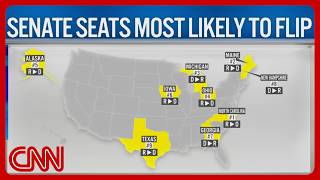
The battle for Senate control is already taking shape — and a new CNN analysis has ranked the 9 Senate races most likely to flip and decide which party controls the upper chamber. Six of those seats are currently held by Republicans. Three belong to Democrats. With the current balance of power, Democrats would need to hold every seat they own and flip four Republican-held seats to reclaim the majority. That's a steep hill, but not an impossible one.
Here's a deep dive into every race on the list, ranked from most to least likely to change hands — and what each one means for the future of the Senate.
 00:45
CNN's on-screen ranking of all 9 competitive Senate races by likelihood of flipping
Watch at 00:45 →
00:45
CNN's on-screen ranking of all 9 competitive Senate races by likelihood of flipping
Watch at 00:45 →
Which 9 Senate Races Will Decide the Majority?
CNN's ranking is based on conversations with strategists involved in each race, polling data, candidate quality, and broader political dynamics. The nine states are, in order of most likely to flip:
- 1. North Carolina (GOP-held)
- 2. Maine (GOP-held)
- 3. Michigan (Democrat-held, open seat)
- 4. Ohio (GOP-held)
- 5. Alaska (GOP-held)
- 6. Iowa (GOP-held, open seat)
- 7. Georgia (Democrat-held)
- 8. New Hampshire (GOP-held)
- 9. Texas (GOP-held)
It's a snapshot in time — with roughly 124 days until the election at the time of analysis, everything is subject to change. But the current picture tells a fascinating story about where each party is vulnerable.
What Do Democrats Actually Need to Flip the Senate?
Let's be blunt about the math. Democrats currently hold fewer seats. To regain control, they must hold every single one of their existing seats — including competitive ones in Michigan and Georgia — and then flip at least four Republican-held seats. That means winning in deeply red or at least purple territory like Ohio, Iowa, Alaska, and either North Carolina or Maine.
03:10
New York Times poll showing Roy Cooper's lead over Mike Watley in North Carolina
Watch at 03:10 →
The broader question hanging over the entire map is whether voter frustration with President Trump and anxiety about the economy will cascade downward and affect these individual Senate contests. Historically, Senate races in red states can insulate themselves from national headwinds. But in a charged political environment, that firewall can crack. Republicans themselves are hoping for resolution on economic issues — including tensions with Iran — before voters head to the polls. There's no guarantee that happens.
Why Is North Carolina the #1 Senate Race to Watch?
North Carolina sits at the very top of CNN's rankings, and both parties know it. This is a GOP-held seat that Democrats haven't won since 2008 — yet right now, Democratic candidate and former Governor Roy Cooper holds a meaningful polling lead over Republican nominee Mike Watley.
Cooper is widely regarded as a strong candidate. He's a popular former governor with statewide name recognition, solid fundraising, and the kind of political resume that plays well in a competitive state. Strategists on both sides of the aisle are watching this race closely.
06:22
Fox News poll showing Josh Turk leading Ashley Hinson in Iowa
Watch at 06:22 →
The Republican concern centers on Watley himself. As former RNC chair and a close Trump ally, Watley has the backing of the White House — but Republican sources have privately expressed worry about his performance as a candidate. He's not seen as a dynamic or energizing presence on the trail. More importantly, some in the party feel he needs an identity that extends beyond his association with Trump, particularly when asking voters to elect him to a six-year Senate term that will outlast Trump's time in office. That's a messaging challenge that hasn't been fully solved.
What Does the Iowa Senate Race Polling Show?
Iowa is one of the most intriguing races on the board. With Senator Joni Ernst retiring, this is an open Republican seat — and the early polling shows Democrat Josh Turk leading Republican nominee Ashley Hinson in at least one Fox News survey.
Hinson is considered a strong candidate by operatives in both parties. She's talented, well-organized, and has a real shot at defying the state's rightward lean. But here's the tension: Hinson has closely aligned herself with Donald Trump, drawing a large portion of her support from MAGA voters. In a state where Trump is popular, that's a reasonable strategy. The risk is that broader frustration with Trump and the economy seeps into even red-leaning states and makes a straight Trump-alignment message harder to sell.
Iowa is shaping up to be a microcosm of the larger Senate map question: does national anti-Trump sentiment have coattails long enough to flip seats in traditionally red territory?
Is John Ossoff Safe in the Georgia Senate Race?
Georgia ranks seventh on CNN's flip list — meaning it's considered more likely to stay Democratic than to switch — but it's still on the map, and that matters. Senator John Ossoff, who won his seat in a dramatic 2020 runoff, currently leads Republican nominee Mike Collins by a striking 13 points in polling.
That's a comfortable margin for now. Ossoff has proven to be a fundraising powerhouse and a candidate with genuine viral appeal — the kind of politician whose speeches produce shareable moments that spread well beyond Georgia. There's already buzz about his potential national ambitions in 2028 if he survives this race.
On the Republican side, anxiety has been simmering for months. Governor Brian Kemp, who might have been the strongest possible challenger, declined to run. The candidate Kemp backed couldn't win the primary. Collins, who did win, is relatively new to the political scene and hasn't been through a high-profile race. Some Republicans are privately worried that he hasn't been fully vetted — and that there could be surprises ahead. Trump himself waited until Collins was clearly going to win before endorsing, a sign that even the White House wasn't fully sold early on.
Why Is Michigan's Democratic Primary So Critical?
Michigan sits third on CNN's list, but here's the twist: it's a Democrat-held seat that Democrats desperately need to keep. With Senator Gary Peters retiring, this open seat has become a major vulnerability. Democrats can't afford to lose Michigan — it would make the already difficult math of winning back the Senate essentially impossible.
The Democratic primary is contentious and unresolved. One of the candidates, Abdul El-Sayed, recently received a high-profile endorsement from Representative Alexandria Ocasio-Cortez — a signal of progressive enthusiasm but also a potential liability in a purple state general election. El-Sayed runs to the left of the other Democratic candidates and would ultimately face former Republican Congressman Mike Rogers in November.
The AOC endorsement is notable in part because she has been relatively selective about wading into primary races. Analysts have noted that the progressive wing's recent electoral wins in New York and Colorado may have emboldened her to get more involved. Whether that progressive momentum translates to a competitive general in Michigan remains a live question.
Can Republicans Hold Their Senate Majority in 2026?
The short answer: yes, but it's far from guaranteed. Republicans have structural advantages — many of the competitive seats are in red or lean-red states where their candidates start with a built-in edge. And Democrats face a demanding path, needing to run the table defensively while also playing offense in hostile territory.
But the environment is shifting. Voter frustration with Trump and economic anxiety are real forces that operatives in both parties are watching carefully. Candidate quality matters enormously in Senate races, and on that front, Republicans have some genuine concerns — particularly in North Carolina, Georgia, and Iowa. Meanwhile, Democrats have recruited credible candidates across the map and are playing with organizational and financial energy.
With months still to go, this Senate map will look different by Election Day. But right now, control of the upper chamber is genuinely up for grabs — and these nine races are where the story will be written.