
What Does Mamdani's NYC Win Mean for the Democratic Party?
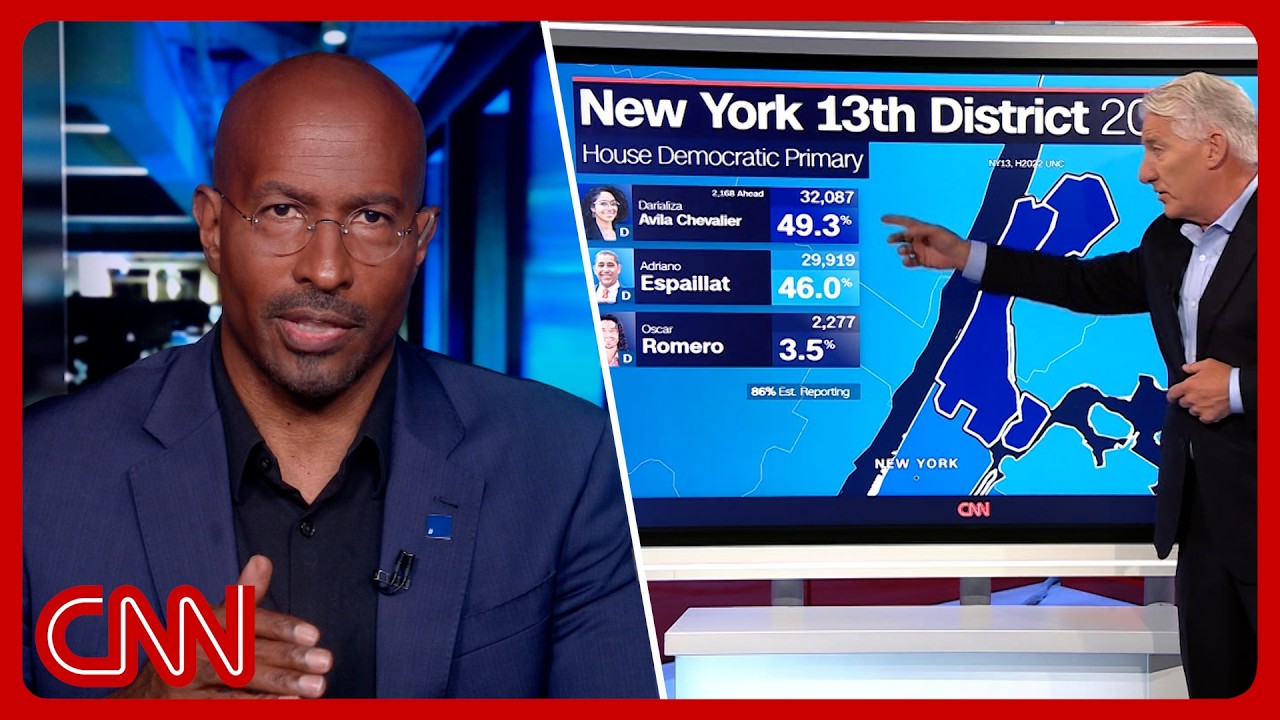
Zohran Mamdani's hat trick in New York City's Democratic primaries is being called a watershed moment — and it's hard to argue otherwise. The question of what Mamdani's NYC primary win means for the Democratic Party is no longer theoretical. In a single night, Mamdani endorsed three candidates across three contested races, and all three won. That's not luck. That's power. As one analyst put it on live television, "The roof is collapsing on the Democratic Party establishment tonight." The insurgency didn't just show up — it showed up and won.
The significance extends well beyond New York. This was a direct confrontation between the progressive insurgency and the party establishment, with heavyweights like Senate Minority Leader Chuck Schumer and House Minority Leader Hakeem Jeffries firmly on the other side. And the establishment lost. Badly. In their own backyard.
 00:45
Van Jones declares the establishment is getting its 'butt kicked' as Mamdani's hat trick becomes clear
Watch at 00:45 →
00:45
Van Jones declares the establishment is getting its 'butt kicked' as Mamdani's hat trick becomes clear
Watch at 00:45 →
Is a Progressive Wave Taking Over the Democratic Party?
For years, the establishment wing of the Democratic Party has managed to contain the progressive left — dismissing figures like AOC as exciting but unelectable outside deep-blue strongholds. Tuesday night complicated that narrative significantly. The progressive wave isn't just showing up in polls or Twitter arguments anymore. It's winning primaries.
What makes this moment different is the combination of a movement and a machine operating simultaneously. Mamdani didn't just inspire voters — he organized them, deployed resources, and delivered results. That's a level of political sophistication that the establishment can no longer wave away as idealistic energy without practical muscle.
- AOC remains one of the most recognizable progressive figures in the country, and her influence looms large over this moment.
- Mamdani's endorsement record now gives him undeniable credibility as a kingmaker in New York City politics.
- The affordability crisis — housing, groceries, healthcare — is fueling voter frustration in ways that benefit candidates who campaign against donor-class politics.
That said, analysts are careful to note this isn't a uniform national wave. States like Iowa saw establishment-backed candidates win comfortably. The progressive surge is real, but it's not monolithic.
03:10
John King breaks down the three races at the Magic Wall, explaining what a Mamdani sweep means for NYC power dynamics
Watch at 03:10 →
Who Is Zohran Mamdani and Why Does He Matter?
Zohran Mamdani is the Democratic Socialist mayor of New York City who, in just six months in office, has become arguably the most consequential endorser in New York Democratic politics. As Politico put it, there is a "new king of New York" when it comes to primary endorsements — and that title now belongs to Mamdani.
What separates Mamdani from the typical progressive politician is his ability to connect rhetoric to results. His supporters argue that he has demonstrated, in a compressed timeframe, that a politician can make promises to ordinary voters — not donors, not lobby groups, not billionaires — and actually keep them. That's a powerful message at a time when voter cynicism about both parties is at historic highs.
His hat trick endorsement sweep also signals something larger: Mamdani is positioning himself as a voice in the national conversation about where the Democratic Party should go, both heading into the 2026 midterms and the 2028 presidential cycle.
Can Progressive Dems Win Outside New York City?
This is the central tension that analysts and party strategists are wrestling with in the aftermath of Tuesday's results. New York City is a uniquely fertile environment for progressive candidates — it's dense, diverse, heavily unionized, and deeply blue. The question is whether Mamdani's brand of democratic socialism can travel.
06:30
Panel clashes over whether Daria Elisa Avila Chevalier's positions will haunt Democrats in swing districts
Watch at 06:30 →
The honest answer, according to multiple analysts, is: it depends. In cities like Seattle, Portland, and Los Angeles, a Mamdani-style progressive could likely thrive. In purple districts in states like Maine, Michigan, or Pennsylvania, the calculus is entirely different. Swing voters in those regions are far more sensitive to positions on immigration enforcement, public safety, and fiscal policy.
There's also the matter of candidate quality. Mamdani is a skilled communicator who stays focused on bread-and-butter economic issues — affordability, housing, working-class relief. Not every progressive candidate has that discipline. The risk for Democrats is that the energy from NYC primaries inspires candidates in swing districts who lack Mamdani's political instincts, potentially handing seats to Republicans.
Who Is Daria Elisa Avila Chevalier and Why Is She Controversial?
One of the three Mamdani-backed winners drew significant attention for reasons that go beyond electoral politics. Daria Elisa Avila Chevalier, who defeated long-standing Democratic incumbent Adriano Espaillat in a closer-than-expected race, carries a record that gives moderate Democrats heartburn.
CNN previously reported that she had deleted Twitter posts in which she expressed support for abolishing police, prisons, and borders, as well as positions that called into question Israel's right to exist and advocated for seizing private property and nationalizing major industries. In a recent interview, she reportedly stated that all deportations are immoral — and when pressed with hypotheticals about violent offenders, she did not walk that position back.
Her victory is a flashpoint in the debate over the Democratic Party's direction. Supporters argue that voters in her district looked past the controversies because they prioritized economic representation over ideological purity tests. Critics — including some within the party — warn that her positions will become Republican attack ads in swing districts across the country, defining Democrats in places where they're trying to compete.
How Will Republicans Weaponize These Democratic Wins?
Republicans wasted no time in signaling their strategy. Far-left primary victories in New York City are a ready-made contrast for GOP campaigns in competitive districts. Terms like "open borders," "abolish the police," "anti-Israel," and "socialist" are already being deployed — and Tuesday night's results give those attacks fresh ammunition.
The parallel being drawn is to the Republican experience in 2010-2012, when nominees like Sharron Angle, Todd Akin, and Richard Mourdock won primaries in competitive states and then lost winnable Senate seats because their positions alienated general-election voters. Several analysts on air made this comparison explicitly, warning that Democrats risk repeating that mistake.
The most vulnerable terrain: districts like Maine's 2nd Congressional District, where a very progressive candidate is now positioned to run for the seat being vacated by moderate Democrat Jared Golden. Republicans are openly confident they can flip that seat — and results like Tuesday's in New York City only add fuel to that argument.
What Do These Results Mean for Jeffries and Schumer?
If you're Hakeem Jeffries or Chuck Schumer, you woke up Wednesday morning with a serious problem. Both leaders have built their influence on the assumption that the establishment wing of the party controls the machinery — the endorsements, the money, the candidate pipelines. Tuesday night challenged that assumption directly.
For Jeffries, the challenge is especially acute. As House Minority Leader, he has to manage a caucus that is pulling harder to the left than at any point in recent memory. If Democrats retake the House majority, he'll be Speaker with a vocal, emboldened progressive bloc that just demonstrated it can win primaries against incumbents Jeffries supports.
For AOC, the results arguably open a door. Her future — whether that's a Senate run against Schumer, a gubernatorial bid, or a 2028 presidential campaign — just got a stronger tailwind. The progressive infrastructure that delivered for Mamdani would likely mobilize behind her in any statewide or national race.
The bottom line: New York City just sent a message that neither wing of the Democratic Party can ignore. Whether it's a preview of a national realignment or a localized blue-state phenomenon, the debate has officially begun — and the establishment no longer controls the terms of it.