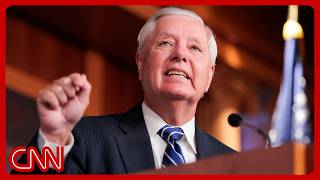
Senator Lindsey Graham is dead at 71. His office confirmed the South Carolina Republican died on Saturday night following what they described as a brief and sudden illness — stunning Washington, the political world, and anyone who had seen him actively posting on social media just days before. Graham had represented South Carolina in the US Congress since 1995, making him one of the longest-serving and most recognizable voices in the Senate. His family is asking for privacy as the nation processes the shocking news.
 00:15
CNN anchor reacts live to breaking news of Sen. Lindsey Graham's death
Watch at 00:15 →
00:15
CNN anchor reacts live to breaking news of Sen. Lindsey Graham's death
Watch at 00:15 →
There was no public warning. No indication anything was wrong. Graham had been photographed and filmed just days earlier in Ukraine, meeting with Ukrainian President Zelensky, and was posting actively to X about President Trump's trip to NATO as recently as two days before his death. The question on everyone's mind right now: how did Lindsey Graham die?
How Did Lindsey Graham Die?
According to his office, Graham died on Saturday night from a brief and sudden illness. Beyond that, no specific cause of death has been confirmed. His team offered no further medical details, and speculation — whether it was a heart attack or something else entirely — remains just that: speculation. What is known is that Graham showed no outward signs of illness in his final days. He was 71 years old, had just won the South Carolina Republican primary on June 9th seeking reelection, and by every public indication appeared to be in his usual form.
The abruptness of his death has left Washington in genuine shock. Graham was posting about geopolitics and praising President Trump publicly just 48 hours before his passing. The phrase used by his office — a brief and sudden illness — suggests this was not a prolonged condition but something acute and fast-moving. Until an official cause of death is released, the full picture remains incomplete.
02:40
Graham's final social media posts from Ukraine, just days before his death
Watch at 02:40 →
What Was Lindsey Graham Doing in Ukraine Before He Died?
In the days leading up to his death, Lindsey Graham was in Ukraine meeting with President Volodymyr Zelensky. He posted photos and official statements from the trip on his X account, appearing healthy, engaged, and fully active in his Senate duties. The trip was entirely in line with Graham's long career as one of the most vocal champions of US military involvement abroad.
Graham had been one of the loudest Senate voices in support of US assistance to Ukraine since Russia's invasion. His Ukraine visit, followed closely by his death, has only deepened the sense of disbelief. Just days before he died, he was on the world stage doing what he had done for decades — advocating for American military engagement and projecting US influence internationally. For those who followed his career closely, it was vintage Lindsey Graham right up to the very end.
What Is Lindsey Graham's Political Legacy?
Few senators in modern American history generated more debate — or more column inches — than Lindsey Graham. First elected to the US House of Representatives in 1995, he rose steadily through the ranks before moving to the Senate, where he became one of the chamber's most visible and polarizing members.
04:10
Archival footage of Graham alongside John McCain and Joe Lieberman — the Three Amigos
Watch at 04:10 →
- Champion of military intervention: Graham consistently pushed for a more aggressive US foreign policy, particularly around Iran, Israel, and the broader Middle East.
- Strong pro-Israel advocate: He was one of Washington's most reliable voices in defense of the US-Israel relationship.
- Ukraine supporter: He visited Kyiv multiple times and was one of the leading Senate advocates for military aid to Ukraine.
- The Three Amigos: Graham formed one of Washington's most famous bipartisan friendships alongside the late Senator John McCain and former Senator Joe Lieberman. The trio called themselves the Three Amigos and styled themselves as foreign policy mavericks.
Even his critics acknowledged his effectiveness. Graham knew how to work the Senate, how to read a room, and — critically — how to read the Republican Party and position himself accordingly. That instinct for political survival kept him relevant across multiple political eras.
How Did Graham Go From Trump Critic to Trump's Closest Ally?
Perhaps no chapter of Graham's career was more scrutinized — or more mocked — than his stunning transformation from one of Donald Trump's sharpest 2016 critics to one of his most enthusiastic allies. During Trump's first presidential campaign, Graham said things about Trump that were genuinely remarkable for their harshness. He warned openly about what a Trump presidency would mean for the country and the Republican Party.
Then Trump won. And Lindsey Graham adapted.
By the time of Trump's second term, Graham was calling him the GOAT of all presidents on social media, golfing with him regularly, and working closely with the administration on foreign policy strategy — including the Iran military intervention that has dominated recent headlines. The two men, both charming in their own distinct ways, developed a genuine working rapport. According to those familiar with the relationship, Trump was in more regular contact with Graham than almost any other senator, relying on him to help formulate strategy and move legislation.
Trump also provided something invaluable to Graham: political protection. In an era where the former president has made and broken Senate careers with a single endorsement, Graham had Trump's backing. That support helped ensure Graham faced no serious primary challenge despite the politically volatile climate. Graham helped deliver for Trump in the Senate; Trump helped Graham survive in South Carolina. It was, by any measure, a mutually beneficial arrangement — even if it left some longtime Graham watchers puzzled about where his true convictions actually lay.
Was There a Real Ideological Center to Lindsey Graham?
That question has followed Graham throughout his career. His defenders argued that his core was always consistent: a hawkish, interventionist foreign policy, a strong military, and an unwavering belief in American power projection abroad. His critics said he was simply a gifted political navigator who moved with the winds of the GOP rather than against them. Both arguments have merit. What's harder to dispute is that Graham was extraordinarily skilled at staying relevant — across the Bush years, the Obama years, the McCain era, and the Trump era — in ways that few senators ever manage.
What Did Lindsey Graham Believe About Iran and Foreign Policy?
If there was one issue where Graham never wavered, it was Iran. For decades, he was among the Senate's loudest voices calling for military pressure on Tehran. As recent US military operations in Iran have unfolded, Graham was one of the architects of that hawkish Senate consensus, working alongside the Trump administration to build support for intervention. His death comes at a moment when that policy debate is very much alive, and his absence will be felt in those discussions.
More broadly, Graham believed deeply in an activist American foreign policy — one where the United States does not retreat from the world stage but actively shapes it through military strength and strategic alliances. That worldview defined his Senate career from beginning to end.
Who Will Replace Lindsey Graham in the Senate?
It is, as analysts have already noted, almost certainly too early to think through the full political implications of Graham's death. What can be said is that South Carolina is a solidly Republican state. The seat is not expected to be competitive for Democrats. The governor of South Carolina will likely appoint a replacement to serve until a special election can be held. Who that person is — and whether they can fill the very specific and outsized role Graham played in the Senate — remains an open and genuinely interesting question.
Graham was not just a vote. He was a voice, a media presence, a dealmaker, and a foreign policy force. Finding someone who checks all of those boxes in South Carolina's Republican political landscape will not be straightforward.
A Washington Original, Gone Too Soon
Whatever you thought of Lindsey Graham's politics — and people thought very different things — he was undeniably one of a kind. Charming, media-savvy, controversial, adaptable, and always somewhere near the center of whatever story Washington was telling about itself. He died as he had lived: active, engaged, working, and very much in the middle of it all. He was 71 years old.