
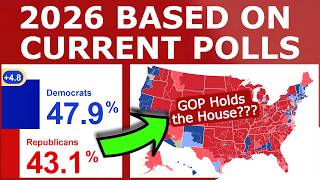
Can Republicans hold the House in 2026? Based on the latest polling, the answer is a cautious but increasingly confident yes. New data from Quantus — one of the most accurate pollsters of the 2024 cycle — shows Republicans at 43.1% on the generic ballot versus Democrats at under 48%, with roughly 9% of voters still undecided. That gap, combined with favorable redistricting and a string of political wins for the Trump administration, puts Republicans in a surprisingly strong position heading into what many predicted would be a brutal midterm year.
Can Republicans Actually Hold the House in 2026?
Going into 2026, Republicans currently hold 211 House seats to Democrats' 205, with around 19 races designated as competitive toss-ups. Of those toss-ups, roughly 13 are held by Republican incumbents — which might sound alarming at first glance. But when you look closer, several of the remaining contested seats are in districts where Donald Trump won by double digits in 2024, including seats like Vicente Gonzalez's Texas district.
 04:15
Current House seat breakdown: Republicans at 211, Democrats at 205, with 19 competitive toss-ups
Watch at 04:15 →
04:15
Current House seat breakdown: Republicans at 211, Democrats at 205, with 19 competitive toss-ups
Watch at 04:15 →
Here's the key context most analysts are missing: the generic ballot gap right now essentially mirrors Joe Biden's margin in 2020. And in 2020, Republicans ended up with roughly 213 House seats despite losing the presidency. Factor in the redistricting gains Republicans have locked in this cycle — while Democrats fumbled their Virginia referendum and left seats on the table in states like Ohio, Indiana, Utah, and South Carolina — and Republicans enter 2026 with a structural cushion that the raw polling numbers don't fully capture.
If Republicans keep the generic ballot within 5 points, they are almost certainly the favorites to hold the House. If it stays within 4 to 5 points and momentum continues building, an asterisk midterm — where Republicans actually gain seats — becomes a real possibility. That would be historically unprecedented for a party already in power during a midterm cycle and would represent a catastrophic failure for Democratic electoral strategy.
Which House Seats Are Actually Toss-Ups in 2026?
Let's break down the most contested House races and what the current environment means for each of them.
08:40
District-by-district toss-up analysis across Arizona, Florida, Michigan, and Pennsylvania
Watch at 08:40 →
- Arizona's 1st District: Likely Republican hold. High-propensity GOP voters in this district provide a cushion even in a D+4 or D+5 environment.
- Arizona's 6th District (Ciscomani): More competitive. A narrower seat where Ciscomani needs to outperform the national environment to survive.
- California's 22nd District: The far-left challenger could benefit from a midterm environment, making this one of the more genuine toss-ups on the map.
- Colorado (Gabe Evans): Competitive but not a foregone conclusion. Evans may not hold on, but it will be close.
- Florida (Moskowitz seat): Despite the incumbent's crossover appeal, registration trends in Florida favor Republicans picking this one off.
- Iowa (Miller-Meeks / Nunn): Republicans may split these two seats, with one holding and one flipping.
- Michigan's 7th District (Tom Barrett): Likely Republican hold, especially if Abdul El-Sayed wins the Democratic primary — a matchup that plays well for Barrett given Michigan's competitive top-of-ticket dynamics.
- Michigan's 10th District: More ancestrally Democratic, making it trickier to hold without a strong incumbent like John James on the ballot.
- New Jersey (Tom Kean / Lawler): Lawler is becoming an institution in his district — think Brian Fitzpatrick-style durability. Kean is less certain but still competitive.
- Ohio (Marcy Kaptur): Top-of-ticket effects in Ohio could help Kaptur survive, but Republicans have a real shot at Bresnahan's Pennsylvania seat nearby.
- Virginia (Jen Kiggans): Likely hold. Kiggans is an overperformer in a district where Republicans trend higher propensity.
- Washington (Marie Perez): Shouldn't even be called a toss-up at this point. Perez does enough performative moderate votes and faces a weak challenger.
- Wisconsin (Derrick Van Orden): Faces the same opponent again. If Democrats make a poor gubernatorial nomination decision and the generic ballot stays within 4-5 points, Van Orden holds on.
The bottom line on the House: Republicans could do three seats worse than the current projections and still hold their majority. That is not the environment Democrats were expecting when 2025 began.
What Is the 2026 Generic Ballot Showing Right Now?
The current generic ballot has Republicans at 43.1% and Democrats failing to crack 48%, with around 9% of voters undecided. That undecided pool is critical — and right now, the momentum among those voters is trending Republican.
It's worth noting that even when you strip undecideds out entirely, the adjusted gap shifts to roughly a 5 to 6 point environment — territory where Republicans have historically performed well due to their structural advantages in the House map. Democrats peaked at 49% and have not been able to push beyond that ceiling, which is a warning sign for a party that needs to run up the score in their best districts to offset geographic disadvantages elsewhere.
02:10
Quantus poll showing 56% approve vs 13% disapprove of the US-Iran preliminary agreement
Watch at 02:10 →
How Did the US-Iran Deal Affect Trump's Approval?
One of the biggest political storylines shaping the 2026 environment is the preliminary US-Iran nuclear agreement. A new Quantus poll shows 56% of Americans approve of the deal, with only 13% disapproving. That's nearly a 4-to-1 approval margin — and it's driving real political consequences.
The average voter, regardless of party, wants an end to conflict and is responding positively to the idea of a deal that keeps Iran from obtaining a nuclear weapon. Neoconservative voices on the right are frustrated, wanting full regime change. The left, meanwhile, is largely stone-faced about the agreement because they know it represents a genuine political win for Trump — one they can't easily attack without looking out of touch with public opinion.
The downstream effects matter too. Gas prices have already begun declining, and if the deal holds and Iran stays non-nuclear, Trump will be able to run the 2026 midterm cycle on a platform of peace and economic relief. That is a fundamentally different political environment than the one Democrats were counting on when they anticipated a 2006-style wave year.
What Does the 2026 Senate Map Look Like?
The Senate map is actually the easier side of the equation for Republicans in 2026. Here's a quick rundown of the most competitive races:
- Iowa & Nebraska: Safe Republican holds. Democrats have delusional hope here — it won't materialize.
- Florida: Republicans win by 10+. Not competitive.
- Texas (Paxton): Could win by more than 5, even being conservative in the estimate.
- Ohio (Brown): Sherrod Brown loses by 2 to 5 points in this environment.
- North Carolina & Georgia: Remain genuinely competitive. Georgia could go to a runoff if Mike Collins can get his spending up in time.
- New Hampshire: Close, but John Sununu would be a strong Republican candidate if he runs. Not a sure flip, but a real opportunity.
- Maine (Susan Collins): Collins is built for this environment. The last time she ran in a D+4 year, she won by 9 points. Against a challenger with significant candidate quality issues, she likely wins by around 6 — outruns the national environment by roughly 10 points.
- Michigan (Slotkin vs. Rogers): Mike Rogers wins this one. Elissa Slotkin loses in a D+4.5 environment.
- Alaska (Dan Sullivan): Sullivan finishes around 51-52%, and Mary Peltola falls short under the ranked-choice voting system.
The projected Senate outcome: Republicans 53, Democrats 47. Republicans hold their majority and may even add a seat depending on how Georgia and North Carolina break.
How Does Redistricting Shape the 2026 Midterm Map?
Redistricting is the silent factor that most pundits are underweighting in their 2026 analysis. Republicans have locked in meaningful gains through the redraw process, while Democrats failed to maximize their opportunities. They botched their Virginia referendum, which would have offset some Republican gains. Meanwhile, Republicans showed restraint — arguably too much — in states like Ohio, Indiana, and South Carolina, leaving seats on the table voluntarily.
Democrats gave Republicans a free seat in Utah and didn't get the South Carolina consolidation they needed. When you account for all of this, the structural map in 2026 favors Republicans even more than a raw generic ballot number suggests.
Are Democrats on Track to Win Back Congress in 2026?
Based on everything the polling currently shows — the generic ballot, the Iran deal approval surge, falling gas prices, Republican redistricting advantages, and Democratic candidate quality issues — the answer right now is no. Democrats are not on track to retake either chamber.
If the environment holds anywhere close to where it sits today, Republicans hold the Senate comfortably and hold the House against what was supposed to be a historically devastating midterm cycle. If Trump were truly the historically unpopular president Democrats describe, they would be projected to gain 40+ seats the way Republicans did during Obama's first midterm. Instead, they may gain zero — or even lose ground. That would be the most damaging electoral result for a party riding this level of institutional confidence in a very long time.
The 2026 midterms are still months away, and the environment will shift. But right now, the data tells a clear story: Republicans have the momentum, the map, and increasingly the issues on their side.