
What Is the Federal Crackdown Happening in Washington DC?
Washington DC is currently the site of one of the largest coordinated federal law enforcement operations in American history. Under President Trump's direction, virtually every federal law enforcement agency — the US Marshals, FBI, DEA, ATF, ICE, HSI, Secret Service, and US Park Police — has been deployed simultaneously into the nation's capital to hunt wanted fugitives, crack down on violent crime, and clean up the streets. A reporter recently embedded with these teams for a full night to see exactly what this federal law enforcement operation in Washington DC looks like from the inside.
The operation stages out of US Park Police Headquarters, where team leaders from each agency consolidate, share intelligence, assign targets, and roll out in coordinated teams. The goal isn't random stop-and-frisk policing — it's targeted fugitive apprehension based on active warrants from DC Superior Court, DC District Court, the Metropolitan Police Department, and surrounding counties.
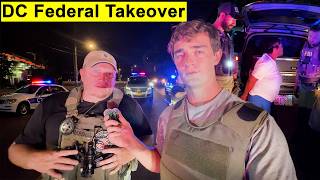 03:45
Agents stage at US Park Police HQ before rolling out — every major federal law enforcement agency present in one location
Watch at 03:45 →
03:45
Agents stage at US Park Police HQ before rolling out — every major federal law enforcement agency present in one location
Watch at 03:45 →
How Do US Marshals Actually Track Down Fugitives?
The US Marshals Service, founded in 1789 and the oldest federal law enforcement agency in the country, leads the fugitive apprehension mission. But their methods are far more sophisticated than most people imagine.
According to the Chief Inspector overseeing the Regional Fugitive Task Force, marshals don't just drive around looking for suspicious people. They build detailed intelligence packages on specific targets before ever leaving the command vehicle. Their tools include access to state, local, and federal partner databases, proprietary investigative programs, and years of institutional knowledge — because, as the chief noted, fugitives tend to get rearrested multiple times over their careers, leaving behind a trail of patterns and contacts.
On the night of this ride-along, analysts inside the mobile command vehicle worked up multiple warrants simultaneously. Within hours, fresh intelligence pinpointed an actively wanted fugitive in DC's Fourth District. The team mobilized immediately.
- Target: A man with an active Metropolitan Police Department warrant
- Known for: Drug sales and illegal gun possession
- Time from intelligence to arrest: Less than one hour
- What they found: A loaded gun hidden inside a hollow tree trunk near apartment buildings
The marshals also stressed that gangs operating in DC are not disorganized street crews — they have clear hierarchies, defined territories, and operate with a level of coordination that rivals legitimate organizations. That structure is part of what makes the intelligence-driven approach so important.
11:20
Inside the US Marshals mobile command vehicle — where intelligence is processed and arrests are coordinated in real time
Watch at 11:20 →
Is Crime Actually Going Down in DC Since the Operation Began?
According to agents on the ground, the numbers are striking. Before the federal operation began, Washington DC was averaging three to four shootings per night. Since all federal agencies deployed simultaneously, that figure has dropped to approximately three shootings per week. That's a reduction of roughly 80 percent in shooting incidents, at least according to the agents' own reporting.
In addition to the drop in shootings, the operation has produced hundreds of arrests and the seizure of dozens of illegal firearms in just the first few days. On the single night covered in this report, agents from multiple agencies collectively seized guns, arrested a wanted fugitive, and disrupted active drug distribution in a residential neighborhood — all within a few hours.
Agents also reported something unexpected: widespread gratitude from ordinary DC residents. People were reportedly approaching officers on the street to whisper thank-yous. One driver pulled over during a traffic stop specifically to tell agents they appreciated the work. The attorney general, who addressed agents before deployment, said the response from residents had been one of the most surprising elements of the entire operation.
Why Are Protesters So Angry About Federal Agents in DC?
Not everyone is celebrating. As agents arrested the fugitive and searched the area around the tree where the gun was hidden, a protest formed on the sidewalk almost immediately — and it grew quickly.
18:55
Agents arrest the wanted fugitive in a DC residential neighborhood — multiple agencies converge within minutes of intelligence confirmation
Watch at 18:55 →
Protesters raised several distinct objections. Some called the deployment an excessive show of force for a single arrest. Others argued that the mass presence of federal agencies — ICE, FBI, DEA, ATF, Marshals, and more — represented something far more sinister than crime reduction. One protester, a self-described six-generation DC resident and federal worker, called it a declaration of war on the city. Another protester drew explicit comparisons to Nazi Germany and Italian fascism, arguing that targeting vulnerable populations — including homeless people and people of color — followed the same historical playbook that led to genocide, and that ICE's expansion of detention beds by over 100,000 was proof of intent.
Several protesters challenged the legitimacy of arresting someone for having a gun, invoking Second Amendment rights — a point quickly countered by agents who confirmed the arrested man was a convicted felon, which bars gun ownership under federal law regardless of the Second Amendment.
The tension was real and at times heated, with insults exchanged on both sides. But the protest also illustrated a genuine divide in how DC residents perceive the operation — as either long-overdue intervention or the beginning of something much darker.
22:10
The illegal firearm found hidden inside a tree trunk just feet from apartment buildings where families live
Watch at 22:10 →
Why Is Chasing Fugitives One of the Most Dangerous Jobs in Law Enforcement?
Most people don't think about what makes a fugitive uniquely dangerous compared to other criminals. The chief inspector explained it clearly: a fugitive who knows they're facing life in prison when caught has essentially nothing to lose. That psychological reality makes them unpredictable and often violent.
Fugitives who are already on the run frequently continue committing crimes — sometimes escalating — because they reason that additional charges can't make their situation much worse. Some actively resist arrest with lethal force. The chief confirmed he had personally been shot at during his career, and that fugitive apprehension consistently ranks among the most violent work any law enforcement officer can do.
That same evening, before the operation even ended, an officer elsewhere in DC was assaulted during the day shift and hospitalized with a concussion. The attorney general confirmed the officer was expected to recover, but the incident underlined the daily risks these agents accept.
27:40
Protesters confront federal agents at the arrest scene, comparing the operation to historical fascism and calling it the beginning of genocide
Watch at 27:40 →
How Many Guns Has the DC Federal Operation Seized So Far?
Within the first week of the operation, agents had taken several dozen illegal firearms off DC streets. The gun recovered during this particular arrest — a weapon hidden inside a hollowed-out space beneath a tree trunk in a residential neighborhood, just steps from apartment buildings — was emblematic of the broader pattern agents described.
Fugitives and drug dealers in DC are routinely found in possession of illegal firearms, often stashed in creative locations to avoid detection during casual police contact. The combination of an active drug trade and easy access to hidden weapons creates constant danger for residents who live in those neighborhoods — particularly children.
The attorney general pointed to the gun seizures as the most alarming discovery of the operation, noting that when agents arrest someone with an active murder warrant, they frequently find that person is also armed. She called that reality terrifying — and said it was the clearest argument for why the operation was necessary.
What Do DC Residents Actually Think About the Federal Crackdown?
Perhaps the most unexpected moment of the night came after the arrest, when the son of the woman who had been briefly detained arrived to pick her up. She had been cleared of any involvement and released. Her son — himself a DC law enforcement officer — had a message that cut directly against the protesters' narrative.
He described growing up in DC and watching his mother get shot nine times. He talked about seeing his stepfather cut across the eye just walking down the street. He spoke about human trafficking, drug trafficking, and the normalization of violence in neighborhoods that outsiders never experience. And he said, simply, that DC needed this — that the city had needed exactly this kind of intervention for a long time.
His perspective, standing just yards away from the very scene that protesters were calling fascism, was a reminder that the debate over this operation is not simply federal government versus the people. It's a city deeply divided by lived experience — where people who grew up watching the violence firsthand often see the same operation very differently than those who didn't.
Whether the crackdown produces lasting safety or sparks a broader backlash remains to be seen. But for one night on the streets of Washington DC, it was impossible to ignore the reality that both sides — the agents hunting fugitives and the protesters demanding they leave — believed completely that they were on the right side of history.