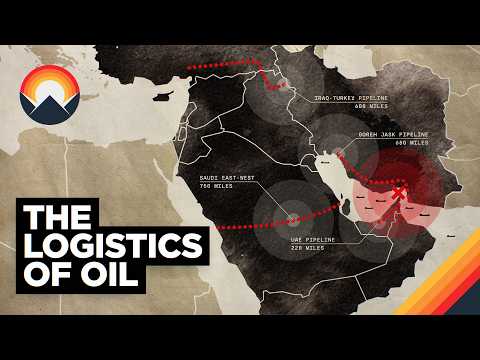
The alternatives to the Strait of Hormuz for oil exports do exist — pipelines, eastern ports, overland trucking corridors, and proposed railways — but none of them can fully replace what the strait provides. Before the recent Iran conflict disrupted traffic, between 100 and 150 ships crossed the Strait of Hormuz every single day, carrying crude oil, natural gas, food, medicine, and industrial equipment. When that flow stops, no combination of backup routes can absorb the volume. What the Gulf states are actually building are survival routes, not replacements.
Why Is the Strait of Hormuz So Critical to the Global Economy?
The Strait of Hormuz is not just another shipping lane. It is the foundation around which the Gulf states built their entire existence. Saudi Arabia, the UAE, Qatar, Kuwait, and Bahrain all depend on a single, narrow waterway they do not control. Roughly 20 percent of the world's oil and a significant share of global LNG exports pass through this chokepoint. Close it, and you do not merely slow energy markets — you paralyze the domestic supply chains of the countries that sit behind it.
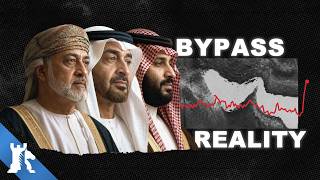 01:45
Map showing the Strait of Hormuz and the volume of daily shipping traffic that passes through it
Watch at 01:45 →
01:45
Map showing the Strait of Hormuz and the volume of daily shipping traffic that passes through it
Watch at 01:45 →
That is the uncomfortable truth the recent Iran conflict forced into focus. Even after a ceasefire was declared on April 7th, the strait remained largely closed by mutual American and Iranian blockades, with only a handful of vessels able to move. Suddenly, the region's dependence on a passage it does not control was no longer an abstract strategic concern. It was a live economic crisis — and it set off a rush of planning that was, in many cases, long overdue.
What Are the Real Alternatives to the Strait of Hormuz?
The bypass strategy breaks down into two distinct layers. The first is energy: pipelines that move crude oil and gas away from the Persian Gulf and toward alternative export terminals. The second is logistics: ports, roads, railways, trucks, and air routes that keep food, medicine, and consumer goods moving when maritime trade through Hormuz is disrupted. Both layers matter, and both face serious constraints.
On the energy side, the most developed alternative is Saudi Arabia's East-West Petroline, which runs from the kingdom's eastern oil fields to the Red Sea port of Yanbu. During the Hormuz closure, Riyadh increased crude exports through this route and is now looking to expand it further. Additional east-west pipelines are under consideration, alongside a $7 billion Jeddah-Dammam railway and expanded highway and trucking capacity to support it.
04:10
Saudi Arabia's East-West Petroline route from eastern oil fields to the Red Sea port of Yanbu
Watch at 04:10 →
The UAE has its own workaround. It is the only Gulf country with serious port access both inside the Persian Gulf — Jebel Ali and Khalifa — and outside the strait, at Fujairah and Khor Fakkan on the Gulf of Oman. The Emirati leadership is now accelerating a second west-east pipeline planned for launch in 2027, which would double the country's oil export capacity through Fujairah. In the meantime, Khor Fakkan has been handling imports of food, medicine, and consumer goods that would normally flow through Jebel Ali.
Which Pipelines Can Bypass the Strait of Hormuz?
There are currently two functioning pipeline bypasses of any real significance. Saudi Arabia's Petroline has a capacity of around 5 million barrels per day, though actual throughput is lower. The UAE's Abu Dhabi Crude Oil Pipeline, which runs to Fujairah, has a capacity of 1.5 million barrels per day. A second Emirati pipeline, once completed, would roughly double that figure.
To put those numbers in context: before the disruption, somewhere between 17 and 21 million barrels of oil passed through the Strait of Hormuz every day. Even at full capacity, existing and planned pipelines would cover only a fraction of that volume. The arithmetic simply does not work at scale. The Gulf states know this. The true purpose of these pipelines is not to replace Hormuz but to keep revenues flowing during a crisis long enough to avoid fiscal collapse.
Could Saudi Arabia and the UAE Survive a Hormuz Closure?
Of all the Gulf states, Saudi Arabia and the UAE are best positioned to endure a prolonged closure — but their advantages are relative, not absolute. Saudi Arabia can move oil west to the Red Sea. Higher oil prices during the conflict also gave Riyadh more fiscal headroom, though that boost is constrained by export limitations. The UAE benefits from its dual-coast geography, though moving goods from Fujairah and Khor Fakkan over the Hajar mountains into Abu Dhabi and Dubai's industrial centers is significantly slower and more expensive than unloading at Jebel Ali.
08:30
UAE's dual-coast port geography showing Jebel Ali inside the Gulf and Fujairah outside Hormuz
Watch at 08:30 →
The smaller Gulf states are in a far more exposed position. Qatar is wealthy but geographically trapped. Its LNG exports depart from Ras Laffan and must pass through Hormuz. Any serious land-based alternative would require deep integration with Saudi Arabia, the UAE, or Oman — and after the 2017 blockade that cut off Qatar's air, sea, and land connections for four years, Doha has every reason to treat a pipeline through Saudi territory as a potential lever of pressure rather than a lifeline. Kuwait faces similar constraints. Its options run south through Saudi Arabia or north through Iraq, and both routes carry political risk and financing complications that have stalled progress for years.
Why Does Political Mistrust Undermine GCC Integration?
The Gulf Cooperation Council talks about integration constantly. The reality is far messier. There is no common currency, no unified defense policy, and not even a customs union that functions as advertised. The GCC customs union has existed since 2015, but member states continue to carve out self-serving exceptions. Saudi Arabia has classified goods from UAE free zones as non-GCC products, effectively using trade regulations as political leverage. In 2009, Riyadh refused to recognize Emirati identity cards at border crossings — a deliberate move to disrupt travel and trade. The 2017 Qatar blockade was only the most dramatic example of connectivity being weaponized.
This history matters enormously for infrastructure planning. A pipeline, railway, or road corridor is only as reliable as the political relationship it depends on. When Gulf states have demonstrated a willingness to close borders and block transit routes as instruments of pressure, the smaller and more vulnerable nations have rational reasons to be suspicious of corridors that run through their larger neighbors' territory.
Could an Iraq-Turkey Energy Corridor Replace Hormuz?
One idea that repeatedly surfaces in regional policy discussions is an Iraqi energy and logistics corridor connecting the Persian Gulf to Turkey and from there to Europe. On paper, it has genuine appeal — it offers overland capacity beyond Hormuz and ties Gulf energy to broader continental trade routes. In practice, it depends on Iraq: a country dealing with weak institutions, active militia influence, persistent infrastructure gaps, and competing foreign powers pulling in different directions. Baghdad may eventually build something functional, but a corridor of that complexity cannot be conjured into existence by a crisis on a tight timeline.
13:55
Timeline of GCC political disputes — 2009 border closures, 2017 Qatar blockade — showing how connectivity becomes a weapon
Watch at 13:55 →
The Arab Gas Pipeline revival faces similar problems. Running through Jordan and Syria before connecting to Turkey, it could in theory address energy shortages in Lebanon and link Gulf producers to European markets. But Syria remains politically fragile, with major security gaps that make investor confidence essentially impossible to establish right now. The Hejaz Railway — once running from Istanbul to Mecca and now discussed as a symbolic prestige project — adds another layer of technical impossibility: it uses a narrow gauge incompatible with Saudi Arabia's modern standard-gauge network, meaning any revival would require a complete overhaul of the Syrian and Jordanian sections.
Why Do Gulf Mega Projects So Often Stall on Paper?
Three problems recur across every major infrastructure proposal in the region. The first is commercial logic. Investors know that Hormuz has reopened before and will likely reopen again. That makes it extremely difficult to justify permanent, full-scale alternatives for a crisis that may prove temporary. Capital follows certainty, and the long-term status of Hormuz is anything but certain.
The second problem is security. A corridor outside Hormuz is not automatically safe. During the recent conflict, Iran struck Saudi Arabia's East-West pipeline and targeted Omani ports. Every bypass route — pipeline, railway, or terminal — remains a potential military target.
The third problem is the Gulf's underlying infrastructure gap. For decades, there was simply no commercial reason to build large highway networks or freight railways across the Arabian Peninsula's interior. Ships were cheaper and more efficient. As a result, land-based infrastructure was chronically underfunded, delayed, or cancelled outright. The UAE delayed railway development after the 2015 oil bust. Saudi Arabia's NEOM project has been pushed back toward 2030. These are not isolated failures — they reflect a region where maritime trade was always the rational default.
The Gulf states are not wrong to be building. Reducing dependence on the Strait of Hormuz is a legitimate strategic goal, and the projects underway in Saudi Arabia, the UAE, and Oman will provide meaningful resilience. But resilience is not replacement. Sometimes the shortest route on a map is still the longest way around geography.