
When Iran closed the Strait of Hormuz in retaliation for US and Israeli strikes, global oil supply contracted by about 8%. Prices, however, shot up 60% — roughly seven and a half times the size of the actual supply disruption. If that math feels wrong to you, you're not alone. But the reason oil prices spike so dramatically on a relatively modest supply cut comes down to three interlocking forces: the brutal inelasticity of oil demand, the herd behavior of commodity traders, and a sudden collapse in marine war risk insurance. Together, they turned a serious but manageable disruption into a full-blown price crisis.
What Actually Happened When the Strait of Hormuz Closed
In early 2026, Iran's IRGC broadcast a message over VHF Marine Radio declaring all navigation through the Strait of Hormuz forbidden, then backed that declaration up with missile and drone strikes on vessels that tried to transit anyway. On paper, this was catastrophic. Around 20% of the world's oil passed through this 20-mile-wide chokepoint before the war.
 01:15
Map showing the Strait of Hormuz chokepoint and which Gulf producers depend entirely on it for exports
Watch at 01:15 →
01:15
Map showing the Strait of Hormuz chokepoint and which Gulf producers depend entirely on it for exports
Watch at 01:15 →
The Gulf is home to some of the world's most significant oil producers. Kuwait pumps 2.6 million barrels a day. The UAE produces 4.1 million. Saudi Arabia dwarfs them all. Smaller players like Bahrain and Qatar add meaningfully to the total. For countries like Kuwait, Qatar, and Bahrain — which have no alternative export route — the closure was economically devastating. They are collectively 100% reliant on tankers transiting the strait.
But not every Gulf producer was left helpless. Several had anticipated this exact scenario and built their way around it.
Which Countries Have Pipelines That Bypass the Strait?
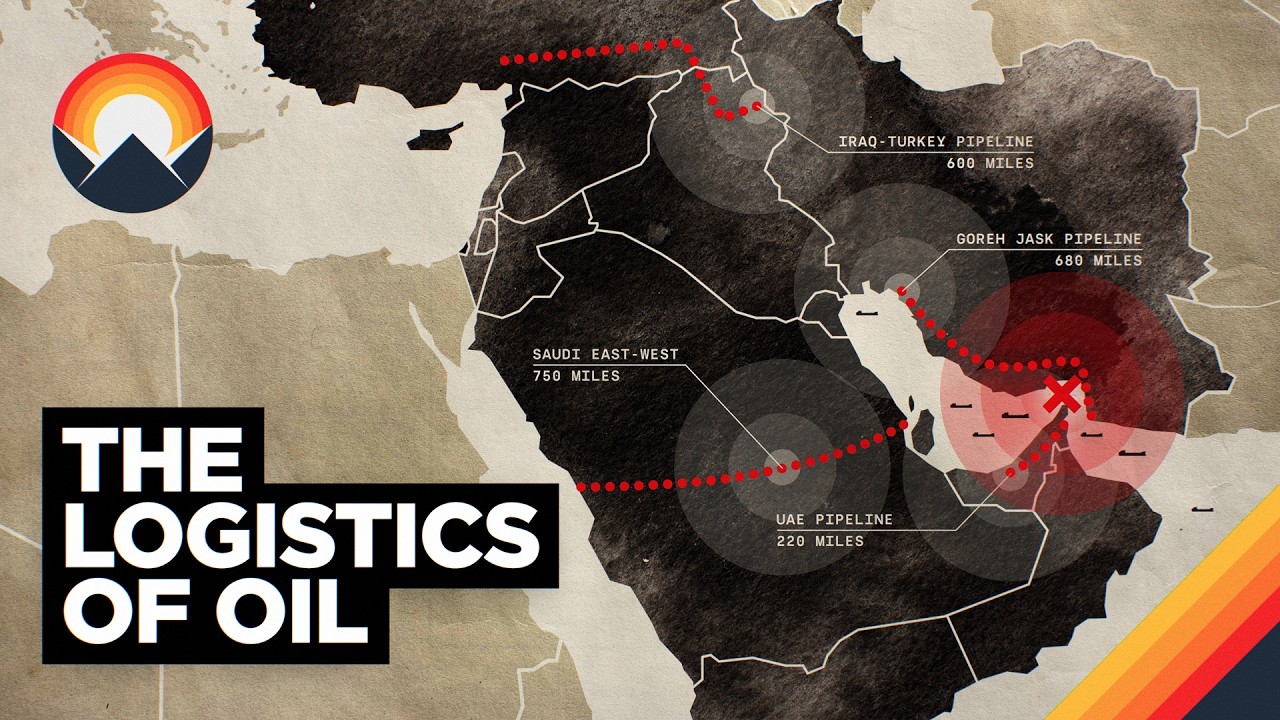
The UAE started building a bypass pipeline back in 2008, and while official statements cited cost savings, the real motivation was obvious: Iran had been threatening to close the strait for decades, and the UAE knew it was physically possible. The result is that a slim majority of Emirati oil now loads at the port of Fujairah — on the other side of the strait entirely.
04:30
Diagram of the four key bypass pipelines: UAE to Fujairah, Iran to Jask, Iraq to Turkey, Saudi Arabia to Yanbu
Watch at 04:30 →
Iran itself built a similar pipeline to the port of Jask, reportedly capable of handling about 15% of its normal export flows immediately, with room to scale. Iraq has a pipeline running through Kurdistan to a Turkish port, which not only bypasses the Strait of Hormuz but also the Suez Canal. In practice, it had been largely idle due to political disputes between Baghdad and the Kurdistan Regional Government — but a deal struck weeks into the war could eventually ramp it to 600,000 barrels a day.
Then there's Saudi Arabia's crown jewel: a 1,200-kilometer east-west pipeline built after the Iran-Iraq War in the 1980s, capable of moving up to 5 million barrels a day through to the Red Sea port of Yanbu — potentially more if its parallel natural gas line is converted to carry crude. Collectively, these pipelines significantly blunted the disruption. Global oil production in March 2026 contracted by roughly 8%, not the 20% a naive read of the pre-war numbers might suggest.
Why Did Oil Prices Jump 60% on an 8% Supply Drop?
This is where economics gets genuinely interesting. The concept at play is called elasticity of demand — the relationship between price changes and how much demand responds. Take breakfast cereal. If a brand raises prices 10%, research shows demand drops about 30%. Consumers just switch brands or eat something else. The elasticity is high, meaning demand is flexible.
07:45
Chart comparing breakfast cereal demand elasticity (-3) versus oil demand elasticity (-0.1) to illustrate why price spikes so dramatically
Watch at 07:45 →
Oil is the opposite. It is one of the most inelastic commodities on Earth. Academic research pegs oil's short-term demand elasticity at around -0.1, meaning a 10% price increase only reduces demand by about 1%. Why? Because there is no quick substitute. Internal combustion engines need oil. About three-quarters of personal driving in the US is non-discretionary — commuting, school runs, grocery trips. Trucking companies don't stop trucking because diesel costs more; they pass the cost on. Personal vehicles only account for about a quarter of global oil consumption anyway. The rest is commercial, and commercial demand barely flinches in the short term.
So when supply contracts 8%, the market has to raise prices enough to destroy that 8% of demand. Given how inelastic oil is, that requires a massive price increase. The actual numbers — 8% supply contraction producing a 60% price spike — imply an elasticity of roughly -0.13, which is almost exactly in line with what economic theory predicts. The market didn't overreact. It reacted correctly, by the math.
How Do Commodity Traders Distort the Oil Market?
If the math says 60% is about right, then why did it take the market so long to get there? In the opening days of the conflict, prices barely moved — just 6% on Monday, less than 5% on Tuesday, essentially flat on Wednesday, even as reports of drone strikes on tankers kept coming in.
11:20
Timeline of oil price movements in the opening days of the conflict, showing the delayed market reaction
Watch at 11:20 →
The answer is commodity traders. This sector makes its money by betting on where oil prices will go — and through doing so at massive scale, they become one of the most powerful forces shaping where prices actually go. If a large enough consensus of traders believes prices will fall, prices tend to fall. If they believe prices will rise, they rise. It becomes a self-fulfilling prophecy.
In the opening days of the war, trader sentiment was shaped by a narrative: that this would be a limited, short-term conflict. President Trump's initial statement described the operation as aimed at eliminating imminent threats, language that implied a contained military action. Traders pointed to precedent — the Venezuela operation, the Syria strikes, even the June 2025 bunker-buster campaign against Iranian nuclear sites — all of which had stayed limited in scope. So traders collectively bet the disruption would be brief, keeping prices artificially suppressed relative to the physical reality unfolding in the Gulf.
How Did Marine War Risk Insurance Halt Gulf Shipping?
What finally woke the market up wasn't more drone footage — it was paperwork. The moment Iran started firing missiles across the Middle East, the world's major marine insurers simultaneously cancelled their war risk insurance policies with 72-hour notice.
To understand why this was such a shock, consider what's at stake. A very large crude carrier is worth $80–$130 million. Its cargo at pre-war prices was worth another $130 million or more. No shipping company can absorb that risk on its own. War risk insurance — covering strikes by missiles, drones, and mines — is effectively mandatory. Without it, ships simply don't sail.
The cancellations created a bureaucratic wall that physically prevented oil from floating out of the Gulf, regardless of whether Iranian missiles were actually in the air at that moment. As weeks passed, some insurers began writing new policies — but at a cost that had risen more than tenfold, often hitting 3% of the ship's value per voyage, compared to 0.1–0.25% before the war. That's a transformative cost increase that isn't going away quickly, now that hypothetical threats have become documented reality.
Will Oil Prices Stay Elevated Long-Term?
Even as alternative pipeline routes ramped up through the second half of March and the effective supply contraction shrank, oil prices continued hovering near $100 a barrel. For every barrel that came back online via the UAE's Fujairah terminal or Saudi Arabia's Yanbu port, trader sentiment shifted in the other direction — pricing in longer disruption, structural uncertainty, and the dawning realization that Gulf oil was never as geopolitically secure as the markets had been treating it.
For years, as Gulf states grew wealthier and more stable, markets had quietly started treating their oil exports as almost as reliable as North Sea or US shale production. Iran's ability to functionally shut down the entire region's export infrastructure overnight shattered that assumption. The illusion of Gulf stability is gone, and markets are unlikely to forget it even after the strait reopens.
Long-term, higher sustained oil prices will eventually shift behavior — accelerating EV adoption, incentivizing investment in alternative pipelines, and pushing importers to diversify supply. But short-term elasticity is brutal, and until the Strait of Hormuz is either secured or rendered structurally irrelevant to global oil logistics, the world will likely continue paying a geopolitical premium every time it fills up a tank.