Could the US Actually Invade Iran?
The short answer is: the US could enter Iran, but it almost certainly could not win a ground war there at an acceptable cost. For years, a US military incursion into Iran was treated as a red line too dangerous to cross. The terrain is punishing, the risks unpredictable, and the political rewards vague at best. Even as Trump's latest diplomatic outreach has temporarily pulled both sides back from the brink, the underlying nuclear question remains unresolved. If those talks collapse, Washington would once again face the same impossible math — how do you generate leverage over Iran without marching on Tehran? The answer, according to US military planners, may lie not in a full invasion but in seizing specific, high-value locations along Iran's periphery. Five sites keep appearing in those discussions, and understanding each one reveals exactly why a military campaign against Iran is so much harder than it looks on a map.
What Would Happen If the US Attacked Iran?
Before examining individual targets, it is worth understanding the broader environment any US operation would enter. Iran is not a flat, open country that can be crossed in weeks. Mountains ring much of the country, while deserts, salt flats, and marshlands fill the gaps between population centers. Any invading force would have to fight through some of the most difficult terrain in the entire Middle East before reaching anything of strategic value.
 01:15
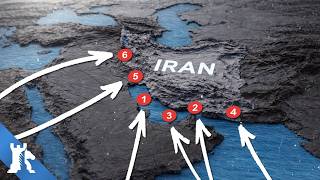
Map showing Iran's southern coastline and the five key strategic locations discussed in the video
Watch at 01:15 →
01:15
Map showing Iran's southern coastline and the five key strategic locations discussed in the video
Watch at 01:15 →
The Pentagon's preferred workaround is Iran's southern coastline — a narrow strip packed with oil terminals, commercial ports, and military installations, all of it directly accessible from the Persian Gulf and Arabian Sea. But accessibility is not the same as vulnerability. The moment US forces attempt to seize territory, they would be trading a military operation for an open-ended political, economic, and diplomatic crisis. The first mile into Iran might be measured in kilometers. The next hundred would be measured in years.
Why Is Kharg Island Iran's Most Vulnerable Target?
Of all five potential entry points, Kharg Island is the one that most directly threatens Iran's economic survival. Between 90 and 95 percent of Iran's crude oil exports pass through this single small island in the Persian Gulf. The reason is purely geological: the Gulf's shallow coastline cannot accommodate the draft depth of large oil tankers, so Iran funnels crude through overland pipelines to Kharg, where the water runs deep enough for supertankers to dock safely.
04:30
Kharg Island — where 90-95% of Iran's crude oil exports are loaded onto tankers
Watch at 04:30 →
For US planners, that concentration of export infrastructure in one place is enormously tempting. Seizing Kharg would be the next best thing to capturing Tehran itself — maximum economic damage without pushing deep into Iranian territory. But that logic collapses under scrutiny. Any disruption to Kharg's operations would send shockwaves through global energy markets almost immediately. Iran would retaliate across the region, and neighboring Arab states — many of them close US partners — would face the blowback. The very thing that makes Kharg an attractive target is precisely what makes striking it so dangerous. It cannot be hit quietly. There is no version of this operation that stays local.
Could the US Ever Control the Strait of Hormuz?
The Strait of Hormuz is the world's most important oil chokepoint, and on paper, controlling it would give Washington extraordinary leverage over both Iran and global energy flows. In practice, the Strait is not a single object that can be captured — it is a layered geography of waterways, islands, coastlines, and military positions that would all need to be secured simultaneously.
Any serious attempt to control the Strait would require operations against both Bandar Abbas, Iran's largest naval base, and the island of Qeshm. Neither can be bypassed. And holding the Strait would not be a one-time military event. Iranian coastal defense systems, anti-ship missile batteries, and naval forces would have to be continuously suppressed. Hundreds of Iranian fast-attack boats could swarm fixed US positions with rocket fire. Waves of missiles and rockets could sustain pressure around the clock from inland launch positions hidden in the Zagros Mountains. What begins as a limited naval operation would spiral quickly into a prolonged, expensive war with consequences felt in every economy on earth that depends on Gulf oil exports.
09:10
The Strait of Hormuz showing the layered Iranian defensive positions around Bandar Abbas and Qeshm
Watch at 09:10 →
What About the Three Gulf Islands — Abu Musa and the Tunbs?
Abu Musa, Greater Tunb, and Lesser Tunb sit at the entrance to the Gulf and are sometimes floated as more manageable objectives — smaller targets, easier to seize, lower political cost. The operational concept sounds clean: US Marines land, secure the islands, restore the airstrips, establish forward operating bases, and use them as pressure points.
The reality is grimmer. Iran's coastline stretches more than 1,500 kilometers, with the Zagros Mountains providing both elevation and concealment for launch positions that cover every one of those islands. More troubling still are Iran's fiber-optic guided drones — systems connected to operators via physical cable rather than radio signals, making them effectively immune to electronic jamming. With cables reaching up to 60 kilometers and the ability to be launched in large swarms, these drones could reduce any fixed US garrison on the islands to a sustained attrition nightmare. US Marines would not be holding a forward base. They would be sitting inside a target.
Why Is Khuzestan the Most Plausible Invasion Route?
Khuzestan is where a ground invasion becomes most conceivable — and most dangerous. The province sits just across the border from Kuwait, where the US maintains a significant military presence. It is oil-rich, home to a large Arab population that has historically had tense relations with the central government in Tehran, and geographically accessible in ways that other parts of Iran simply are not.
15:45
Khuzestan province and the Kuwait-Iraq corridor that any ground invasion would need to transit
Watch at 15:45 →
An advance into Khuzestan would likely stage through Kuwait and transit southern Iraq's Basra region — essentially the same corridor Saddam Hussein used when he invaded Iran in 1980. But that corridor is no longer permissive. Iranian-aligned proxy militias, including the Popular Mobilization Forces with a claimed strength of over 200,000 fighters, operate throughout southern Iraq. Long before a single US soldier crossed into Iranian territory, those forces could turn the entire southern half of Iraq into a war zone. The most direct path into Iran is simultaneously the most contested.
How Would Iran Defend Itself Against a US Invasion?
Iran's defensive strategy does not rely on defeating the United States in a conventional engagement — it relies on making any sustained US presence unbearably costly. The tools for doing that are already in place: anti-ship missiles, layered coastal defenses, fast-attack boat swarms, ballistic missile stockpiles, and an extensive network of proxy forces across Iraq, Syria, Lebanon, and Yemen.
Every one of the five entry points discussed above runs into the same fundamental problem. The US could establish a foothold. What it cannot do is hold that foothold cheaply, translate it into political outcomes, or prevent Iran from retaliating across a much wider theater. Military operations tend to develop momentum of their own. A limited operation to seize Chabahar's deep-water port, for instance, would still leave US forces hundreds of kilometers from any target that actually matters, with an entire hostile country between them and their objective.
Would Kurdish Militias Join a War Against Iran?
One variable that US planners might try to exploit is Iran's western border, where several Kurdish militant organizations — including the Kurdistan Democratic Party of Iran, the Kurdistan Freedom Party, and various Komala factions — have been moving toward greater coordination against Tehran. In theory, American support for these groups could open a second front and stretch Iranian resources thin.
In practice, the Kurdish factor is riddled with complications. The groups are divided, uneven in capability, and some may not be willing to risk full-scale confrontation with Iran. The Kurdistan Regional Government in Iraq has strong incentives to stay out of the conflict entirely, fearing Iranian retaliation. Turkey would oppose any Kurdish military expansion near its borders. And perhaps most critically, US support for a Kurdish uprising could allow Tehran to frame the entire conflict as a defense of Iranian territorial integrity — galvanizing domestic support at exactly the moment Washington is trying to fracture it.
The Core Dilemma: Leverage Without Victory
Taken together, these five options — Kharg Island, the Strait of Hormuz, the Gulf islands, Chabahar, and Khuzestan — reveal a consistent pattern. Each offers some form of leverage. Each also carries the high probability of escalating far beyond its original scope. The deeper the potential impact of any given target, the greater the risk of triggering a wider regional war that no one fully controls.
A military operation can begin with a clear and limited objective. History shows repeatedly that it rarely ends that way. Entering Iran is one thing. Sustaining a costly war, managing escalation across multiple fronts, and eventually translating military gains into durable political outcomes is something else entirely. As long as diplomacy remains alive, these five options stay on the shelf. But the shelf is not far away — and every item on it comes with a price tag far higher than the sticker suggests.