
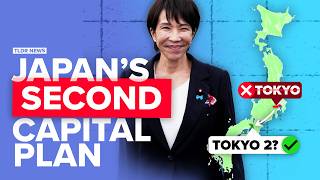
Japan needs a second capital city because Tokyo — home to nearly a third of the country's entire population and the seat of all major government and financial institutions — sits in one of the most seismically dangerous regions on Earth. If a catastrophic earthquake or tsunami struck Tokyo, the entire machinery of the Japanese state could grind to a halt. A designated backup capital would ensure that core government functions continue no matter what. It sounds simple enough. The politics, however, are a different story entirely.
How Over-Reliant Is Japan on Tokyo?
Tokyo is enormous. The city proper holds over 14 million people, but the greater Tokyo area — the wider urban sprawl — is home to somewhere in the mid-to-high 30 millions, making it one of the largest urban agglomerations on the planet. That level of concentration creates serious structural problems for the rest of Japan.
 01:45
Map showing the greater Tokyo area and its population concentration relative to the rest of Japan
Watch at 01:45 →
01:45
Map showing the greater Tokyo area and its population concentration relative to the rest of Japan
Watch at 01:45 →
Half of all listed Japanese companies are headquartered in Tokyo. The city drives a disproportionate share of national economic output. It is, without question, Japan's political, financial, and cultural center of gravity. And it keeps pulling people in — particularly young, working-age Japanese from smaller towns and rural prefectures — leaving those communities increasingly hollowed out.
Japan is already dealing with a severe demographic crisis driven by low birth rates and an aging population. The Tokyo magnet effect makes it worse. In 2025, only seven of Japan's 47 prefectures recorded any population growth at all — and four of those were in the greater Tokyo area. The depopulation of regional Japan is accelerating, bringing labor shortages, economic stagnation, and the slow disappearance of entire communities.
Decentralizing power and investment away from Tokyo isn't just about disaster preparedness. It's increasingly a matter of national survival for regions outside the capital.
03:10
Diagram of the Nankai Trough's location along Japan's Pacific coast and the tectonic plates involved
Watch at 03:10 →
What Is the Nankai Trough and How Dangerous Is It?
Japan sits at the intersection of four tectonic plates, which makes it one of the most seismically active countries in the world. The single biggest threat is the Nankai Trough — a highly active underwater trench running along Japan's Pacific coast that periodically produces massive, civilization-scale earthquakes.
Japan's earthquake research committee currently estimates the probability of a Nankai mega-quake occurring within the next 30 years at around 80%. That is not a remote risk. That is a near-certainty on a generational timescale.
The 2011 Tōhoku earthquake and tsunami — a magnitude 9.0 event — killed nearly 20,000 people and caused catastrophic damage across northeastern Japan. Japan is extraordinarily well-prepared for disasters by global standards, but no level of preparedness fully neutralizes a mega-quake. The concern is not just the human toll. It is what happens to the country's ability to govern itself when the capital is the epicenter.
What Does Japan's Second Capital Bill Actually Say?
The Japanese government has submitted a bill to parliament that would formally establish the principle of a second capital city. Crucially, it does not actually designate one. The legislation would enshrine the concept in law and leave the actual selection decision to the prime minister and cabinet.
05:30
Overview of the coalition agreement between the LDP and Ishin that produced the second capital proposal
Watch at 05:30 →
The goal is to get the bill passed before the current parliamentary session closes on July 17th. Under the proposal, the second capital would act as a functional backup — capable of carrying out core government and economic operations if Tokyo were incapacitated. Associated policy levers like economic incentives, infrastructure investment, and the transfer of certain government offices would then follow to build out the second capital's capacity.
The bill emerged from the coalition agreement struck in October 2025 between the ruling Liberal Democratic Party (LDP) and its junior coalition partner, the Japan Innovation Party, known as Ishin.
Why Is Osaka Pushing So Hard for the Second Capital?
The second capital idea comes directly from Ishin's policy platform, and Ishin has a very specific city in mind: Osaka. It is Ishin's home base and political stronghold, and the party has long championed Osaka's case for a more prominent role in Japan's national architecture.
But there is a deeper strategic layer here. One of Ishin's defining long-term goals — arguably its entire political identity — is to reorganize Osaka Prefecture into a single metropolis with a governing structure similar to Tokyo's. Despite controlling both Osaka Prefecture and Osaka City for over a decade, Ishin has twice failed to get this reorganization approved by local voters, with narrow defeats in referendums in 2015 and 2020.
Ishin wants a third referendum in 2027. And the party originally tried to use the second capital legislation to improve its odds. The initial Ishin demands included expanding the voter pool for the referendum to cover all of Osaka Prefecture and inserting a clause that would make only Tokyo-style metropolises eligible to be named second capital — meaning only Osaka, if the referendum passed, would qualify.
The LDP rejected these provisions. After considerable back-and-forth, Ishin's referendum-boosting demands were dropped from the bill. But Ishin is clearly betting that even without those provisions, the second capital designation — once created — will naturally land on Osaka.
Which Cities Are Competing to Be Japan's Second Capital?
With the designation left open by the bill, several cities have stepped forward to make their case:
- Osaka — Ishin's preferred choice and the most politically connected candidate given the coalition dynamics.
- Nagoya — A major industrial and manufacturing hub in central Japan, with its own case for national significance.
- Saitama — Located within the greater Tokyo area, which raises obvious questions about whether it would actually be safe in the event of a Tokyo-level disaster.
- Fukuoka — Perhaps the most compelling choice from a pure disaster-resilience standpoint. Located on Japan's western coast, Fukuoka is far from Tokyo, not on the Pacific coast facing the Nankai Trough, and sits in a significantly less seismically active zone. It is the candidate least likely to be hit by the same disaster that takes out the capital.
The tension between the politically convenient choice (Osaka) and the most geographically logical choice (Fukuoka) sits at the heart of the debate.
Will the Second Capital Bill Actually Pass?
The political path for this bill is genuinely difficult. Prime Minister Sanae Takichi's LDP holds a strong majority in the lower house of parliament following February's election. But the upper house is another matter — the LDP does not hold a majority there, which is exactly why the partnership with Ishin is so valuable. Ishin's support helps the coalition get closer to the numbers it needs.
That dependency puts Takichi in an uncomfortable position. She needs to keep Ishin satisfied enough to stay in the coalition, without making moves that alienate her own LDP members or push away other smaller opposition parties — like the DPP — whose support she may also need to secure an upper house majority.
Right now, opposition parties are deliberately slowing legislative progress in the upper house. Their grievances include concerns about Takichi's parliamentary management style, a scandal involving a defamatory campaign video, and proposed electoral reforms that have proved deeply contentious. With less than two weeks remaining in the parliamentary session, the window for passing the second capital bill is closing fast.
Whether Japan ends up with a second capital — and which city gets the designation — will depend as much on the LDP's ability to manage fractious coalition politics as it does on any rational assessment of geography or disaster risk. That is, unfortunately, how most important decisions get made.