
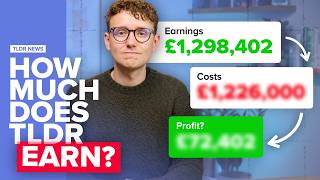
How much money does a YouTube news channel actually make? If you've ever wondered what's behind the curtain of an independent media operation, TLDDR's annual finance breakdown is one of the most transparent answers you'll find anywhere on the internet. In 2025-26, TLDDR earned a total of £1,298,442.70 in revenue and — after years of losses — finally posted a profit of £72,000. Here is exactly how they did it, line by line.
How Much Does a YouTube News Channel Actually Make?
TLDDR's total revenue for the 2025-26 financial year came in at just over £1.29 million, up 28% from the previous year. That might sound like a lot, but the story is more nuanced than a single headline number. The channel operates across three YouTube channels — TLDDR Global, TLDDR EU, and TLDDR UK — and has diversified far beyond ad revenue to get there. The biggest growth driver wasn't YouTube at all. It was a physical magazine.
 01:45
TLDDR revenue breakdown showing how product income now exceeds YouTube and sponsorship revenue combined
Watch at 01:45 →
01:45
TLDDR revenue breakdown showing how product income now exceeds YouTube and sponsorship revenue combined
Watch at 01:45 →
What's most striking about TLDDR's financial picture is how dramatically the revenue mix has shifted. YouTube advertising and sponsorships, which most people assume are the backbone of any creator business, now account for less than half of total income. Products — primarily their magazine Too Long — have taken over as the dominant revenue stream. That's a genuinely unusual position for a YouTube channel to find itself in.
How Much Does YouTube Pay Per View in 2025?
YouTube programmatic advertising — the skippable and unskippable ads that run before and during videos — generated £332,723.58 for TLDDR in 2025-26. That works out to approximately £0.002 per view, or roughly 0.2p, across a total of 157,440,071 views. To put that in plain terms: for every thousand views, TLDDR earned about £2.
That figure is actually down 10% from the previous year, when the channel earned around £376,000 from roughly 172 million views. The drop reflects a broader trend in YouTube ad revenue, which has become increasingly volatile as economic conditions shift. Breaking it down by channel, TLDDR Global brought in £138,000, TLDDR EU contributed £125,000, and TLDDR UK added £64,000.
03:20
YouTube ad revenue per channel: Global £138K, EU £125K, UK £64K
Watch at 03:20 →
In response to the decline, TLDDR is hiring four new team members specifically focused on improving YouTube output — including a new animator and a dedicated business journalist tasked with relaunching the TLDDR Business channel. The goal is straightforward: more videos, better videos, more views.
How Much Do YouTube Sponsorships Actually Pay?
Sponsored segments — the brand deals that appear at the end of TLDDR videos — brought in £212,782.40 in 2025-26, down 14% from the £246,000 earned the previous year. There are two reasons for this decline. First, the sponsorship market has tightened significantly, with economic uncertainty reducing brand spending and an increase in AI and gambling-related sponsors that TLDDR refuses to work with on principle.
Second — and more deliberately — TLDDR ran far fewer external sponsor segments this year. In 2024, virtually every video carried an external sponsor. By 2026, that dropped to just 23 weeks of the year. The rest of that promotional time was redirected toward promoting their own products, particularly Too Long. That's a calculated trade: lower short-term sponsorship income in exchange for building a more valuable, self-owned revenue stream.
TLDDR also maintains a strict manifesto around sponsorships, with a detailed list of companies they won't work with and processes designed to prevent sponsors from influencing editorial decisions. That limits how aggressively they can monetise through brand deals — but it's a trade-off they've made deliberately in service of journalistic integrity.
06:10
Too Long magazine subscriber growth — from roughly 4,500 to 8,300 subscribers year-over-year
Watch at 06:10 →
Can a YouTube Channel Make More Money From a Magazine Than Ads?
Yes — and TLDDR is the proof. Too Long, their physical print magazine, generated £515,410 in 2025-26, up an extraordinary 228% from the year before. That single product line now outearns both YouTube ad revenue and sponsorships — combined. For a channel that started as a YouTube news operation, that's a remarkable transformation.
The growth is driven by two factors: more issues published per year than previously, and a rapidly growing subscriber base. TLDDR currently has 8,300 magazine subscribers, nearly double the figure from the previous year. Subscribers receive a 20% discount on every issue, creating a reliable, recurring revenue foundation that gives the business far more financial predictability than ad revenue ever could.
Alongside the magazine, TLDDR also launched TLDDR Party, a membership tier offering access to documentaries, a behind-the-scenes podcast called The Bullpen, extended content, and audio versions of magazine articles. In the months since its proper launch, Party has generated approximately £63,793.50 when bundled revenue is factored in. Then there's Assembly Required, a coffee table book showcasing the world's most beautiful parliament buildings, which pulled in £113,996.88. Combined merchandise revenue added another £25,000+, bringing total product revenue to well over £700,000 — more than the entire revenue of the business just a few years ago.
09:45
Full cost breakdown slide showing staffing at £680K as the largest single expense
Watch at 09:45 →
What Does It Cost to Run an Independent Media Company?
Total costs for TLDDR in 2025-26 came to £1,226,000, up 11% from the prior year. Here's where that money went:
- Staffing: £513,000 in wages, plus £168,000 in employer taxes — a combined £680,000. TLDDR maintains strict employment policies requiring fair wages for everyone, with no interns or unpaid positions.
- Office space: £121,514 in rent, plus £26,988 in business rates — approximately £150,000 in total.
- Product costs: £326,670 spent on printing, shipping, packaging, warehousing, international taxes, and tariffs for the magazine and merchandise.
- General operating expenses: £64,260, covering accounting fees, insurance, office expenses, news subscriptions, travel, new tech hardware, documentary production, and software including Adobe, Slack, and Zendesk.
- Tax benefit: Because TLDDR made a loss the previous year, their corporation tax bill was minimal, and VAT reclaims from business expenses actually resulted in a net £30,725 back from HMRC — an unusual but welcome line item.
Staffing is by far the largest cost, which is almost inevitable for a company that produces journalism without AI assistance. TLDDR's explicit anti-AI content policy means every article, script, and piece of analysis is produced by a human — a principled stance that comes at a real financial cost.
Is TLDDR Finally Profitable?
Yes. After posting a small loss in 2024-25, TLDDR turned a profit of £72,421.40 in 2025-26. That's a meaningful milestone for a bootstrapped, independent media company that has never taken venture capital, outside investment, or wealthy donor money. The founder still owns 100% of the business.
Two caveats are worth noting. First, with a profitable year now on record, TLDDR will owe a larger corporation tax bill in the next accounting period, which will reduce net profit going forward. Second, the four newly hired team members will increase the staffing cost line substantially. Financial modelling suggests the new hires should generate enough additional revenue to cover their costs, but both factors will bear watching.
What Is the Too Long Magazine and Why Does It Matter?
Too Long is TLDDR's flagship print magazine, covering global politics and current affairs with the same editorial approach as the YouTube channel — independent, rigorous, and sponsor-influence-free. The latest issue covers Trump's military interventions across his second term, Britain's political instability following another change of prime minister, Russia's declining global influence, and whether the world is heading toward a new major conflict.
What makes the magazine significant from a business perspective is what it represents: a direct relationship with readers that doesn't depend on platform algorithms, ad markets, or third-party sponsors. Every subscriber who pays for Too Long is a direct, recurring vote of confidence in TLDDR's journalism — and those 8,300 subscribers are the primary reason the business is now profitable. Subscribers receive 20% off every issue, and new subscribers using the code money26 can get an additional discount, bringing the cost of a first copy as low as $4.99.
The broader lesson from TLDDR's 2025-26 finances is one that many independent creators are starting to learn: building your own products, your own subscriber base, and your own direct revenue channels is increasingly more resilient than depending on YouTube ad rates or the sponsorship market. It takes longer. It's harder. But when it works, it works in a way that algorithms and economic cycles can't easily undo.