
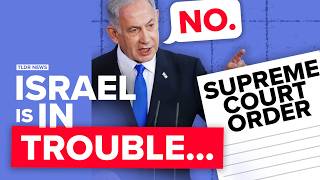
Israel is in a constitutional crisis. Last Sunday, Benjamin Netanyahu's government did something no Israeli government has ever done before: it formally announced that it would reject and disobey a ruling by Israel's Supreme Court. The cabinet voted unanimously to defy the country's highest court, openly declaring it would not recognize any decision made under the court's current order. What triggered it — a dispute over a media regulator — might sound mundane, but it sits at the heart of a long-running war between Netanyahu and the Israeli judiciary, and it threatens to reignite the deep, simmering tensions tearing apart one of the world's most politically polarized democracies.
What Is Israel's Constitutional Crisis in 2026?
The constitutional crisis emerged from a standoff between Netanyahu's government and Israel's Supreme Court over the composition and authority of a media regulatory body called the Second Authority for Television and Radio. In mid-June, the Supreme Court ruled that this regulatory council could continue to operate even without meeting the legally required quorum — an exceptional intervention given the extraordinary circumstances. Netanyahu's government rejected this ruling outright, calling it an overreach and accusing the court of being, in the words of Communications Minister Shlomo Kahi and Justice Minister Yariv Levin, "drunk with power."
 01:45
The Israeli Supreme Court building — the institution whose ruling Netanyahu's government has now openly rejected for the first time in Israeli history
Watch at 01:45 →
01:45
The Israeli Supreme Court building — the institution whose ruling Netanyahu's government has now openly rejected for the first time in Israeli history
Watch at 01:45 →
According to the Times of Israel, this is the first time in Israeli history that a sitting government has openly declared it will not respect a ruling from the nation's highest court. The statement, endorsed unanimously by the cabinet, said the government would not recognize any decision, approval, appointment, or action taken by the Second Authority Council while it remained in its current state. The immediate practical impact on the regulator may be limited — but the symbolic and constitutional implications are enormous.
What Is the Channel 13 Media Dispute About?
To understand why this crisis erupted, you need to follow the money — and the media. At the center of the story is Channel 13, an influential but loss-making commercial broadcaster known for running critical investigative journalism about Prime Minister Netanyahu. Channel 13 has been the subject of competing acquisition bids in 2026.
One bidder was Patrick Drahi, a French-Israeli telecom billionaire who owns the Netanyahu-aligned i24 News network. Critics, including the Union of Journalists in Israel, warned that a Drahi takeover would erode press freedom and fit into what they called the government's "master plan to capture the media." However, Drahi's bid was ultimately edged out by a rival consortium led by Assaf Rapaport, an Israeli tech billionaire and outspoken critic of Netanyahu's judicial reform agenda.
03:20
Channel 13's newsroom — the broadcaster at the center of the media ownership dispute that triggered the constitutional standoff
Watch at 03:20 →
The sale to Rapaport required approval from the Second Authority — Israel's broadcast regulator. Here's where it gets messy. The regulatory council's term expired at the end of 2025. Netanyahu's government tried to appoint new members, but several appointments faced legal challenges over conflicts of interest, leading the Supreme Court to order the previous council to remain in place pending its ruling. Then, several council members reportedly resigned under pressure from Communications Minister Kahi — a move that appeared designed to push the council below its legally required quorum of two-thirds, effectively paralyzing it and blocking the Channel 13 sale. The Supreme Court stepped in again and ruled the council could still function. That ruling is the one Netanyahu's government just refused to obey.
Why Did Netanyahu Defy the Israeli Supreme Court?
On the surface, Netanyahu's government claims the Supreme Court's ruling contradicts the law — that allowing a regulatory body to function below quorum is legally incoherent. But few serious observers believe this dispute is really about administrative law. The deeper reasons are political, personal, and structural.
Netanyahu has been fighting an ongoing corruption trial — allegations he vigorously denies — and his relationship with the judiciary has been openly hostile for years. His government has long accused the Israeli Supreme Court of having a liberal bias, being undemocratic, and interfering excessively in executive decision-making. From Netanyahu's perspective, an independent broadcaster under the control of a prominent critic (Rapaport) and approved by a court-backed regulator is a direct political threat — especially with elections approaching in October 2026.
What Are Israel's Judicial Reforms and Why Do They Matter?
Netanyahu's tension with the courts didn't start with Channel 13. After returning to power following the 2022 election at the helm of the furthest-right government in Israeli history, Netanyahu pushed a sweeping package of judicial reforms designed to weaken the Supreme Court's power and independence. The proposals would have curtailed the court's ability to strike down legislation and overhauled the process of appointing judges.
06:10
Mass protests against Netanyahu's judicial reforms in 2023 — the same battle now reigniting ahead of the 2026 elections
Watch at 06:10 →
The reforms triggered some of the largest mass protests in Israeli history through 2023, with hundreds of thousands taking to the streets week after week. The judicial overhaul was largely shelved following the October 7, 2023 Hamas attack and the outbreak of the war in Gaza, as the country pivoted to a wartime footing. But in recent months, the government has sought to revive elements of the overhaul — and the latest move to defy the Supreme Court fits neatly into that broader agenda.
How Long Has Netanyahu Feuded With Israel's Judiciary?
Netanyahu's feud with Israel's courts is not new — it is years in the making and deeply personal. His corruption trial, which has dragged on across multiple governments, has created an obvious incentive to weaken the judicial institutions that hold power over his fate. Critics have long argued that the judicial reform push was not about democratic principle but about Netanyahu's personal legal exposure and his government's desire to cement political control over independent institutions.
The government's defiance of the Supreme Court is the latest and most dramatic escalation in this feud, but it comes with a clock ticking. Israel is heading toward an election in October 2026, and Netanyahu's coalition faces a make-or-break moment. For his opponents, the timing is not coincidental.
Could Netanyahu Refuse to Accept Israel's Election Results?
That's the fear being voiced openly by some of Netanyahu's opponents. Yair Golan, leader of the center-left Democrats party, went as far as to say that the decision to ignore the Supreme Court ruling is "the operational order ahead of election day" — an accusation that Netanyahu's coalition is laying the groundwork to refuse to accept election results it doesn't like.
Opposition leader Yair Lapid called the government "criminal," while former Prime Minister Naftali Bennett warned that disobeying a court ruling "leads to anarchy in the streets and the dismantling of our state." Israeli President Isaac Herzog added his voice, saying non-compliance with a court ruling is "a red line that must not be crossed under any circumstances." Whether Netanyahu's move is a calculated normalization strategy or a short-term political gambit remains to be seen — but the alarm among Israel's democratic establishment is unmistakable.
How Divided Is Israel From the Inside?
For international observers, the past two years of Israeli news have been dominated by the country's wars — Gaza, the West Bank, Lebanon, Syria, Iran. But Israel's internal divisions are just as consequential a story, and the data makes that clear.
- A May 2026 Israeli Democracy Institute poll found that only 40% of Israelis were optimistic about the future of democratic rule in their country.
- An even smaller 21% were optimistic about social cohesion.
- A Jewish People Policy Institute poll found that 55% of Israeli Jews see polarization and internal conflict as the greatest threat to Israel's continued existence — more so than an Iranian nuclear bomb or the Palestinian conflict.
Israel is fracturing along multiple fault lines simultaneously: the approach to bringing home the October 7 hostages, military service exemptions for ultra-Orthodox Jewish Israelis, the judicial reforms, media freedom, and now the government's open defiance of its own Supreme Court. The constitutional crisis over a media regulator may look like a niche legal dispute — but it is really a window into something much larger: a democracy under serious internal stress, heading toward an election that may prove to be one of the most consequential in its history.