Why Does Labradorite Change Color?
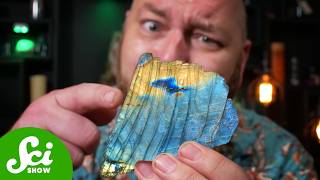
Labradorite changes color because of a phenomenon called labradorescence — and surprisingly, there is no blue or green pigment in the stone at all. The color you see is entirely structural, produced by light bouncing between ultra-thin alternating layers of two different minerals inside the crystal. These layers, called exsolution lamellae, are only a few hundred nanometers thick — thousands of times thinner than a human hair. When light enters the translucent stone, it refracts and reflects off the boundaries between these layers, causing certain wavelengths to reinforce each other while others cancel out. The result is that electric flash of blue, green, or gold that seems to glow from just beneath the surface.
It's the same physics that gives a DVD its rainbow shimmer or a blue morpho butterfly its iridescent wings. But in labradorite, it took hundreds of millions of years and an entire supercontinent to set the stage for it to happen.
 0:42
Close-up of labradorite showing the electric blue flash of labradorescence against a gray stone background
Watch at 0:42 →
0:42
Close-up of labradorite showing the electric blue flash of labradorescence against a gray stone background
Watch at 0:42 →
What Is Labradorescence and How Does It Work?
Labradorescence is the term for the specific optical effect seen in labradorite, and it belongs to a broader category called structural color. Unlike the color in paint or dye, which comes from pigment molecules absorbing certain wavelengths of light, structural color is produced purely by physical structure — in this case, microscopic layers of material with slightly different optical properties.
Inside a labradorite crystal, alternating layers of two types of feldspar — calcium-rich anorthite and sodium-rich albite — sit stacked on top of each other. Each has a slightly different refractive index, meaning they bend light by slightly different amounts. As light passes through these layers, it reflects off each boundary and interferes with itself. Some wavelengths of light constructively interfere, amplifying a specific color, while others destructively interfere and effectively disappear.
To produce the characteristic electric blue flash that labradorite is famous for, these albite-anorthite layers need to be between 128 and 252 nanometers thick. Because the layer thickness may vary across a single stone, the color display is never quite the same twice — every piece of labradorite has its own unique frozen fire.
2:15
Animation or map showing the supercontinent Gondwana and the location of present-day Madagascar within it
Watch at 2:15 →
What Was Gondwana and Why Does It Matter?
Before we can understand how labradorite forms, we need to travel back more than 600 million years to a world almost unrecognizable from our own. Long before the more famous supercontinent Pangea, there was Gondwana — a colossal landmass that contained the precursors to modern Africa, India, Australia, Antarctica, and South America all crushed together into one enormous continent.
Gondwana covered up to a fifth of Earth's surface, and it was not just large in area — it was thick. Continental crust averaging around 40 kilometers deep, with mountain roots plunging as far as 75 kilometers in places where ancient landmasses had collided. This immense thickness was crucial. It created an impenetrable lid over the mantle below.
When heat from the mantle tried to escape upward through plumes of hot material, it couldn't punch through all that crust to form volcanoes. Instead, the magma got trapped in underground chambers called plutons, buried tens of kilometers deep. And being trapped, it just sat there. For millions of years. Slowly cooking. And that's exactly what labradorite needed.
How Is Labradorite Formed Inside the Earth?
Labradorite's formation story begins in what is now Madagascar, at the time a sliver of land sandwiched between Africa and India in the heart of Gondwana. Supercontinent plutons — those sealed magma chambers deep in the crust — created the ideal conditions for a very special kind of rock called anorthosite, made almost entirely of feldspar minerals.
4:30
Diagram illustrating exsolution lamellae — alternating albite and anorthite layers and how light reflects between them
Watch at 4:30 →
The chemistry of those Madagascan plutons happened to fall in just the right range: between 50% and 70% calcium-rich anorthite, with the remainder being sodium-rich albite. That specific composition is the definition of labradorite. But having the right chemistry is only the beginning. Raw labradorite is a dull, unremarkable gray. The frozen fire comes from a second process that requires something even rarer: time and sustained heat.
What Is Fractional Crystallization?
As the magma in those ancient plutons began to slowly cool, a sorting process called fractional crystallization took hold. Different minerals have different melting points, so as the temperature dropped, minerals crystallized out of the melt one by one in a specific order.
Dense, dark, iron-rich minerals like olivine and pyroxene formed first and sank to the bottom of the magma chamber. Lighter minerals like quartz and feldspar were less dense and floated toward the top. Over millions of years, this produced surprisingly pure and well-sorted layers of mineral — including concentrated masses of feldspar with just the right labradorite composition sitting in the upper portions of the pluton.
The key word here is slowly. In most geological settings, magma cools quickly and minerals are locked in place as soon as they crystallize. But inside a supercontinent, the surrounding rock insulates the pluton so well that temperatures stay elevated for an extraordinarily long time — long enough for something remarkable to happen even after the feldspar has solidified.
What Are Exsolution Lamellae in Minerals?
Here is where things get genuinely extraordinary. At high temperatures, calcium-rich anorthite and sodium-rich albite are perfectly happy coexisting in a single mixed crystal. But at lower temperatures — the kind you find near Earth's surface — they would much rather separate into their own pure forms.
Normally, once a mineral has crystallized, that mixture is locked in. But inside the deep, slow-cooling plutons of Gondwana, temperatures dropped gradually enough that individual calcium and sodium ions could still migrate through the solid crystal, rearranging themselves into alternating pure layers. These layers — the exsolution lamellae — are just a few hundred nanometers thick, because atoms moving through solid rock can only travel so far.
This separation only happens within a very specific compositional window: the feldspar must contain between 50% and 70% anorthite. Too much calcium or too little, and the lamellae don't form the right way. The temperatures must also stay elevated for long enough to allow the migration to complete. Supercontinent plutons are one of the very few environments on Earth that reliably check all these boxes — which is why labradorite with true labradorescence is not found just anywhere.
Where Is Labradorite Found in the World?
Despite the extraordinary conditions required to create it, labradorite is not as rare as you might expect. The geological processes that produce it, while slow and precise, have repeated themselves enough times across Earth's history to create significant deposits in several locations.
- Labrador, Canada — where the stone gets its name, first formally identified here
- Madagascar — the ancient origin point tied to the Gondwana supercontinent
- Finland — where a variety called spectrolite, known for particularly vivid colors, is found
- Australia, Mexico, and Russia — smaller but notable deposits
Today, labradorite is mined and cut into large decorative slabs, sculptures, and polished specimens. The stone has become popular in interior design, jewelry, and among mineral collectors precisely because no two pieces ever look the same — a direct consequence of the fact that the nanometer-scale lamellae vary from crystal to crystal and even within a single stone.
The Biggest and Smallest Forces in Nature, Working Together
What makes labradorite genuinely astonishing is the sheer scale of contrast involved in its creation. It took a supercontinent covering a fifth of the Earth's surface, millions of years of geological patience, temperatures exceeding a thousand degrees, and the slow migration of individual atoms across distances measured in nanometers — all working together in a very specific sequence — to produce a flash of blue light that fits in the palm of your hand.
The Inuit legend of frozen fire turns out to be a surprisingly accurate metaphor. The colors are locked inside the stone, the product of invisible structure rather than visible pigment. Smash the rock, and you'll scatter that structure. The fire goes out. But left intact, labradorite carries a record of some of the most dramatic events in Earth's deep geological past — written in light, one nanometer at a time.