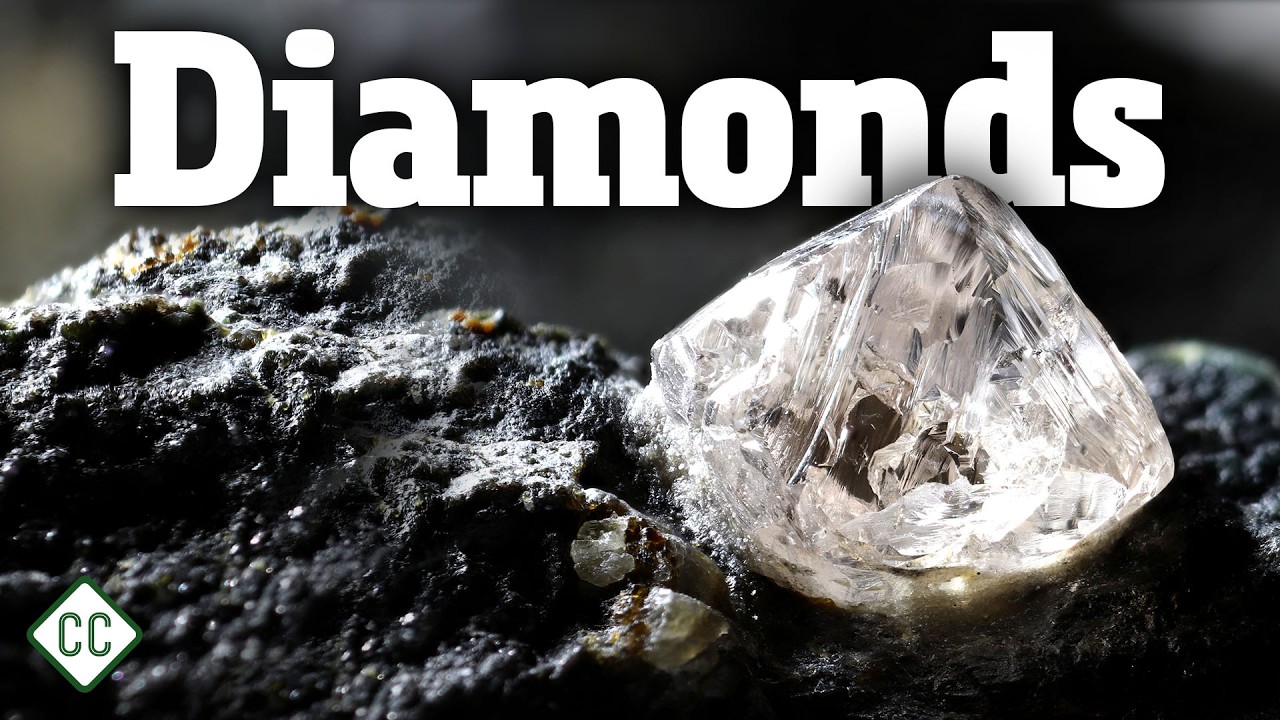

So how do diamonds form in the earth? The short answer: deep, slow, and violently. Diamonds crystallize in the upper mantle, roughly 150 kilometers or more below the surface, under extreme heat and pressure that locks carbon atoms into an incredibly dense crystal structure. Then, ancient volcanic eruptions blast them toward the surface inside a special rock called kimberlite. The whole process can take up to 3 billion years — and it has absolutely nothing to do with coal.
 0:30
The Hope Diamond on display at the Smithsonian Museum of Natural History — 45.52 carats of deep-Earth history
Watch at 0:30 →
0:30
The Hope Diamond on display at the Smithsonian Museum of Natural History — 45.52 carats of deep-Earth history
Watch at 0:30 →
Are Diamonds Really Made from Coal?
Let's kill this myth right away. You've almost certainly heard the motivational metaphor: a diamond is just a lump of coal that handled pressure well. It's a great poster quote. It's a terrible geology lesson.
Yes, coal is made of carbon. And yes, so are diamonds. But the similarity ends there. Coal forms from compressed organic matter — dead plants and animals — near the earth's surface. Diamonds form far deeper, in conditions coal never gets close to. The pressure and temperature required to create a diamond's signature crystal structure simply don't exist where coal is found. So the next time someone uses that metaphor, you have full geological permission to correct them.
How Do Diamonds Actually Form in the Earth?
Diamonds form in cratons — the ancient, super-stable roots of continents that extend deep into the earth. These regions are hot enough and pressurized enough to rearrange carbon atoms into the extraordinarily tight crystal lattice that makes diamonds the hardest naturally occurring substance on the planet.
3:10
Diagram showing how kimberlite eruptions blast diamond-bearing rock to the surface through carrot-shaped pipes
Watch at 3:10 →
Most diamonds form in the upper mantle, the layer just below Earth's outer crust. But some — including the legendary Hope Diamond — form even deeper, in the transition zone and lower mantle, more than 600 kilometers below the surface. Those super-deep diamonds may hitch a ride on plumes of extra-hot rock rising from the lower mantle before they can be carried any further toward the surface.
Here's the wild part: most diamonds started forming up to 3 billion years ago. The volcanic eruptions that eventually brought them to the surface? Those happened between 250 and 50 million years ago. So by the time a diamond gets mined and set into a ring, it has been sitting underground longer than dinosaurs have existed. That's not a gemstone — that's a time capsule.
What Is Kimberlite and How Does It Carry Diamonds Up?
For centuries, humans could only find diamonds by sifting through riverbeds — a process called alluvial mining. No one knew what kind of rock they originally came from. That changed in 1870, when miners in Kimberley, South Africa found diamonds not in a riverbed, but directly in the ground, embedded in a volcanic rock that had never been studied before.
5:45
The Big Hole mine in Kimberley, South Africa — visible from space and the site of the original kimberlite diamond discovery
Watch at 5:45 →
That rock was named kimberlite, after the town. And it turned out to be the delivery vehicle for nearly every diamond ever mined.
Here's how it works: when continents break apart, they disturb the mantle below. Over millions of years, carbon dioxide and water trapped in deep pockets of magma build up enormous pressure. Eventually, that pressure releases in a massive kimberlite eruption — molten rock shooting upward at high speed, carving out carrot-shaped pipes through the earth's subsurface. As the magma rises, it rips up chunks of deep mantle rock. If you're lucky, some of those chunks are studded with diamonds.
The last known kimberlite eruption happened 13 million years ago. Whether another will ever occur is unknown. For now, we're mining the diamonds that ancient eruptions already delivered.
What Makes the Hope Diamond So Famous — and Cursed?
On display at the Smithsonian Museum of Natural History, the Hope Diamond is one of the most visited objects in the world. It weighs a staggering 45.52 carats and is valued at up to $350 million. Its deep blue color comes from trace amounts of boron mixed into the carbon structure during formation.
The Hope Diamond is also a super-deep diamond, formed more than 600 kilometers below Earth's surface — which is part of what makes it scientifically extraordinary. It offers clues about conditions in parts of the earth that humans have never directly observed.
As for the curse? Previous owners have allegedly suffered wild dog attacks, beheadings, and gangrene. Louis XIV of France owned it by 1668 and later died of gangrene, for what it's worth. Geologically speaking, though, the diamond is just a remarkable specimen. Probably.
Are Diamonds Actually Rare — or Is That a Myth?
Here's something the jewelry industry would rather you not know: diamonds are not particularly rare. They are more commonly found than many other precious gemstones. The idea that diamonds are scarce is largely a marketing construction — and one corporation is almost entirely responsible for it.
When massive diamond deposits were discovered in South Africa in the 1870s, it suddenly became possible to find diamonds in enormous quantities. A British financier named Cecil Rhodes seized the moment, buying up shares in diamond mines until he controlled enough of them to form the De Beers Mining Company. By 1887, De Beers owned every diamond mine in South Africa. For the next seven decades, it controlled the majority of diamond mines worldwide.
De Beers deliberately restricted the supply of diamonds entering the market to maintain the illusion of scarcity — and kept prices artificially high. By the 2000s, De Beers finally lost its monopoly. But the myth that diamonds are rare? That's proven much harder to mine out of public consciousness.
Are Lab-Grown Diamonds Real or Fake?
This might be the most important myth to bust for anyone currently shopping for jewelry: lab-grown diamonds are real diamonds. Full stop.
In the 1940s, scientists at General Electric launched a project called — brilliantly — Project Superpressure. The goal was to replicate the conditions of the earth's mantle in a laboratory. They took graphite (another carbon-based material) and subjected it to extreme heat and pressure. Within weeks, they had created a genuine diamond.
Modern lab-grown diamond production uses tiny fragments of natural diamonds as seeds, then grows new diamonds around them in a controlled environment. The result is chemically, physically, and optically identical to a diamond pulled from the ground. A geologist cannot tell them apart without specialized equipment — because they are the same thing, just with a different origin story.
The practical advantages are significant:
- Cost: Lab-grown diamonds can cost up to 85% less than mined diamonds of equivalent quality.
- Environment: Diamond mines cause serious environmental damage. The Big Hole mine in Kimberley is so large it can be seen from space, and mining contributes to erosion and water pollution.
- Ethics: Natural diamond mining raises serious human rights concerns, particularly in regions with less social stability.
What Are Blood Diamonds and Why Do They Still Exist?
Blood diamonds — also called conflict diamonds — are natural diamonds mined in war zones and sold to finance armed conflict. They are most prevalent in parts of central and west Africa, where regional instability cuts communities off from social and resource networks. Small-scale mining operations in these areas have been documented using forced labor and child labor, with profits directly funding violent conflicts.
International organizations have worked to reduce blood diamonds in the global supply chain, most notably through the Kimberley Process Certification Scheme. However, critics argue the process has significant gaps and that conflict diamonds still enter the market.
It's worth noting that the picture is complicated. Proponents of natural diamond mining argue it can provide economic opportunity in some of the world's poorest regions, and that some forms of diamond mining are less environmentally harmful than other extractive industries. These are genuinely complex cultural, political, and economic questions without simple answers.
But geologically? A lab-grown diamond and a naturally mined diamond are one and the same — just formed on very different timelines, and with very different consequences.
Why Diamonds Are More Than Just Pretty Rocks
Beyond their cultural and commercial value, diamonds are extraordinary scientific tools. Minerals and fluids trapped as inclusions inside diamonds during their formation preserve a record of what the deep mantle looked like billions of years ago. Researchers like Dr. Kate Kiseeva have used garnet inclusions in diamonds to study the composition of the deep mantle in ways that would otherwise be impossible.
In other words, every diamond is a sealed message from deep inside the earth, written in carbon and delivered by volcanic explosion over the course of billions of years. Whether you find that romantic, terrifying, or both — that's geology doing what it does best.