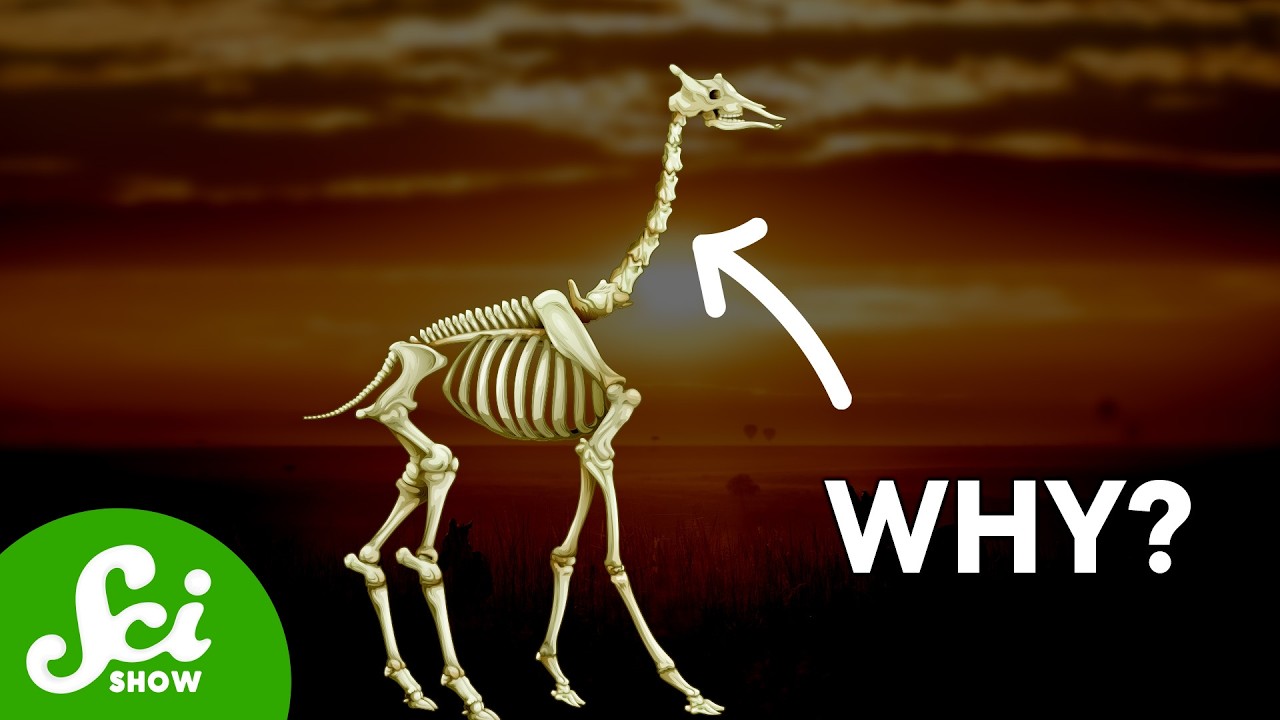

Humans and giraffes have the same number of neck bones — exactly seven. That fun fact has been floating around the internet for years, and it checks out. But the reason why is far weirder than you might expect. It involves millions of years of evolutionary pressure, a surprisingly strong link to childhood cancer, and the way your diaphragm developed before you were born. Buckle up, because your spine has a story to tell.
How Many Neck Bones Do Humans Have — And What Are They?
Before diving into the evolutionary mystery, it helps to know a little spinal anatomy. Humans have four types of vertebrae: cervical (neck), thoracic (upper-to-mid back), lumbar (lower back), and sacral (fused together in your pelvis). The breakdown looks like this:
 00:42
Diagram of the four types of human vertebrae: cervical, thoracic, lumbar, and sacral
Watch at 00:42 →
00:42
Diagram of the four types of human vertebrae: cervical, thoracic, lumbar, and sacral
Watch at 00:42 →
- 7 cervical vertebrae — your neck
- 12 thoracic vertebrae — your upper and mid back
- 5 lumbar vertebrae — your lower back
- 5 sacral vertebrae — fused into a wedge in your pelvis
There's also the coccyx — your vestigial tailbone — but that's a conversation for another day. The key number here is that seven for the cervical column. And here's the wild part: virtually every mammal on Earth shares that exact number, whether it's a mouse, a whale, or a giraffe with a neck six feet long.
Why Do Almost All Mammals Have Exactly 7 Cervical Vertebrae?
Most vertebrate groups are remarkably flexible with their vertebral counts. Snakes can have anywhere from 136 to more than 290 vertebrae. Some salamander populations actually change their vertebral count based on the temperature their eggs were exposed to during development — yes, really. Birds, reptiles, and amphibians all mix it up without much trouble.
Mammals, on the other hand, are locked in. Almost every mammal species has between 26 and 27 vertebrae total — seven of which are always cervical. There are only three known exceptions out of thousands of mammal species: manatees (usually six cervical vertebrae), two-toed sloths (as few as five), and three-toed sloths (as many as ten). That's it. Three exceptions, across millions of years of mammal evolution. For context, powered flight evolved independently three separate times in vertebrates, and that feels significantly more complicated than growing an extra neck bone.
03:15
Comparison of vertebral counts across vertebrate groups — snakes vs. mammals
Watch at 03:15 →
So why is the mammal cervical count basically frozen? There are two major hypotheses, and both of them are genuinely surprising.
What Is a Cervical Rib and Why Is It Linked to Cancer?
In 1999, a researcher named Frietson Galis published a landmark paper exploring this exact question. Her approach was clever: instead of looking at fossil records or evolutionary trees, she looked for modern humans who had a mutation in the genes responsible for forming cervical vertebrae. The telltale sign of that mutation is a cervical rib — a small, rib-like bone growing off the seventh cervical vertebra, where ribs don't normally belong.
What she found was striking. Cervical ribs are extremely rare in the general adult population — one large study of over 4 million X-rays found only 0.2% of adults had them. But in fetuses and stillborn infants, the rate was around 30% in those with no other visible abnormalities, and over 60% in those with multiple major abnormalities.
Even more alarming: children with certain cancers were significantly more likely to have cervical ribs. One study of 1,000 children with tumors found that 21.8% had at least one rib abnormality, compared to just 5.5% of children without tumors. For neuroblastoma specifically, the rate climbed to 33%. Leukemia and brain tumors hovered around 27%.
05:48
Chart showing cervical rib rates in children with and without tumors
Watch at 05:48 →
The interpretation? Mutations that alter the number of cervical vertebrae are strongly associated with developmental disruptions that are often fatal — either through cancer, miscarriage, or stillbirth. That means individuals with these mutations rarely survive long enough to pass them on. Natural selection, it turns out, is brutally efficient at weeding out cervical vertebrae changes in mammals.
Cervical ribs also carry a non-cancer risk: thoracic outlet syndrome, a degenerative condition where nerves in the neck and shoulder are compressed, severely limiting arm function. So even in the absence of cancer, an extra neck bone can make life very difficult.
What Are Hox Genes and Why Do They Control Your Spine?
To change how many vertebrae you have — or what type they are — you need to make changes in your Hox genes. These are a group of master regulatory genes that essentially serve as the blueprint for early embryonic development. They tell an undifferentiated cluster of cells how to organize itself into a body, including how many segments to make and what kind each one should be.
In most vertebrate groups, tweaking Hox gene expression is relatively consequence-free. But in mammals, those same Hox genes also govern a huge number of other critical developmental processes that happen simultaneously. Changing the gene expression for cervical vertebrae seems to throw a wrench into those other processes — including ones tied to cancer suppression and basic organ development. That's the core of Galis's hypothesis: the cancer penalty for messing with cervical Hox gene expression is so severe in mammals that the mutation almost never survives long enough to become a permanent feature of a species.
08:22
Demonstration of diaphragm movement during deep breathing and its connection to the lower ribcage
Watch at 08:22 →
Why Can't Mammals Just Evolve More Neck Bones?
The second major hypothesis ties back to a muscle you use every second of your life: the diaphragm. When your diaphragm contracts, your lungs inflate. When it relaxes, they deflate. It's the engine of every breath you take.
Here's the developmental twist: in early fetal development, the cells that become the diaphragm originate at the cervical spine before migrating down to their final position. The nerve that makes the diaphragm work — the phrenic nerve — also exits from the cervical spine. So your neck and your breathing are developmentally entangled in a very deep way.
There's also a mechanical reason the diaphragm's position matters. Try this: put your hands on the bottom of your ribcage and take a deep breath. You'll feel those ribs expand outward. That's because your diaphragm is attached to the lower, moveable ribs — and that attachment is what allows your lungs to fully inflate. If the diaphragm sat higher up, attached to immovable ribs, breathing deeply would be much harder.
For most mammals, the diaphragm sits right at the border between moveable and immovable ribs. Mess with the cervical vertebrae, and you risk shifting that boundary — potentially impairing breathing. Notably, the two mammal groups that do have unusual cervical counts (two-toed sloths and manatees) also have atypical diaphragm positioning. They apparently made it work, but they're the rare exceptions.
Non-mammal vertebrates don't have this problem because they don't have diaphragms. Birds use air sacs, other reptiles manually expand their ribs with muscles, and amphibians breathe through an entirely different mechanism. Without a diaphragm to protect, there's no developmental cost to reshuffling the vertebral deck.
Which Animals Break the 7 Neck Bone Rule?
To recap the handful of rebels in the mammal world:
- Manatees — usually six cervical vertebrae; they're essentially giant, neckless blobs, so they may have simply had less need for a distinct neck region. Their close relatives, dugongs, achieve a similarly short neck by having extremely flattened, pancake-like vertebrae instead.
- Two-toed sloths — as few as five cervical vertebrae
- Three-toed sloths — as many as ten, which is remarkable
Sloths and manatees also have notably lower metabolic rates than most mammals. One theory is that slower metabolism produces fewer free radicals — the byproduct of cellular energy use that can cause DNA damage and lead to cancer. If your metabolism is sluggish enough, the cancer risk associated with Hox gene changes might be reduced enough that the mutation can survive. It's speculative, but it fits the pattern.
Why Do Humans and Giraffes Have the Same Number of Neck Bones? The Bottom Line
The answer to why humans and giraffes share the same number of neck bones — seven — comes down to a combination of developmental biology, evolutionary penalty, and deep genetic constraints that are uniquely intense in mammals. Changing cervical vertebrae in a mammal means risking cancer, miscarriage, breathing problems, and a cascade of other developmental failures. So while evolution is perfectly happy to give a snake 290 vertebrae or let a salamander adjust its spinal count based on egg temperature, it has been remarkably reluctant to touch the mammalian neck.
Giraffes could theoretically benefit from a few extra neck bones to support that enormous neck. Camels and llamas might too. But the developmental cost of making that change appears to be too high for natural selection to ever let it stick — at least in the last few hundred million years. So for now, the giraffe and you are neck and neck. Literally.