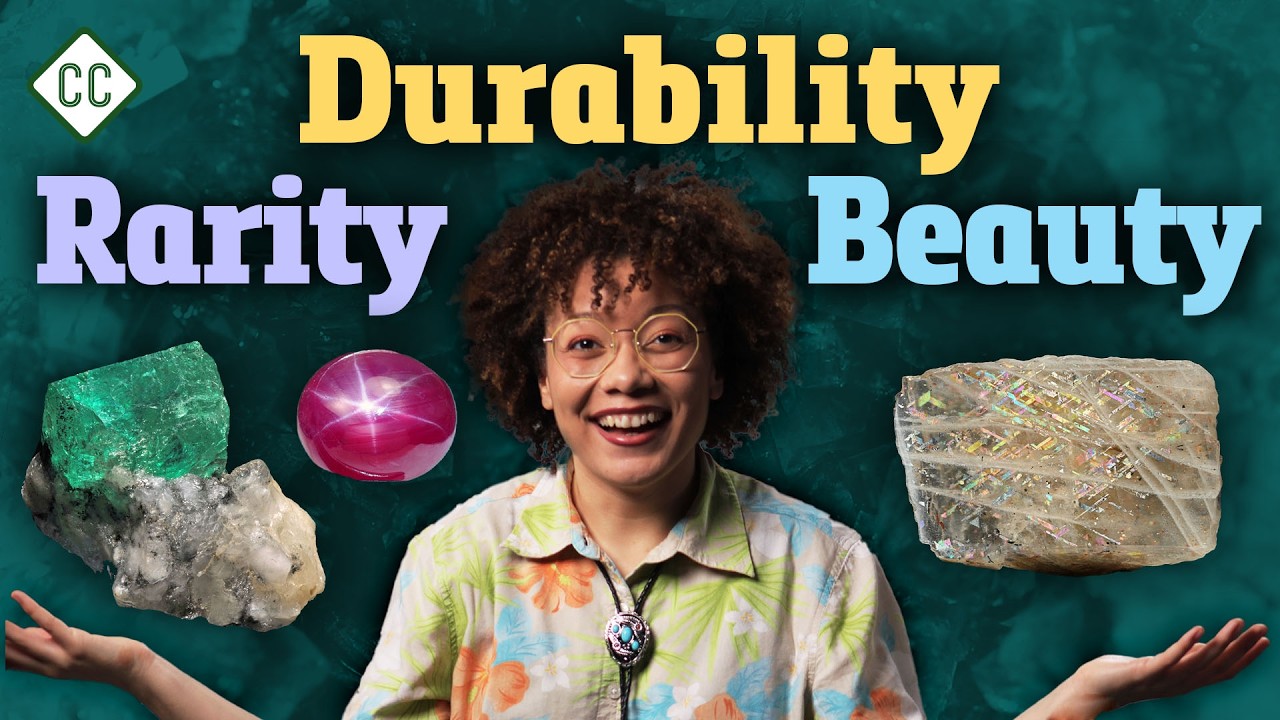

How do gemstones form? The short answer: in a surprising number of ways — from slowly cooling magma deep underground, to superheated water circulating through rock cracks, to, in at least one jaw-dropping case, a meteorite slamming into desert sand. Gems are minerals (or sometimes organic materials) prized for three core qualities: hardness, rarity, and beauty. But the story of how they get that way is anything but ordinary.
How Do Gemstones Form in Nature?
Most gemstones are minerals — inorganic materials made of atoms arranged in an orderly, repeating crystalline structure. When that crystal is also durable, rare, and beautiful, we call it a gem. But the conditions that create them vary wildly.
Many beloved gems — like emerald, aquamarine, and topaz — form as molten rock cools very slowly deep underground. The slower the cooling, the larger and more perfect the crystals can grow. Other gems form through a process that looks a lot like making rock candy: hot, mineral-rich water circulates through deep cracks in Earth's crust. As it cools, minerals like quartz and fluorite begin to crystallize out of the solution.
When those crystals form inside underground cavities, you get a geode — a rough, unremarkable-looking rock on the outside, lined with sparkling crystals on the inside. Over millions of years, the rock layers above erode away, and the geode reaches the surface, waiting for someone to crack it open.
And then there are the outliers. Fulgurite forms when lightning strikes sand, fusing it instantly into a glassy tube. And at least one famous gem may have formed when a meteorite exploded above — or slammed into — the Sahara Desert.
No matter how they form, all gems need the same basic ingredients: the right temperature, pressure, time, space, and chemical elements. Common elements like silicon, carbon, and oxygen are the backbone of most gems. But tiny traces of other elements — impurities, technically — are often what give gems their color.
What Gemstone Was Found in King Tut's Tomb?
When archaeologists opened the tomb of the Egyptian pharaoh Tutankhamun (King Tut) in 1922, they found an ornate breastplate among his treasures. At its center was a striking yellow-green gemstone carved in the shape of the scarab beetle god Ra. For decades, geologists couldn't definitively identify it or explain how it formed.
The answer, it turns out, is literally out of this world.
What Is Libyan Desert Glass — and Did a Meteorite Make It?
About a decade after King Tut's tomb was discovered, British surveyor Patrick Clayton found a collection of similar yellow-green stones scattered across a remote part of the Sahara called the Great Sand Sea, near the Egypt-Libya border. He assumed it was a quirky type of quartz. It became known as Libyan desert glass.
For years, geologists offered all kinds of theories: lightning strikes, lunar volcanoes, ancient atmospheric events. As technology improved, researchers started finding real answers — and they were extraordinary.
- The glass is approximately 28 million years old.
- Evidence points to extreme heat and pressure — far beyond anything ordinary Earth geology could produce.
- Minerals within the glass, like dark streaks of cristobalite, couldn't have formed through normal earthly processes.
- Chemical analysis revealed traces of iron not native to our planet.
The leading theory? A meteorite either struck the desert sand or exploded in a low-altitude airburst above it, generating enough heat to melt the sand and re-crystallize it into glass — along with those mysterious dark streaks of extraterrestrial material mixed in.
In other words, the gem at the center of a pharaoh's breastplate was likely forged by Earth's encounter with a space rock. Some mysteries remain — scientists still debate whether it was a direct impact or an atmospheric explosion — but one thing is clear: Libyan desert glass is unlike almost anything else on the planet.
What Actually Makes a Gemstone Valuable?
Beyond the obvious sparkle, gemologists — scientists who study gems — evaluate stones on several specific properties:
- Hardness: Resistance to scratching, measured on the Mohs hardness scale.
- Toughness: Resistance to chipping or fracturing.
- Stability: Resistance to heat, chemicals, and light that can fade a gem's color.
- Brilliance and fire: How light reflects and refracts through the stone.
- Luster and transparency: Surface quality and how much light passes through.
Color is also huge — and it's where chemistry gets interesting. Ruby and sapphire are actually the same mineral (corundum), just with different trace impurities giving them their distinct colors. Watermelon tourmaline gets its multicolored bands from shifts in the surrounding environment as it grew. And some gems develop inclusions — trapped fluids, gases, or other minerals — that create effects like the silky star pattern inside a star ruby.
Inclusions can also work as geological fingerprints. Certain emeralds are identifiable as coming from Colombia because of a specific mineral inclusion called parisite found inside them. (It's a mineral, not a flesh-eating bug.)
What Is the Mohs Hardness Scale for Gems?
The Mohs hardness scale ranks minerals from 1 (softest, like talc) to 10 (hardest, like diamond) based on their resistance to scratching. It's one of the primary tools gemologists use to identify and classify gems. A harder mineral will scratch a softer one — so if a stone scratches glass (which sits around 5.5), it's likely above that on the scale.
Hardness contributes directly to a gem's durability and, by extension, its value. Diamonds, at a 10, are the hardest natural material on Earth — though hardness isn't the same as toughness. A diamond can still chip if struck at the right angle.
Are 'Precious' and 'Semi-Precious' Gem Labels Meaningless?
You've probably heard gems described as precious (diamonds, rubies, emeralds, sapphires) or semi-precious (everything else). The implication is that precious gems are rarer and more valuable. But in practice, those labels are nearly useless.
A high-quality garnet — technically "semi-precious" — can be worth significantly more than a low-grade diamond. Rarity, color, clarity, cut, and size all interact in complex ways that no two-tier label system can capture. Gemologists and serious dealers tend to avoid these terms for exactly that reason.
Synthetic vs. Natural Gems: What's the Real Difference?
Since the 1870s, scientists have been trying to shortcut the millions-of-years geological process by growing gems in a lab. Today, there are two categories to know:
- Simulants: Materials that only look like a gem — think glass shaped like a diamond, or cubic zirconia. They're chemically different from the real thing.
- Synthetic gems: Lab-grown stones that are chemically and structurally identical to natural gems. A lab-grown ruby is still a ruby.
The efficiency difference is staggering. In nature, rubies form over millions of years. In a lab, they can be grown in as little as three hours. And without all that mining, they're considerably more accessible.
Natural gems still command premium prices — people pay for provenance and rarity. But synthetic gems are increasingly popular as a more sustainable and ethical option. Mining for natural gems can involve significant land degradation and, in some regions, serious human rights concerns including forced labor and displacement of Indigenous communities.
As for telling them apart? The average shopper almost certainly can't. High-end dealers rely on microscopes, UV lamps, lasers, and X-rays to distinguish a gem formed over millennia in the Earth's crust from one grown last week in a laboratory.
Why Humans Have Always Been Obsessed With Gems
From King Tut's space-forged breastplate to a $36 billion global industry in 2025, humanity's fascination with gems has never wavered. We've attributed powers to them, woven them into mythology, and fought wars over them. Indigenous Australians have long believed opals were left behind in the footsteps of the Creator. Roman philosopher Pliny the Elder was the gemstone authority of his era — though he also believed you could only break a diamond with a tool soaked in goat's blood, so take his advice with a grain of salt.
What connects ancient Egyptians to modern gem collectors is the same mix of wonder and curiosity: what is this beautiful thing, and where did it come from? Thanks to modern geology, we finally have some answers. And in at least one extraordinary case, the answer came from outer space.