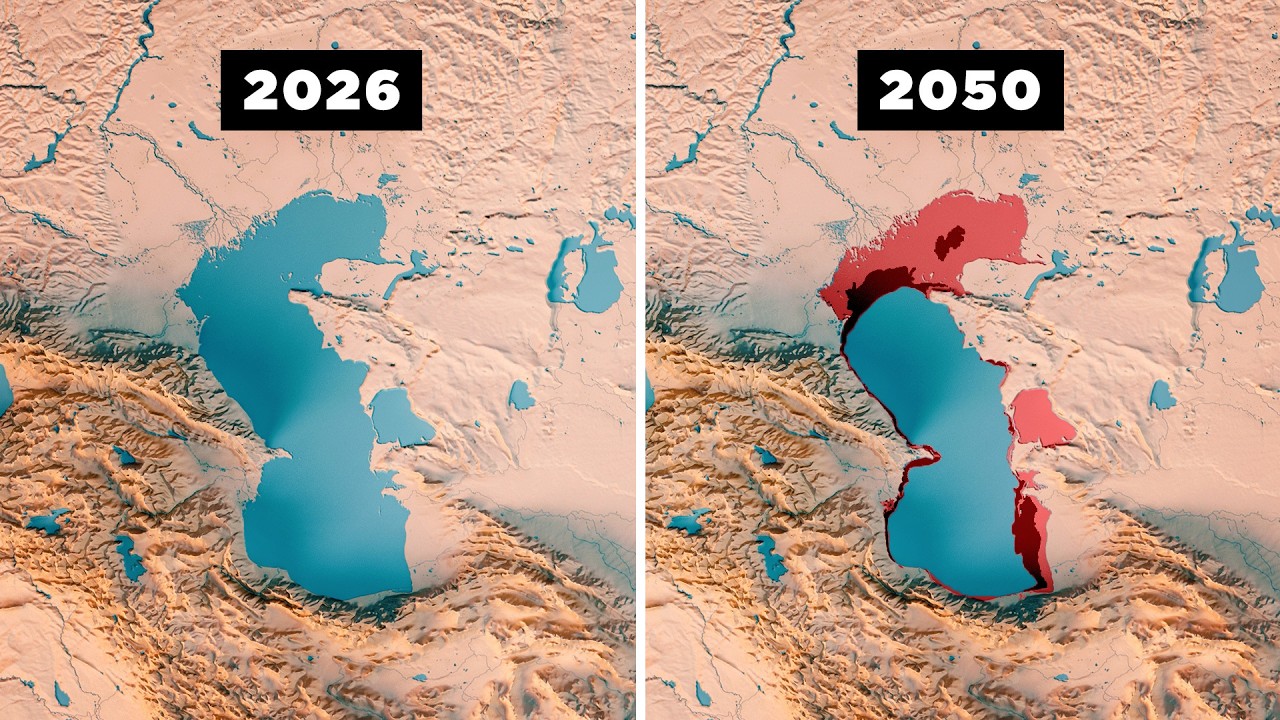

The Caspian Sea is shrinking — and it's happening faster than most of the world realizes. The largest inland body of water on Earth is projected to drop between 9 and 18 meters in water level by the end of the 21st century, according to multiple peer-reviewed studies, including a landmark 2020 paper published in Nature. That means an area roughly the size of Portugal could dry up and vanish from the map within many of our own lifetimes. The causes are a combination of reduced river inflow, increasing evaporation driven by climate change, and decades of industrial pressure — and the consequences for ecosystems, economies, and geopolitics are almost hard to overstate.
 00:45
Satellite comparison showing the Caspian Sea's shrinking northern basin over recent decades
Watch at 00:45 →
00:45
Satellite comparison showing the Caspian Sea's shrinking northern basin over recent decades
Watch at 00:45 →
Why Is the Caspian Sea Shrinking So Fast?
As a fully enclosed, landlocked sea with no natural connection to the world's oceans, the Caspian Sea's water level is determined by a simple but fragile balance: water in versus water out. Roughly 130 rivers feed into it, but more than 80% of all river inflow comes from just one — the Volga, the longest river in Europe. And the Volga is delivering significantly less water than it used to.
According to a 2026 peer-reviewed study from the American Geophysical Union, the volume of water discharged by the Volga into the Caspian fell from an average of 263 cubic kilometers per year between 1991 and 2005, down to just 231 cubic kilometers per year between 2006 and 2020 — a reduction of roughly 12%. Researchers attribute this decline not to Soviet-era dam construction (no new dams have been built along the Volga since the 1980s), but to a measurable drop in precipitation across the river's catchment area.
At the same time, the sea is losing more water through evaporation than ever before. Between 1979 and 2015, the average annual surface air temperature over the Caspian rose by around 1°C. That might not sound like much, but the same 2026 study found that up to 40% of the Caspian's total water volume loss since 2000 can be attributed to increased evaporation alone. Less water coming in, more water escaping into the atmosphere — and a warming world that's only going to make both trends worse.
04:10
Chart of Caspian Sea water level measurements from 1900 to present, indexed against global mean sea level
Watch at 04:10 →
What Will the Caspian Sea Look Like by 2100?
Scientists from the University of Bremen and Utrecht University modeled two scenarios in their 2020 Nature study. Under a medium emissions scenario, the Caspian Sea could decline by 9 meters by 2100 — translating to a loss of 23% of its current surface area. Under a high emissions scenario, the drop reaches 18 meters and the surface area loss hits 34%.
Either way, the transformation would be dramatic and largely irreversible on any human timescale. A Portugal-sized chunk of seabed would emerge as new dry land — but don't expect a land rush. Given the Caspian's long history of oil extraction, industrial dumping, and shipping pollution, most of that newly exposed lakebed is expected to be heavily contaminated. Like the dried-up bed of the Aral Sea before it, the Caspian's exposed floor would likely become a source of toxic dust storms, poisoning the air quality across the surrounding region.
More urgently, the northernmost portions of the sea — the shallowest section with a mean depth of just 5 meters — could largely disappear by 2050, even under the more optimistic emissions scenario.
07:55
Map illustrating projected coastline changes under 9m vs 18m sea level decline scenarios by 2100
Watch at 07:55 →
How Much Has the Caspian Sea Already Shrunk?
This isn't a future problem — it's already well underway. At the start of the 20th century, the Caspian sat at approximately 25.8 meters below global mean sea level. It fell through mid-century, stabilized briefly in the 1950s and '60s, then plunged again to its lowest recorded point in 1977 at negative 29 meters. Soviet-era interventions and a shifting climate partially reversed the trend through the mid-1990s, but since then it has been in near-constant decline.
NASA satellite data confirms that since 1996, the Caspian has dropped back to around negative 28 meters — nearly as low as its 1977 record. In total, the sea has already lost approximately 23,858 square kilometers of surface area since the 1990s, almost entirely concentrated in the shallow northeastern corner near Kazakhstan. That loss has been happening quietly, largely out of global headlines — but it is very real and accelerating.
Which Countries Will Be Hit Hardest?
Five countries border the Caspian: Russia, Kazakhstan, Turkmenistan, Azerbaijan, and Iran. All five will feel the consequences, but the impacts won't be equal.
Kazakhstan and Russia will bear the brunt of the northern basin's collapse. Major ports like Aktau and Kuryk in Kazakhstan, and Astrakhan and Makhachkala in Russia, will find themselves increasingly stranded as the shoreline retreats. A 2025 study published in Nature found that more than a third of all measured industrial infrastructure around the Caspian — refineries, gas plants, ports — will sit more than 5 kilometers from the new shoreline by century's end.
Azerbaijan's capital Baku could end up more than a kilometer from the new coast. Turkmenbashi in Turkmenistan might find itself 16 kilometers inland. And the Russian city of Lagan could wind up more than 120 kilometers from the water.
Is the Caspian the Next Aral Sea?
The comparison is haunting — and increasingly difficult to dismiss. The Aral Sea was once the third-largest lake in the world. Soviet-era irrigation projects diverted its two main feeder rivers, and by the early 2000s it had shrunk to a fraction of its former size, leaving behind salt flats, rusting ships, and a public health catastrophe for the surrounding population.
The Caspian is far larger, and the causes of its decline are different — driven primarily by climate change rather than direct diversion of inflows. But the trajectory has an uncomfortable similarity. If warming continues on a high-emissions path, the Caspian Sea faces a comparably catastrophic transformation, with the same toxic-dust aftermath already witnessed around the Aral Sea playing out at an even larger scale.
Which Species Are Facing Extinction?
The Caspian is home to hundreds of endemic and migratory species, many of which depend on the shallow northern basin for breeding and survival. The sturgeon populations that underpin both Russia's and Iran's caviar industries spawn in those shallow northern waters — and the loss of that habitat will intensify already severe pressure on what are already critically endangered fish.
Perhaps no species faces a more existential threat than the Caspian seal — the only seal species in the world that lives exclusively in the Caspian. Already classified as endangered, Caspian seals rely on the winter sea ice that forms in the shallow northern basin as their primary breeding and pupping ground. Under even the optimistic 9-meter decline scenario, virtually all of that seasonal sea ice disappears. There is no clear path by which the species could adapt quickly enough to survive the complete collapse of its breeding habitat.
How Does a Shrinking Sea Threaten Billions in Oil Wealth?
The Caspian region holds roughly 3% of the world's oil reserves and 4% of its natural gas reserves. Kazakhstan's Kashagan oil field — the largest oil discovery anywhere on Earth in the last 30 years — sits in the offshore northern basin and has attracted tens of billions of dollars in investment from Kazakhstan and international energy companies.
All of Kashagan's production infrastructure is offshore. Under a 9-meter sea level decline, the field could become completely landlocked — potentially rendering the entire project economically unviable and delivering a devastating blow to Kazakhstan's national economy. Across the region, refineries, processing plants, and ports built to exist on a coastline will increasingly find themselves marooned kilometers from the retreating water.
Why Does This Threaten China's Middle Corridor Trade Route?
The Middle Corridor — a major emerging trade route designed to link China and Europe while bypassing Russia and Iran — runs directly through the Caspian. Goods from China travel by rail across Kazakhstan to the port of Aktau, cross the Caspian by ship to Baku in Azerbaijan, and then continue by rail toward Europe.
A retreating Caspian Sea puts both Aktau and Baku further from viable deep-water port access, throwing serious doubt on the long-term viability of this route compared to alternatives through Russia in the north or Iran in the south. The declining sea levels will also lower water levels in the Volga, shrinking the effective capacity of the Volga-Don Canal — the only artificial waterway connecting the Caspian to the global ocean — and forcing ships using it to be smaller and carry less cargo.
Approximately 15 million people live around the Caspian Sea today. As fish stocks collapse, oil infrastructure gets stranded, ports lose access, and toxic dust storms spread from exposed seabeds, many of those people will face the same fate as the communities that once lived around the Aral Sea — displacement, poverty, and becoming climate refugees. The scale is different, but the pattern is tragically familiar.
Even in the best-case emissions scenario, a 9-meter drop and the loss of nearly a quarter of the sea now appears unavoidable. What humanity still controls is whether the outcome stops there — or whether we drive it all the way to the catastrophic 18-meter scenario. And on that question, the clock is very much still running.