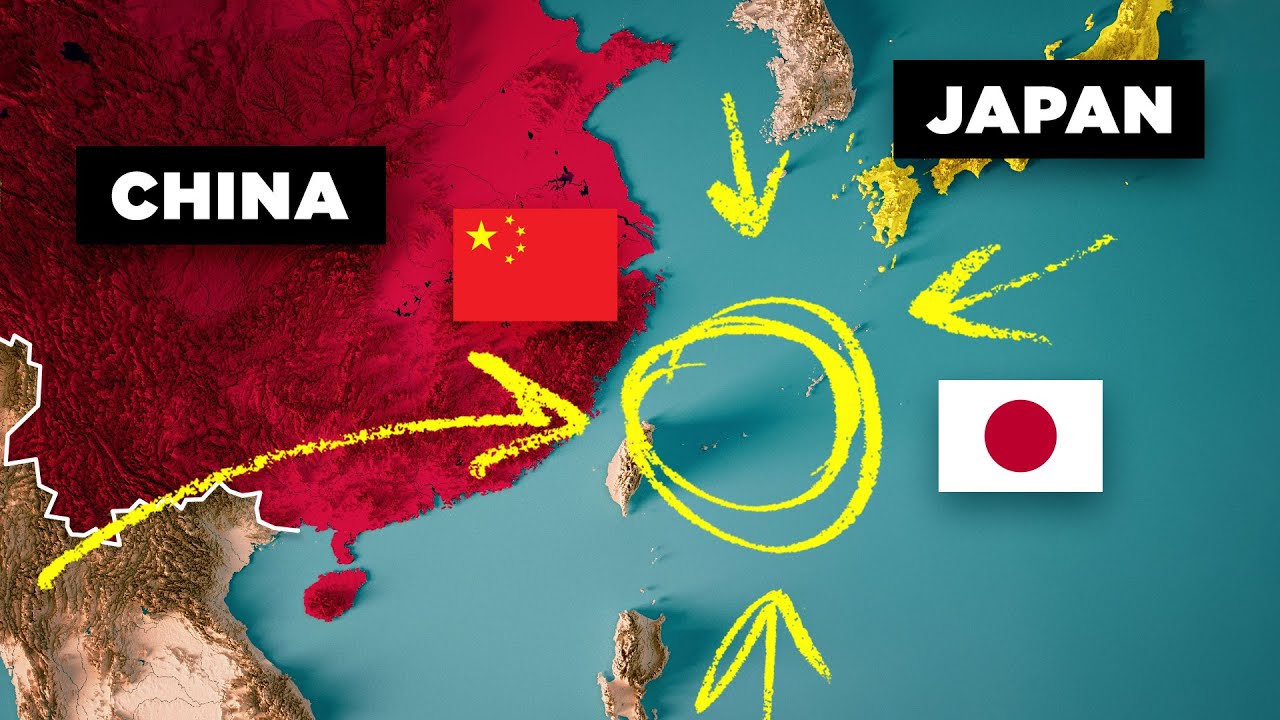

The Senkaku Islands dispute between China and Japan is one of the most dangerous territorial conflicts on Earth — and it revolves around a cluster of uninhabited rocks that you could fit inside a large city airport. Eight tiny islands and rock formations scattered across the East China Sea collectively measure just 6.5 square kilometers. No one lives there. There are no cities, no farms, and almost no buildings aside from a single radar station. And yet, these barren outcrops are the epicenter of a confrontation that has already produced regular aerial and maritime skirmishes, and that carries the very real potential of igniting a full-scale war between the world's second and third largest economies.
 00:45
Aerial view of the Senkaku/Diaoyu Islands showing just how small and barren these contested rocks really are
Watch at 00:45 →
00:45
Aerial view of the Senkaku/Diaoyu Islands showing just how small and barren these contested rocks really are
Watch at 00:45 →
Why Do China and Japan Dispute the Senkaku Islands?
At the heart of the Senkaku Islands dispute is a fundamental disagreement over history, law, and national identity — layered on top of enormous economic and strategic incentives. Japan administers the islands, calling them the Senkaku Islands and considering them an integral part of Okinawa Prefecture. China calls them the Diaoyu Islands and treats them as a core national interest on par with Taiwan, Tibet, Hong Kong, and the South China Sea. Taiwan adds a third claim, calling them the Diaoyutai Islands.
The dispute is not really about the land itself — nobody wants to build a suburb there. It is about what those islands unlock: exclusive rights over a massive stretch of the East China Sea, including its fisheries, its potential oil and gas reserves, and its commanding position over critical military and commercial shipping lanes. Control of the islands determines who controls the surrounding seas, and control of those seas shapes the balance of power across all of East Asia.
What Is the History Behind the Senkaku Islands Dispute?
Understanding the competing claims requires going back centuries. China argues that its sailors discovered the islands during the Ming Dynasty in 1372, and that by 1534 the major islets had been named and documented in a Chinese text, placing them within the maritime frontier of the Ming and later Qing dynasties as part of greater Taiwan. Crucially, however, no archaeological evidence has ever been found showing that the Chinese actually inhabited or settled these islands — suggesting discovery without occupation.
Japan's counter-narrative begins in 1885, when the Japanese government conducted a formal survey of the islands and found them completely uninhabited. Under the legal doctrine of terra nullius — meaning unclaimed land available for any nation to take — Japan formally incorporated the islands into Okinawa Prefecture in January 1895, just months before the conclusion of the First Sino-Japanese War.
04:12
Map showing the competing Chinese and Japanese EEZ claims across the East China Sea, including the disputed median line
Watch at 04:12 →
This timing is everything. When China's Qing Dynasty was defeated in that war, the 1895 Treaty of Shimonoseki forced them to cede Taiwan and its associated islands to Japan. China and Taiwan today argue that the Senkaku/Diaoyu Islands were among those associated islands and were therefore illegally seized as war spoils. Japan insists the two events were entirely separate legal acts — the islands had already been absorbed into Okinawa Prefecture before the war even ended.
The dispute then lay largely dormant for decades. After World War II, the 1951 Treaty of San Francisco required Japan to renounce all rights over Taiwan and its associated lesser islands — but did not explicitly name the Senkakus. The United States then administered Okinawa, including the disputed islands, until 1972. Throughout most of that period, neither the People's Republic of China nor Taiwan formally challenged the American decision to group the islands with Japan — a fact that significantly undermines their current legal standing. In a particularly telling detail, Chinese maps published in the 1950s and 1960s clearly label the islands using their Japanese name, the Senkaku Islands, and place them within Japanese territory.
Everything changed in 1968 when a UN survey suggested the presence of significant oil and gas reserves beneath the surrounding seabed. By 1971, just as the US was preparing to return Okinawa to Japan, Beijing made its first formal claim to what it now called the Diaoyu Islands. The modern dispute was born.
07:30
Chinese-published map from 1969 clearly labeling the islands as the Japanese Senkaku Islands — contradicting modern Chinese claims
Watch at 07:30 →
Who Actually Owns the Senkaku Islands?
Legally and administratively, Japan controls the islands and has done so continuously since 1895, with the exception of the US administration period from 1945 to 1972. Japan purchased several of the islands from private Japanese owners in 2012, consolidating government control and triggering massive anti-Japanese protests across nearly a hundred Chinese cities.
China and Taiwan each claim sovereignty but exercise no actual control. The competing claims rest on genuinely disputed historical and legal interpretations, and no international court has ruled definitively on the matter. The result is a frozen conflict — Japan holds what it has, while China escalates pressure through increasingly assertive naval and aerial patrols designed to challenge and erode the status quo.
What Resources Make the East China Sea So Valuable?
The islands themselves are worthless real estate. The waters around them are another matter entirely. Whoever controls the islands gains control over a massive Exclusive Economic Zone (EEZ) — the area within which a nation holds exclusive rights to all marine and subsurface resources.
The East China Sea is one of the most productive fishing regions on the planet. Since 1950, roughly 5% of all fish caught in the entire world have come from these waters — a haul worth an estimated $300 billion over that span. Japan and China are two of the world's largest fishing nations, and the overlapping EEZ claims mean their fishing fleets are in constant, often dangerous, competition.
Beneath the seabed, the US estimates there could be as many as 200 million barrels of oil and up to 60 billion cubic feet of natural gas in the disputed area. While not enormous on a global scale, these reserves are strategically significant for China and Japan — the world's first and fourth largest importers of hydrocarbon energy respectively. China has already built numerous offshore drilling platforms just west of the median line Japan claims as the EEZ boundary, and both nations have been jointly developing at least one field discovered directly across that contested line.
What Is China's Air Defense Zone Over the East China Sea?
In 2013, China unilaterally declared an Air Defense Identification Zone (ADIZ) stretching across the East China Sea, directly overlapping the disputed islands. Under this zone, China demands that all foreign aircraft flying through the area identify themselves to Chinese authorities and follow Chinese instructions. The zone conflicts directly with Japan's own ADIZ, as well as those of South Korea and Taiwan.
In the years since its declaration, Chinese military aircraft have repeatedly flown through the zone without complying with Japanese air traffic protocols, while Japanese, American, and South Korean aircraft have done the same with China's. The US warned its commercial airlines to avoid the zone if possible. In direct response to these aerial provocations, Japan constructed a radar station on one of the Senkaku Islands in 2016 to better monitor Chinese aircraft movements.
The situation escalated further in 2021 when China passed a law explicitly authorizing its Coast Guard to use lethal force against anyone violating Chinese jurisdictional claims — a direct and unmistakable threat aimed at Japanese vessels operating near the Senkakus.
Would the US Defend Japan if China Attacked the Senkakus?
Yes — at least officially. The United States has repeatedly and publicly affirmed that the Senkaku Islands fall under the 1960 Treaty of Mutual Cooperation and Security between the US and Japan. Under that treaty, the United States is obligated to defend Japan if any of its territories, including the Senkakus, come under foreign attack or occupation. This is precisely why any Chinese military move against the islands would not simply be a bilateral Japan-China conflict — it would almost certainly draw in the United States.
This mutual defense guarantee is a central reason why Beijing has so far stopped short of direct military action, choosing instead to apply persistent pressure through coast guard vessels, military aircraft incursions, and new assertive legislation.
Could China and Japan Actually Go to War Over These Islands?
The strategic logic on both sides makes compromise extremely difficult. Japan cannot surrender the islands because a militarized Chinese presence there would place Chinese naval and air assets directly alongside Japan's most critical energy import routes — the tanker lanes running from the Persian Gulf through the Indian Ocean, across the South China Sea, and through the East China Sea to the Japanese mainland. Losing the islands could mean losing the ability to safely import the energy Japan's entire economy depends on.
China faces a mirror-image fear. Were Japan — or worse, the United States — to ever militarize the Senkakus, those islands would become the closest hostile foreign military bases to China's own equally critical energy import routes running through those same waters.
The result is a classic standoff where neither side can afford to back down, both sides are continuously testing the other's resolve, and the margin for a catastrophic miscalculation grows narrower with every passing confrontation. A full-scale third Sino-Japanese War has not happened yet. Whether the two nations can permanently avoid one over eight tiny uninhabited rocks is one of the defining geopolitical questions of the 21st century.