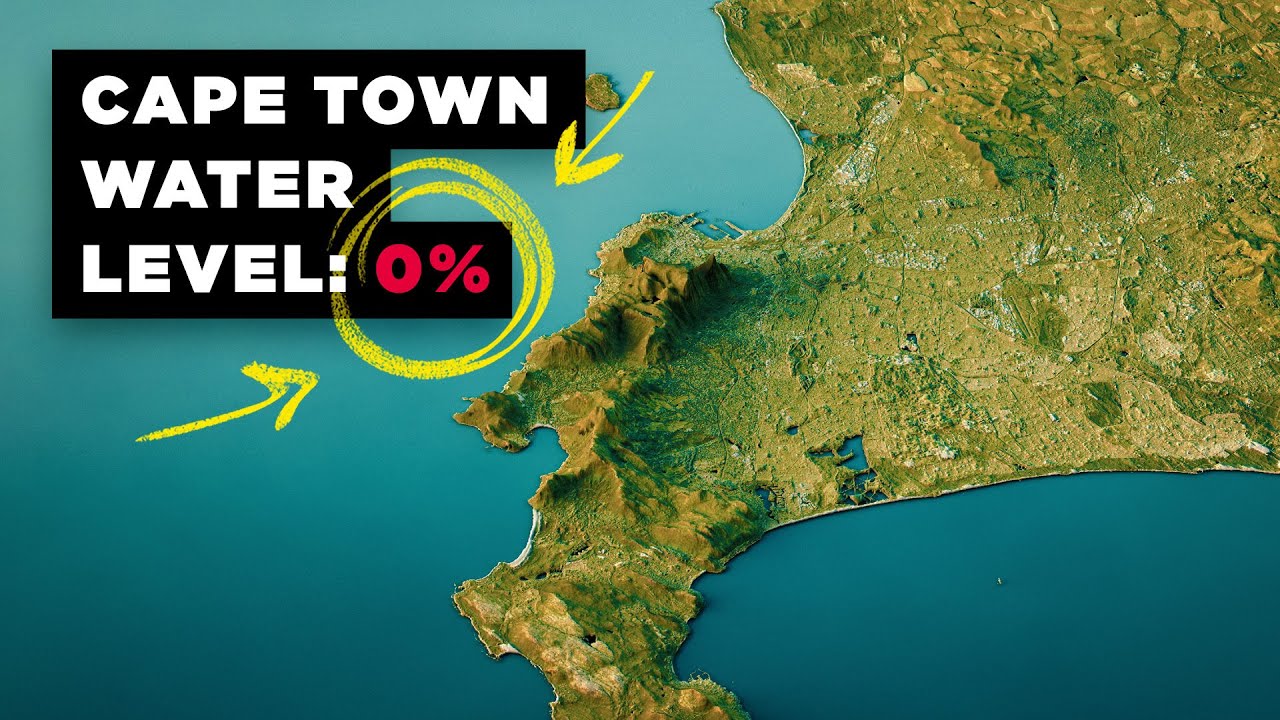

In early 2018, Cape Town nearly became the first major city in the world to completely run out of water. City officials had already named the date: April 12, 2018 — Day Zero. That was the day the taps would shut off for more than 4 million people, who would then be forced to queue at one of 149 guarded water collection points just to collect a daily ration of 25 liters. So why did Cape Town almost run out of water? The answer involves a brutal drought, a city that grew far faster than its infrastructure, decades of racial injustice, and a political system that couldn't get out of its own way.
Why Did Cape Town Almost Run Out of Water?
Cape Town's water supply depends almost entirely on a system of six dams built on nearby rivers. The city sits in a Mediterranean climate zone, which means rain falls mostly in winter and summers are hot and dry. For the system to work, one thing has to happen reliably every year: it has to rain. When it doesn't, there is essentially no backup plan.
That single critical vulnerability was exposed in early 2015 when the winter rains failed to arrive. What followed was the worst drought in the Western Cape's recorded history — a catastrophic three-year dry spell that researchers later concluded was statistically likely to occur only once every 300 years. By the end of 2015, the city's dams had dropped from 72% capacity to just 50%. By May 2017, usable water storage had fallen below 10%. And by the start of 2018, the city was hurtling toward a complete water shutdown.
What Was Day Zero and How Close Did Cape Town Get?
Day Zero was the term Cape Town officials used for the moment the city's municipal water supply would effectively be turned off. The plan, if it arrived, was stark: shut down water to nearly all homes and businesses, maintain supply only to hospitals and the central business district, and set up 149 water collection checkpoints across the city — each guarded by armed police.
Every resident would be limited to just 25 liters of water per day. For context, the average American uses around 310 liters per day. Twenty-five liters is enough for a three-minute shower or four toilet flushes. That's it. That's your entire day's supply.
At the peak of the crisis in January 2018, Day Zero was projected to arrive in just three months. Water restrictions had already been tightened to Level 6B — limiting consumption to 50 liters per person per day. The city was, in every practical sense, on the edge of a water apocalypse.
What Caused the Cape Town Water Crisis?
The drought was the trigger, but it wasn't the only cause. Several compounding factors turned a severe weather event into a near-civilizational catastrophe.
A City That Outgrew Its Water Supply
Between 1995 and 2015, Cape Town's population grew by 71% — from 2.4 million to 4.1 million people. Over that same period, water storage capacity increased by just 17%. The city was adding millions of people while barely expanding its ability to supply them with water. When the drought struck, the existing infrastructure was already stretched dangerously thin.
Total Dependence on a Single Water Source
Unlike many comparable cities around the world, Cape Town had no meaningful alternative water sources. There were no significant underground aquifers to tap into. There were no desalination plants to convert the surrounding Atlantic Ocean's salt water into drinking water. The city's entire water supply flowed from one source — rainfall — and when that source failed, there was nowhere else to turn.
Political Dysfunction at the Worst Possible Time
Cape Town and the Western Cape were governed by the Democratic Alliance, while the national government was controlled by the rival African National Congress. When the crisis began, the two parties became consumed by blame. The DA accused the ANC of withholding infrastructure funding to embarrass a political opponent. The ANC accused the DA of failing to plan ahead. Meanwhile, a DA request for $3 million in water infrastructure funding — submitted in 2015, at the very start of the crisis — was rejected by the national government. The political bickering cost the city precious time.
An Invasive Plant Species Nobody Talks About
One often-overlooked factor: an invasive species of water-hungry plants had taken hold near one of the city's key reservoirs. These plants were consuming an estimated 30 million cubic meters of water per year — water that should have been sitting in storage for the city's residents.
How Did Apartheid Make the Water Crisis Worse?
To understand why Cape Town's population grew so rapidly and why its infrastructure couldn't keep up, you have to go back to apartheid. For decades, South Africa's racist apartheid regime forcibly separated its population by race, and Cape Town's urban core was maintained as a predominantly white area through deliberate policy and brutal enforcement.
In the 1970s, the diverse neighborhood of District 6 was declared a whites-only area. More than 60,000 residents were forcibly removed to the Cape Flats on the city's outskirts. By 1986, the apartheid-era laws restricting black Africans from moving into Cape Town were finally repealed — and decades of pent-up migration followed almost immediately. Between 1970 and 2000, the city's population more than doubled. The share of Black African residents rose from less than 10% to nearly a third of the population.
This rapid population growth was a direct consequence of apartheid's collapse, and the city's water infrastructure — designed and funded under a system that never planned for a fully integrated, rapidly growing population — simply couldn't keep pace.
Where Does Cape Town Actually Get Its Water From?
Cape Town was founded in the 17th century by Dutch traders who needed a resupply depot along the long sea route between Europe and the Far East. They chose Table Bay not because it was the best natural harbor in southern Africa — it wasn't — but because it was the only good harbor location that also had rivers nearby providing fresh water.
Those same rivers are still the foundation of Cape Town's water supply today. A system of six modern dams built on those rivers stores water in reservoirs, which are then distributed across the city through a network of pipelines, tunnels, and canals. The entire system is recharged almost exclusively by winter rainfall — making it extraordinarily vulnerable to any disruption in that annual cycle.
How Did Cape Town Avoid Running Out of Water?
Two things saved Cape Town from Day Zero. First, the extreme water restrictions worked. Limiting residents to 50 liters per day dramatically reduced consumption across the city. Second — and most critically — the winter of 2018 finally delivered meaningful rainfall. By September 2018, the dams had climbed back to 70% capacity. Water restrictions were eased, and by November 2018, life in Cape Town had largely returned to normal.
But "normal" is relative. The infrastructure vulnerabilities that nearly destroyed the city in 2018 have not been fully resolved. Climate projections suggest that severe drought conditions will return to the Western Cape as global temperatures continue to rise. The window to build desalination plants, expand water storage, and develop alternative sources is open — but it won't stay open forever.
Which Cities Could Be the Next Cape Town?
Cape Town's near-collapse was a warning shot heard around the world. By 2025, more than 3.5 billion people are projected to be living in water-scarce regions. Cities like Chennai, Mexico City, Jakarta, and London have all been identified as facing serious water stress in the coming decades. Each of them shares some combination of Cape Town's vulnerabilities: rapid population growth, aging infrastructure, over-reliance on a single water source, and political systems that too often prioritize blame over solutions.
The lesson from Cape Town isn't simply that droughts are dangerous. It's that water systems fail gradually, then suddenly — and the conditions that cause them to fail are often set in motion decades before the taps run dry. The time for cities to act is not when Day Zero is three months away. It's right now, while there's still water in the reservoir.