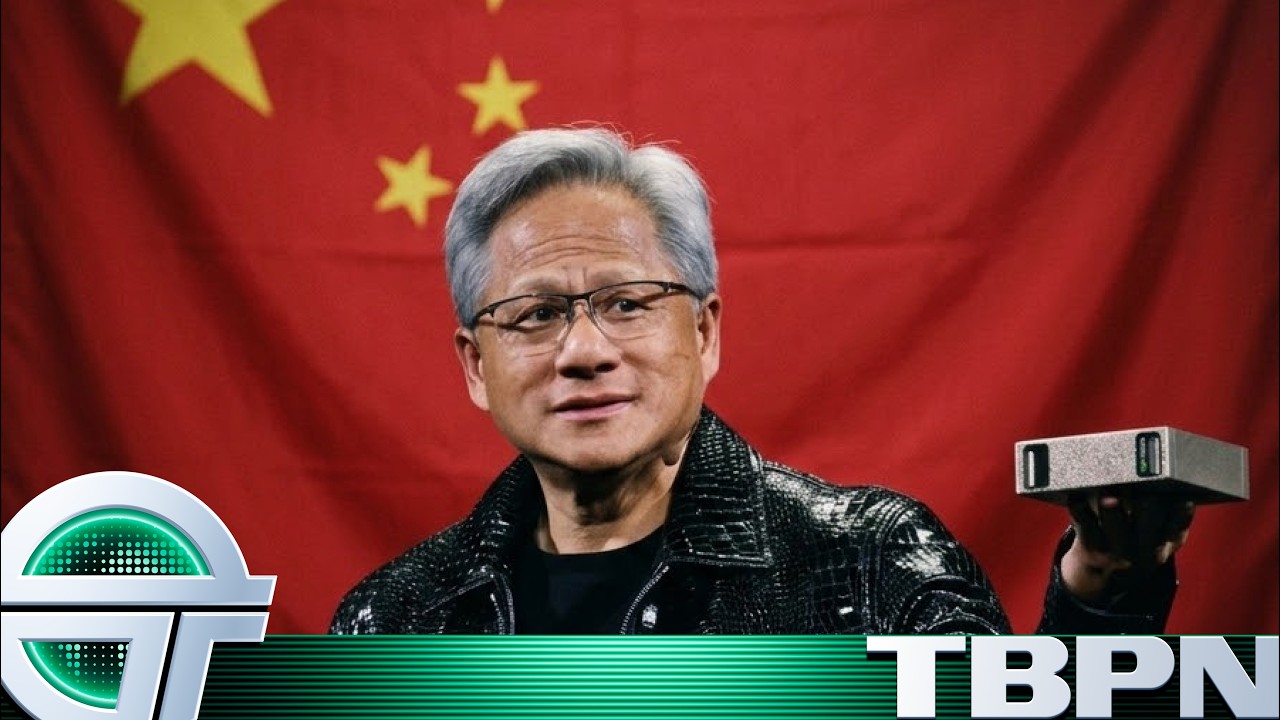

Nvidia is restarting production and sales of its H200 AI chips to China — and Jensen Huang made it official at the company's GTC event. After months of mixed signals, export restrictions, and diplomatic back-and-forth, Nvidia confirmed it has received purchase orders from multiple Chinese customers and is actively firing up its supply chain. So why is Nvidia selling AI chips to China again, and what does this mean for the global semiconductor race? The answer is more complicated — and more consequential — than it first appears.
Why Is Nvidia Selling AI Chips to China Again?
The short answer: the US government gave Nvidia the green light, China's government approved the imports, and Nvidia says demand signals out of China have significantly strengthened in recent weeks. Speaking at GTC, Jensen Huang confirmed: "We have been licensed for many customers in China. We've received purchase orders from many customers and we're in the process of restarting our manufacturing. Our supply chain is getting fired up."
 00:45
Jensen Huang at GTC confirming China purchase orders to CNBC reporter
Watch at 00:45 →
00:45
Jensen Huang at GTC confirming China purchase orders to CNBC reporter
Watch at 00:45 →
The scoop was broken by CNBC's Christina near a bathroom line at GTC — because sometimes that's just how journalism works. She caught Huang walking by, asked if China purchase orders meant he had the green light from both sides, and he simply said yes. That confirmation sent ripples through the tech and finance worlds immediately.
The decision reflects a shift in the Trump administration's calculus on chip exports. After the Commerce Department halted exports of the H20 chip last April, the US reversed course in December by allowing Nvidia to sell the H200 — one generation behind its most powerful current chips — provided 25% of sales revenue is shared with the US government as a de facto export tariff.
What Is the Nvidia H200 and How Powerful Is It?
It's important to clarify which chip we're actually talking about here. The H200 is part of Nvidia's Hopper architecture — not the newer Blackwell series (B200) and not the most advanced current-generation hardware. Think of it as one full generation behind the cutting edge.
03:20
Timeline of Nvidia chip export restrictions from 2022 to present
Watch at 03:20 →
But don't let that fool you — the H200 is still an extremely advanced GPU. For context, the chip that preceded it, the H20, was a deliberately neutered version designed to comply with export restrictions. That chip was so limited it wasn't supposed to be capable of training advanced AI models. Yet researchers at High-Flyer, the team behind DeepSeek, reportedly found ways to use H20 chips effectively — which raised serious questions about whether nerfed chips were really limiting China's AI progress at all.
With H200 access now approved, Chinese AI labs will have access to real, full-capability Hopper-generation hardware. That's a meaningful upgrade. And while it's still not Blackwell, it's more than enough to train highly competitive AI models.
Why Were Nvidia Chips Banned From China in the First Place?
The original chip export ban came from the Biden administration in 2022 under the CHIPS Act. The logic was straightforward on the surface: AI is a strategically critical technology, and keeping advanced chips out of China would slow its AI development while giving the US a structural advantage in the global AI race.
The CHIPS Act also unlocked billions of dollars in incentives for domestic American chip manufacturing — funding projects at Intel, boosting TSMC's Arizona expansion, and catalyzing a broader push to bring semiconductor production back to US soil. The underlying fear was simple: if China has the same compute power as the US, the AI race becomes a fair fight. And Washington didn't want a fair fight.
06:10
The geopolitical argument: how chip bans could reduce deterrence against Taiwan conflict
Watch at 06:10 →
Books like Chip War by Chris Miller documented exactly how semiconductor supply chains became one of the most powerful geopolitical levers in modern history. Chips aren't just products — they're infrastructure, national security assets, and economic weapons all at once.
Does Banning Chips From China Actually Risk a Taiwan War?
This is where the debate gets genuinely complicated — and where a lot of conventional wisdom starts to break down. The argument for keeping chips away from China is intuitive: fewer chips means slower AI, means less military and economic capability. But the second-order effects tell a very different story.
Here's the counterargument that's gaining traction: China's dependence on TSMC's fabs in Taiwan is itself a powerful deterrent against military conflict. TSMC's manufacturing facilities are extraordinarily sensitive — even minor earthquakes require immediate human response from workers who don't even need a notification system because they just know. A military conflict in Taiwan wouldn't just interrupt chip supply — it would likely destroy it entirely.
So if China can't access TSMC chips anyway — because they've been banned — the cost of invading Taiwan drops dramatically. You've removed one of the most powerful economic disincentives to war. That's a dangerous trade-off, especially now. Since 2022, global military conflicts have expanded significantly. The US military is increasingly stretched. The window of risk for a Taiwan conflict is higher than it's been in decades.
By allowing some chip sales to flow through legitimate commercial channels, the argument goes, you keep China economically entangled with the systems that depend on a peaceful Taiwan Strait. The more interlinked the economies, the less likely the conflict.
Will Chip Sales Kill China's Domestic Semiconductor Push?
This is one of the most contested questions in the entire chip debate, and honestly both sides have a point. The concern is real: if Chinese AI labs can just buy H200s, why would Beijing keep pouring money into building a domestic supply chain that isn't competitive yet?
The counter-argument is equally real: the Chinese Communist Party isn't going to abandon its indigenization strategy just because it can buy a drip of H200s. That's simply not how the Party operates. The domestic semiconductor push has political, military, and ideological dimensions that go far beyond commercial logic.
But there's a nuanced middle ground worth considering. Domestic chip fabs need customers to scale. A local Chinese chipmaker needs real purchase orders to justify production runs, improve yields, and develop manufacturing excellence. If AI labs can just import Nvidia chips, that local fab loses customers — and without pressure to perform, it starts looking more like a government vanity project than a competitive business. As one analogy put it: you end up with NASA instead of SpaceX. You can throw money at it, but without the pressure of a real market, you don't get the execution excellence that makes a fab world-class.
Why Does TSMC Hold the Key to the Entire Chip Conflict?
No analysis of the chip war is complete without understanding TSMC's central role. Taiwan Semiconductor Manufacturing Company produces the most advanced chips on the planet — and both American and Chinese technology ecosystems depend on it in profound ways.
TSMC's Arizona expansion, Samsung's US fabs, and Intel's domestic foundry ambitions all represent attempts to reduce that dependency. But none of them are close to matching TSMC's leading-edge capabilities yet. Even Samsung isn't currently manufacturing Nvidia's most advanced chips. Intel's foundry story has been turbulent. Startup fabs are still largely in the planning or early-stage phase.
The uncomfortable reality is that the entire global chip supply chain runs through a small island that sits at the center of one of the world's most volatile geopolitical fault lines. Every policy decision about chip exports to China has to be weighed against what it means for that island's security — and by extension, the security of the fabs that power the global economy.
How Much Could Nvidia Actually Earn From China H200 Sales?
Nvidia hasn't given specific revenue guidance for China H200 sales yet. In its most recent earnings report, the company noted it had received approval to ship small amounts of H200s to China but had not yet generated any revenue from those sales. With the supply chain now officially restarting, that's about to change.
In the past, Nvidia has estimated that the Chinese market for its AI processors could be worth tens of billions of dollars annually. That's a number that gets attention fast — especially when you consider that Nvidia's chips are propping up a significant portion of global stock market valuations and retirement portfolios worldwide.
Chinese AI labs — including those at Alibaba, ByteDance, and others — have real businesses that need real compute. They're not interested in waiting for a domestic chip industry to mature. They want the best tools available now, and Nvidia's CUDA ecosystem remains the dominant platform for AI development. Until a credible alternative emerges — and TPUs and other architectures are making progress, but aren't there yet — CUDA dependency is going to keep driving demand for Nvidia hardware on both sides of the Pacific.
The chip war isn't over. It's just entered a new, more commercially entangled phase — and the next few years will determine whether that entanglement makes the world safer or more fragile.