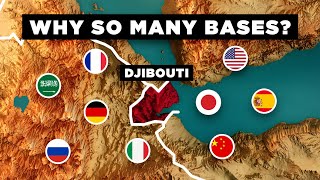
Djibouti has so many foreign military bases because it sits directly beside one of the most critical maritime chokepoints on the planet — the Bab el-Mandeb Strait — a 28-kilometer-wide passage that connects the Red Sea to the Gulf of Aden, and in effect links the Persian Gulf's oil supply to the European market via the Suez Canal. Every major world power needs that strait to stay open, and Djibouti is the only stable country close enough to project military force into it. The result? A tiny nation of under a million people hosting American, French, Japanese, Italian, German, Spanish, Chinese, and soon Saudi Arabian military installations — all within a few miles of each other.
Why Does Djibouti Have So Many Foreign Military Bases?
On the surface, Djibouti looks like an unlikely candidate for global military significance. It's roughly the size of New Hampshire, has the smallest population of any country on the mainland African continent, and is surrounded by some of the most volatile, conflict-ridden neighbors in the world — Yemen, Eritrea, and Somalia. And yet, as of 2023, Djibouti has the highest per capita concentration of foreign military bases on its soil of any country in the world.
 00:45
Map showing the dense cluster of foreign military bases around Djibouti City, including American, French, Japanese, Italian, and Chinese installations within miles of each other
Watch at 00:45 →
00:45
Map showing the dense cluster of foreign military bases around Djibouti City, including American, French, Japanese, Italian, and Chinese installations within miles of each other
Watch at 00:45 →
The reason is almost entirely geographic. Djibouti sits at the precise western entrance to the Bab el-Mandeb Strait — the narrow bottleneck that all ships must pass through to travel between the Indian Ocean and the Red Sea, and ultimately through the Suez Canal into the Mediterranean. For global oil trade, manufactured goods, and liquefied natural gas, this is one of the most irreplaceable passages on Earth. And Djibouti, despite its small size, is the most stable piece of real estate right next to it.
Why Is the Bab el-Mandeb Strait So Important?
The Bab el-Mandeb Strait is only 28 kilometers wide at its narrowest point. Every ship traveling from the Persian Gulf to Europe must pass through it — or sail all the way around the entire African continent, adding weeks to delivery times and dramatically increasing costs. As of 2018, approximately 6.2 million barrels of crude oil were transiting this strait every single day, representing around 9 percent of all the traded oil in the world.
For the European Union, this strait is a lifeline. As of 2022, roughly 20 percent of the EU's oil imports and 24 percent of their liquefied natural gas imports were arriving from Persian Gulf countries through the Bab el-Mandeb and the Suez Canal. The 2021 incident when a single container ship ran aground in the Suez Canal and blocked it for just six days caused an estimated $9.6 billion in halted trade — a brief preview of what a full blockade of either chokepoint could mean for the global economy.
03:10
Animated map showing the Persian Gulf oil trade route westward through the Bab el-Mandeb Strait, up the Red Sea, and through the Suez Canal to European markets
Watch at 03:10 →
Why Does the Persian Gulf Control the Global Economy?
The Persian Gulf region contains roughly half of all the world's known oil reserves and around a third of all current global oil production. It also holds approximately 40 percent of all the world's known natural gas reserves. This includes the largest single oil field ever discovered — the Ghawar field in Saudi Arabia — and the largest single natural gas field ever found, the North/South Pars field shared between Qatar and Iran, which alone represents about one-fifth of all natural gas reserves ever identified on the planet.
The eight countries bordering the Persian Gulf — Iran, Iraq, Kuwait, Saudi Arabia, Bahrain, Qatar, the UAE, and Oman — collectively supply energy to virtually every major economy on Earth. Oil and gas bound for Asia travels east through the Strait of Hormuz across the Arabian Sea toward China, South Korea, Japan, and Taiwan. Energy heading to Europe travels west through the Gulf of Aden, past Djibouti, up the Red Sea, and through the Suez Canal. Block either the Strait of Hormuz or the Bab el-Mandeb, and you've caused an immediate global energy crisis.
Why Is Saudi Arabia So Threatened by the Houthis in Yemen?
Saudi Arabia is the definition of a petro-state. Oil accounts for 40 percent of its entire GDP, and over the past decade, oil revenues have funded an average of 75 percent of the Saudi government's annual budget. If Saudi Arabia loses its ability to export oil, it doesn't just face economic trouble — it faces the potential collapse of the central state and the monarchy that runs it.
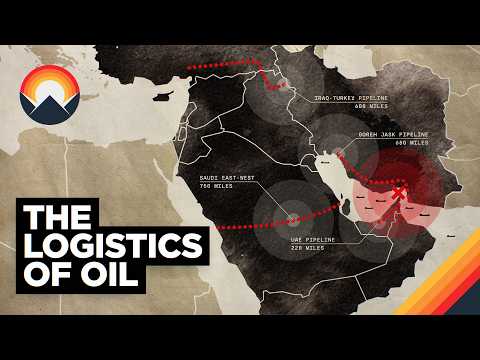
Most of Saudi Arabia's oil fields are in the eastern part of the country, near the Persian Gulf. Their primary export route runs through the Strait of Hormuz — which is controlled on its northern shore by Iran, Saudi Arabia's greatest regional rival. To reduce that vulnerability, the Saudis built the East-West Pipeline, which moves oil across the country to ports on the Red Sea, where it can then be exported through the Bab el-Mandeb to the south or the Suez Canal to the north.
06:55
Map showing Saudi Arabia's East-West Pipeline and the dual chokepoint threat posed by Iran at Hormuz and Houthis at Bab el-Mandeb
Watch at 06:55 →
But then the Houthis emerged. Beginning in 2014, this Shia-aligned rebel faction — allegedly backed by Iran — rose up against the Saudi-backed Yemeni government and seized control of large parts of the country, including territory near the eastern shore of the Bab el-Mandeb Strait. The nightmare scenario for Saudi Arabia is a coordinated Iranian-Houthi blockade: Iran closes the Strait of Hormuz from the north, the Houthis close the Bab el-Mandeb from the south, and Saudi Arabia is suddenly unable to export its oil in any direction. That existential threat explains why Saudi Arabia has been bombing Houthi targets in Yemen for years, and why they're now building their own military base in Djibouti.
What Countries Have Military Bases in Djibouti?
The sheer number of nations with a military footprint in Djibouti is staggering for a country this small:
- United States — Camp Lemonnier, the only permanent U.S. military base on the African mainland, used for drone operations against al-Qaeda in Yemen and al-Shabaab and ISIS in Somalia.
- France — Multiple bases including a naval installation and an air base also used by the U.S. for drone operations; a legacy of Djibouti's colonial history as French Territory of the Afars and Issas.
- Japan — A base that is literally the only overseas military installation Japan operates anywhere in the world, authorized under Japan's pacifist post-WWII framework specifically for anti-piracy operations.
- Italy — A military base squeezed in near the Americans.
- Germany and Spain — No dedicated bases, but troops stationed in local hotels.
- China — A People's Liberation Army Navy base, the first overseas military base China has ever built anywhere in the world.
- Saudi Arabia — A new base agreed upon in 2021, currently under construction.
- Russia and India — Both have been actively courting the Djiboutian government for their own bases for years.
Why Did China Build Its First Overseas Military Base in Djibouti?
China's economy is built on importing massive volumes of raw energy materials from the Persian Gulf, converting them into manufactured goods, and then exporting those goods to consumer markets in Europe and North America. Manufactured exports represent around 30 percent of China's entire economy. The fastest, cheapest route for Chinese exports to reach European markets passes directly through the Bab el-Mandeb Strait and the Suez Canal.
China's official justification for its Djibouti base is anti-piracy operations — keeping shipping lanes secure. And that's not entirely false. But the base also gives China a physical military presence near one of the most critical points in their entire trade network, and a foothold on the African continent at a time when China has been aggressively investing in African infrastructure through its Belt and Road Initiative. Predictably, the U.S. and China have already been trading accusations of spying on each other from their respective bases — including one reported incident of Chinese troops allegedly shining laser beams into the cockpits of American aircraft.
What Makes Djibouti's Location a Geopolitical Goldmine?
Beyond the strait itself, Djibouti's location matters enormously to Ethiopia — Africa's second most populous country with over 120 million people, and one that is entirely landlocked. Because Ethiopia has had a hostile relationship with Eritrea for decades and Somalia is effectively a failed state, Djibouti is the only viable maritime access point for Ethiopian imports and exports. As a result, Djibouti handles more than 95 percent of all imports that enter Ethiopia — a country with more than 120 times Djibouti's own population. That gives Djibouti extraordinary leverage over a regional giant.
How Does Djibouti Benefit From Hosting Foreign Militaries?
Djibouti's president, Ismail Omar Guelleh, has ruled the country since 1999 and is widely criticized for running an authoritarian government. But his foreign policy strategy is, by any measure, remarkably shrewd. By welcoming military bases from virtually every major world power simultaneously — including rivals like the United States and China — Djibouti has essentially made itself untouchable.
Who would attack a country that would simultaneously provoke the U.S., China, France, Japan, and Italy? The presence of so many competing foreign militaries on Djiboutian soil creates a kind of mutual deterrence that protects the country far more effectively than any military of its own ever could. In exchange, Djibouti earns substantial lease payments and economic benefits from each of these nations, funding a government that might otherwise struggle to sustain itself in one of the world's most difficult neighborhoods.
Djibouti is a masterclass in leveraging geography. It is a nation that by all conventional measures should be insignificant — small, poor, arid, and surrounded by chaos. Instead, it has transformed its single greatest asset — location — into a geopolitical shield that keeps it safe while the rest of the region burns. That is genuinely one of the most elegant strategic plays any small nation has ever pulled off.