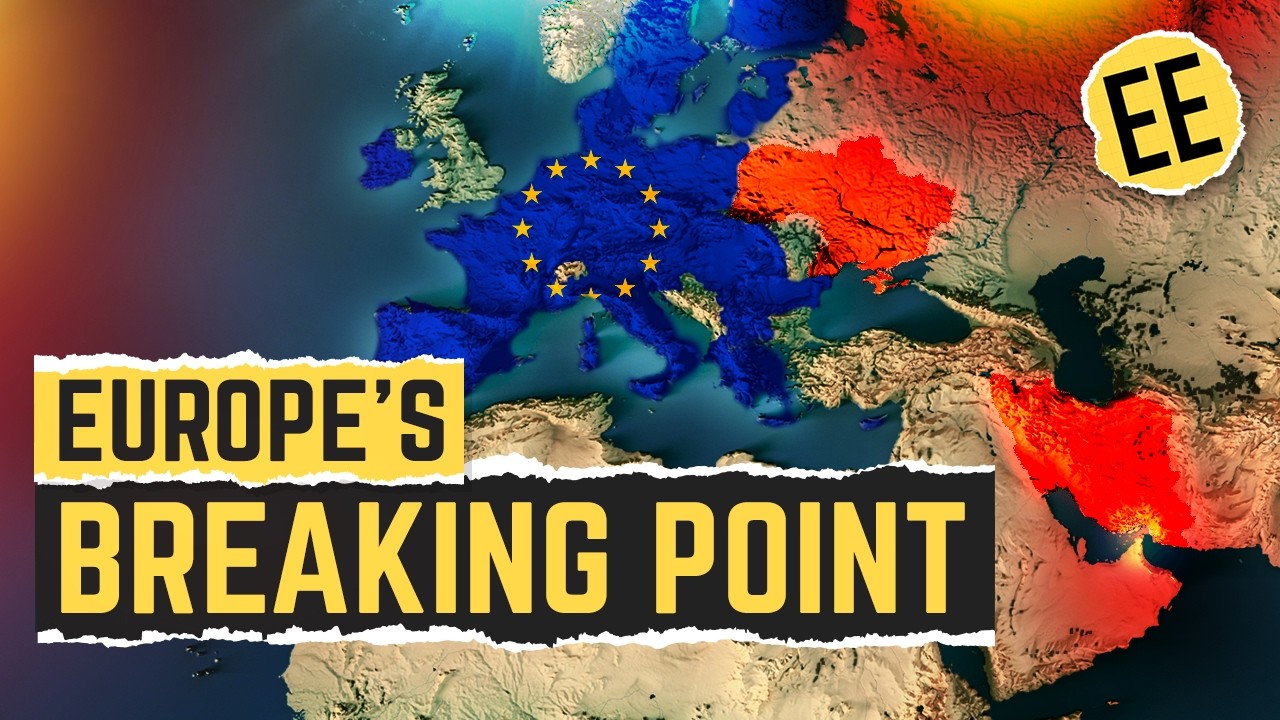

Europe has made its position clear: this is not their war. But the Iran-Israel-US conflict is hitting the European economy hard regardless — through energy price spikes, disrupted shipping lanes, and a manufacturing sector that was already on the ropes. Despite having almost no seat at the negotiating table, Europe may actually be more economically exposed to this conflict than the United States itself. Here's why, and what — if anything — can be done about it.
Why Is Europe So Exposed to the Iran-Israel-US Conflict?
The short answer is geography, energy dependence, and terrible timing. The EU imports 57% of its total energy needs, according to Eurostat. Compare that to the United States, which imports just 17% and is currently the world's largest oil producer. That single gap explains a huge amount of why this conflict lands differently on European doorsteps.
 02:15
Map showing Europe's geographic position between disrupted eastern shipping routes and western tariff pressures
Watch at 02:15 →
02:15
Map showing Europe's geographic position between disrupted eastern shipping routes and western tariff pressures
Watch at 02:15 →
When global energy markets get disrupted — whether through the Strait of Hormuz, the Suez Canal, or both — Europe has very little cushion. It needs the energy, it can't produce enough at home, and so it pays whatever the market demands. The US, by contrast, has the luxury of being largely insulated from the supply side of the equation.
What makes this especially painful is the context. Europe is already dealing with the economic hangover from the war in Ukraine, which cut off Russian energy supplies either through sanctions or infrastructure destruction like Nordstream. Now, just as costs were beginning to stabilise, a second major supply shock is arriving from the south and east simultaneously.
What Happens to Global Energy If the Strait of Hormuz Closes?
Roughly 20 million barrels of oil per day flow through the Strait of Hormuz. That's not a niche shipping corridor — it's the single most important chokepoint in global energy markets. When that flow gets restricted or threatened, it doesn't just affect countries that buy Gulf oil directly. It affects every country on Earth that participates in global energy markets, because oil is traded in a global pool, not a series of bilateral arrangements.
05:40
Breakdown of EU energy import sources showing shift away from Russia toward Norway and the US
Watch at 05:40 →
Think of it less like buying fruit from your local farm and more like a global auction. If the pool of available oil suddenly shrinks, every buyer around that auction gets squeezed — including ones who never bought a single barrel from the Gulf. Europe, as a wealthy but energy-hungry region, ends up paying more regardless of where its oil actually comes from. The USA's largest share of EU fossil fuel imports as of 2025 doesn't insulate European buyers from the pricing pressure at all.
Why Are European Energy Prices Rising Again in 2025?
It's a combination of factors stacking on top of each other. The conflict in the Persian Gulf has reintroduced uncertainty into global energy markets just as Europe had started to find some stability. But the underlying structural problem hasn't gone away: Europe's energy infrastructure was largely built around Russian and Middle Eastern supply routes, and those have now both been disrupted.
Switching suppliers sounds straightforward — Norway and the United States can both ramp up exports — but it's not just a matter of redirecting tankers. Different grades of oil and gas require different processing infrastructure. A refinery built to handle heavy Gulf crude can't simply switch to light American shale without significant and expensive retooling. That kind of change takes years, not months.
Germany made this worse by decommissioning its last three nuclear reactors in April 2023, removing a source of clean, stable, domestically produced power from the grid at the worst possible time. The EU is now having serious conversations about reversing course on nuclear, including small modular reactors, with capacity potentially growing from 98 gigawatts today to as much as 150 gigawatts by 2050. But even the most optimistic version of that plan doesn't help a factory that needs gas to run its furnaces today.
10:22
Diagram of Suez Canal and Bab-el-Mandeb Strait showing the combined shipping chokepoint risk
Watch at 10:22 →
How Does Suez Canal Disruption Hurt European Trade?
While much of the attention has focused on Hormuz, the Suez Canal is arguably the more consequential chokepoint for Europe specifically. It's the main shipping artery linking Europe to Asian markets — and it's already under pressure. Shipping insurance premiums in the Red Sea are elevated, direct dangers remain heightened, and Iran has even threatened to close the Bab-el-Mandeb Strait, which connects the Red Sea to the Gulf of Aden.
If both Hormuz and Bab-el-Mandeb were disrupted simultaneously, roughly a quarter of the world's energy and a significant chunk of Asia's exports to Europe would be blocked at once. That's not just about making iPhones more expensive. It's about the components that European factories need to manufacture the goods they sell to the world. The disruption runs in both directions — goods out and parts in.
Europe is also uniquely stuck geographically. Asian and American markets can reroute trade across the Pacific. Europe doesn't have that option. It sits between two increasingly disrupted trade routes to the east and a tariff wall to the west.
Why Is European Manufacturing Losing Its Competitive Edge?
Manufacturing makes up around 15% of European GDP — compared to roughly 11% in the USA — and closer to 23% when measured as a share of total business activity. That matters because manufacturing is energy-intensive. Higher oil and gas prices don't just raise household electricity bills; they directly increase the cost of making the things European economies actually sell to the world.
15:10
EU vs US GDP growth comparison chart showing Europe's significantly lower economic momentum heading into 2025
Watch at 15:10 →
That competitiveness problem was already serious before this conflict. German automakers, once competing only with each other and with Japan, are now up against Chinese electric vehicle manufacturers producing comparable or arguably better vehicles at a fraction of the cost. Add in rising energy prices, more expensive shipping, and disrupted component supply chains from Asia, and European manufacturers are being squeezed from every direction at once.
The knock-on effects compound quickly. Higher production costs mean less competitive exports, which means lower revenues, which means less tax income, which means governments have less to spend on the support programs people are relying on during exactly this kind of crisis.
How Are US Tariffs Making Europe's Trade Problems Even Worse?
Just as Europe is trying to navigate supply disruptions from the east, trade with its largest partner to the west is also becoming more uncertain. The EU has already prepared countermeasures against American steel and aluminium tariffs and has drawn up a list of around 4,800 categories of American exports worth roughly $18 billion that it could target in retaliation.
Businesses can adapt to higher costs. They can even absorb tariffs with enough notice. What they genuinely can't handle is uncertainty — not knowing what the rules are going to be next month. That unpredictability is itself a drag on investment and growth, at a time when European businesses can least afford it.
How Weak Is European GDP Growth Heading Into This Crisis?
Remarkably weak. The European Commission is projecting just 1.3% growth for the Eurozone in 2025 and 1.2% in 2026. The US economy grew at 2.8% in 2024 and around 2.2% in 2025 — roughly double the European pace even at its slower recent rate. Germany, historically the engine of European growth, managed just 0.2% growth in 2025. France and Italy are both stuck below 1%.
Headline inflation across the Eurozone has come down to around 2%, but that doesn't undo the cumulative damage of years when it was running at 6%, 8%, or even 10% in some countries. Prices don't fall just because the rate of increase slows. Europe is walking into this supply shock already bruised from a rolling series of crises — the 2008 financial crash, the European debt crisis, the pandemic, the Ukraine energy shock — each one landing on a body that hadn't fully recovered from the last.
Can Europe Realistically Cut Its Dependence on Imported Energy?
The progress is real but the timing is brutal. Renewables now generate nearly 47% of Europe's electricity, which puts the continent well ahead of most major economies on energy transition metrics. But the energy that still relies on fossil fuels — particularly for industrial processes — is exactly what's being disrupted right now. You can't power a steel mill with a solar panel. Not yet.
The most practical medium-term steps are deepening energy partnerships with Norway and the United States, and continuing to build out the internal infrastructure to actually move that energy across the continent efficiently. Europe's internal energy market remains surprisingly fragmented — getting gas from a terminal in Spain to a factory in Germany involves crossing multiple national systems that weren't designed to work together seamlessly.
The broader challenge is political coordination. The EU is 27 countries with different energy exposures, different industrial bases, and different political constraints. Poland, which has been investing heavily in diversification, faces this crisis very differently to Italy, which is heavily dependent on Mediterranean shipping and imported fossil fuels. Getting those 27 governments to agree on a coherent response — while simultaneously ramping up defence spending toward €400 billion in 2026 — is an enormous ask.
The uncomfortable reality is that Europe is going to take an economic hit from this conflict no matter what it does. The question is whether that hit is managed in a way that leaves the structural foundations stronger once the dust settles, or whether short-term political decisions make the underlying problems even worse. History suggests the temptation to turn inward — subsidies, price controls, trade barriers — tends to delay the adjustments the economy actually needs to make. Europe has been here before. How it responds this time will determine whether the next crisis finds it in better shape or worse.