
What Is the Federal Takeover of Washington DC?
Washington DC has become the center of a major national debate after President Trump took federal control of the city's policing, deploying the National Guard, FBI, ICE, DHS, and Secret Service to patrol the streets. Trump declared on social media that homeless people must move out immediately, framing the move as a necessary intervention to restore order to the nation's capital. The federal takeover of Washington DC has sparked fierce reactions from residents, activists, lawmakers, and law enforcement alike — and the reality on the ground is far more nuanced than the headlines suggest.
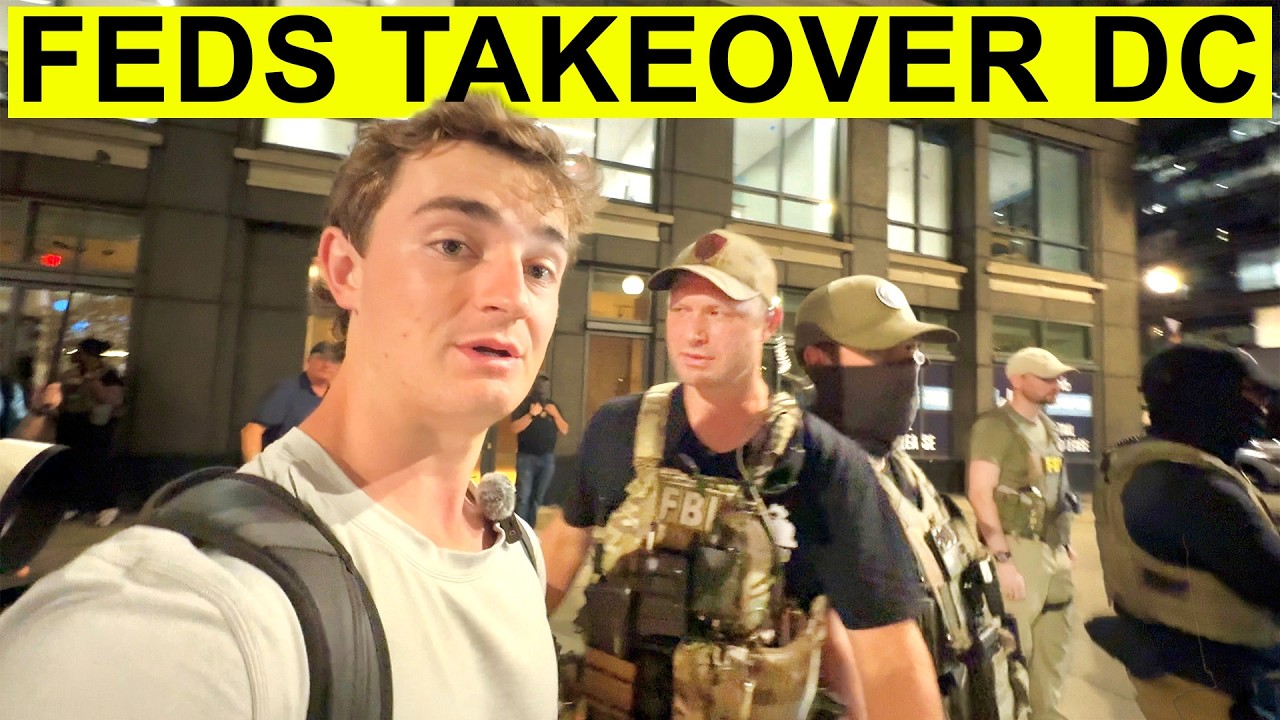
We spent an entire day and night walking the streets of DC, from K Street and Pennsylvania Avenue to Union Station and the area surrounding the Washington Monument, to document exactly what federal law enforcement is doing and how ordinary people are responding to it.
How Bad Is Crime and Homelessness in DC Right Now?
Depending on who you ask, Washington DC is either in the grips of a serious public safety crisis or experiencing a manufactured emergency designed to justify a dramatic power grab. The truth appears to sit somewhere in between.
One longtime DC resident we spoke to near the White House recalled witnessing a murder roughly nine months ago in an alley behind a well-known restaurant on Pennsylvania Avenue. He described the city's policing situation plainly: officers are doing the best they can, but the environment is difficult. Another resident compared today's crime levels favorably to the 1980s, when Washington averaged an astonishing 13 homicides per day and was widely considered the murder capital of the United States.
According to protesters near the National Guard deployment at Union Station, DC crime is currently at a 35-year low. However, federal data and independent crime analysts have noted that in 2023, Washington DC recorded its highest homicide rate in decades, and it currently ranks among the top four most dangerous cities in America. The city's own police department faced scrutiny after an officer was reportedly fired for manipulating crime statistics, adding a layer of distrust to the official numbers from both sides.
What Are Federal Agents Actually Doing on DC Streets?
On the ground, federal law enforcement operations looked far more targeted than the sweeping crackdown many expected. Throughout the day, activity was relatively quiet. National Guard troops were visible near the Washington Monument, but they were not making arrests or confronting civilians — their presence was largely symbolic.
As night fell, the operation shifted into a higher gear. Federal agents, working alongside local Metropolitan Police, set up checkpoints throughout downtown. Homeland Security Investigations (HSI) agents were stationed outside 24-hour stores like Wawa and CVS locations — spots known for late-night shoplifting incidents. The federal teams also patrolled the streets surrounding the White House perimeter.
The first arrest of the night came when law enforcement — including police, Secret Service, and FBI agents — detained a man near the White House who was allegedly distributing narcotics. Officers placed the seized drugs and a large amount of cash into evidence bags at the scene. The arrest illustrated a key point: agents appeared to be targeting active drug dealers rather than simply sweeping up homeless individuals sleeping on the street.
Homeless residents we spoke to at nearby encampments confirmed this. Multiple people said federal agents had walked through their area, spoken to them respectfully, and moved on without making arrests. "They've been respectful," one encampment resident told us. "All they want is the drug dealers and the guns off the street."
Why Are People Protesting Federal Law Enforcement in DC?
Outside Union Station, where the National Guard had set up for the evening, a group of protesters gathered with signs. Notably, the majority of the signs referenced Jeffrey Epstein rather than the DC federal takeover itself — a detail that stood out amid the heavy law enforcement presence.
One protester argued passionately that the federal deployment was fascism, pointing to the crime statistics she believed showed the intervention was unnecessary. "There's no rise in crime. We're down to a 35-year low," she said, adding that DC residents never asked for military presence and did not want it.
Another protester argued that federal agencies were being deployed outside of their intended jurisdictions and that the real targets weren't dangerous criminals but marginalized residents — unhoused people, disabled individuals, and others she described as being "cleansed" from the city. She said she personally knew people who had been detained, calling the situation an "emergency" and a "fascist takeover."
Several protesters expressed concern that if the federal government could take control of DC's streets, the same template could be applied to other major cities like Philadelphia or Chicago. "That's the whole reason to start it here," one demonstrator said.
One protester held a sign referencing Trump's past connections to Epstein, suggesting the DC crackdown was a political distraction. "It's the only thing that seems to make him jump or flinch," she said, calling the whole operation "a circus."
Are DC Residents For or Against the Federal Crackdown?
Street-level opinion in DC was genuinely divided, cutting across demographics in ways that defied easy political labels.
- In favor: Several residents — including a military veteran — said they welcomed the federal presence and wished it was even stronger. One man pointed out that DC's status as the nation's capital means tourists should feel safe walking its streets, and that the city's leadership had failed to provide that. "They need to take control. This is the nation's capital. You got tourists scared to come here," he said.
- Against: Others argued the intervention was an overreach, with one resident saying DC could manage its own affairs if Congress and the president simply allowed local government to function. Another framed the use of federal agents for non-federal crimes as a structural problem, noting that agencies like the FBI already have well-defined jurisdictional roles.
- Pragmatic middle ground: Some residents took a more philosophical view. One homeless man near the encampments near the White House said it was a "catch-22" — the federal government stepping in to do what local institutions have failed to do, but the better solution would be to invest in jobs and drug treatment programs rather than enforcement alone.
Is Washington DC Really One of America's Most Dangerous Cities?
The factual dispute over DC's crime rate was one of the most contentious threads running through the night. Protesters cited a 35-year crime low. Others referenced 2023 homicide data showing DC had one of the highest murder rates of any major American city that year.
One demonstrator pushed back on the framing directly, asking why the National Guard wasn't deployed to the three cities she claimed were statistically more dangerous than DC. It's a fair question — and one that underscores the political dimension of the federal intervention. Washington DC is not just any city. It is the symbolic heart of American democracy, and its condition carries outsized meaning for how the country is perceived both domestically and abroad.
What Happened to Homeless Encampments Near the White House?
Just steps from the White House on K Street and Pennsylvania Avenue, we found four tents still standing despite notices warning residents to vacate. Stickers had been placed on the tents informing occupants they needed to move. Despite the warnings — amplified by media coverage — the encampments remained in place.
As of the time of filming, federal agents had not forcibly removed the occupants. The situation remained tense but peaceful at those locations, with residents waiting to see whether authorities would follow through on threatened clearances.
What became clear from an entire day and night on the streets of DC is this: the federal takeover of Washington DC is real, it is active, and it is producing genuine arrests of drug dealers operating near the seat of American government. Whether it represents a necessary intervention or an unconstitutional power grab depends entirely on who you ask — and the city's residents are anything but unified on the answer.