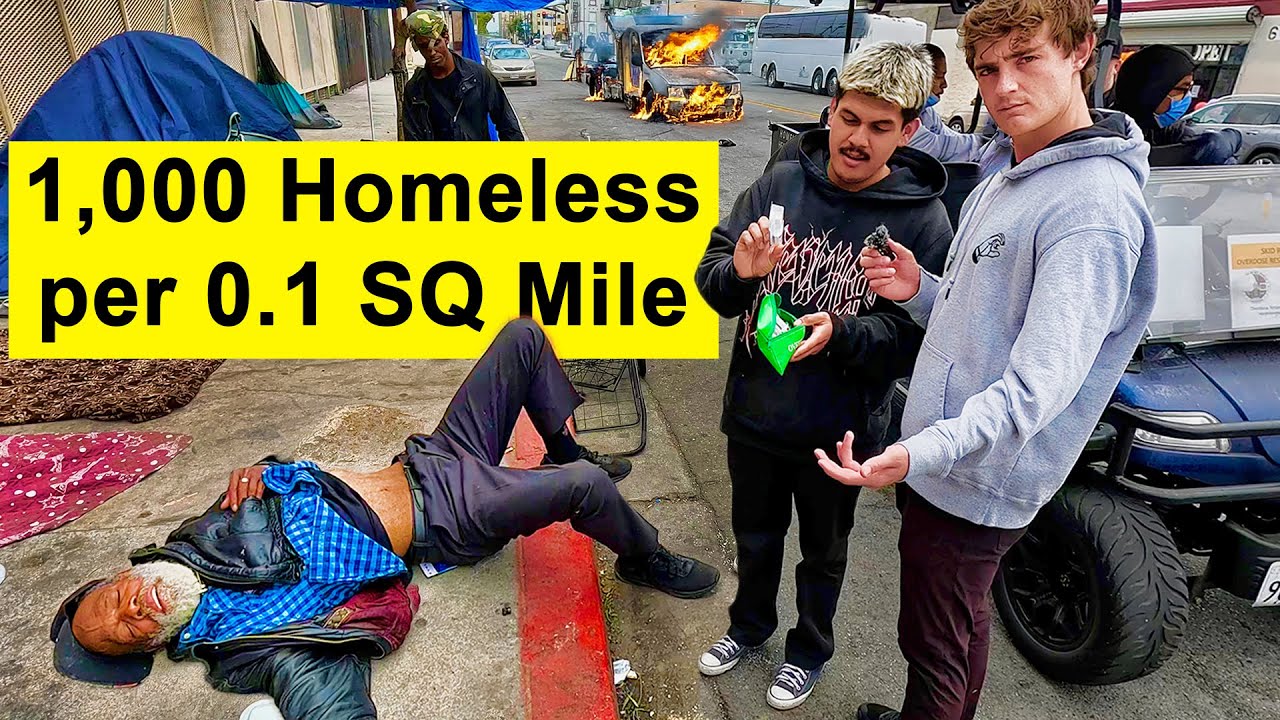

Skid Row in Los Angeles is not a scene from a dystopian movie — it is a real, living neighborhood crammed into less than half a square mile of downtown LA, where over 4,500 people currently live on the streets. That is more people per square mile than the entire city of Washington DC, and every single one of them is homeless. Walking through Skid Row means stepping over tent cities, smelling open fires burning everything from clothing to drug paraphernalia, and coming face to face with a crisis that has been decades in the making. This is what Skid Row Los Angeles really looks like in 2024.
What Is Skid Row LA Really Like in 2024?
The first thing that hits you is the scale. Over 40 people per block are surviving — and in some cases, actively using drugs just to get through the day. Tents line every sidewalk. People have set up chairs, tables, and makeshift kitchens right on the pavement. The city provides portable outhouses that workers clean daily, a dangerous job given the needles, disease, and waste involved.
On any given morning, fires break out on street corners. During one visit, firefighters were battling a blaze at 11 a.m. that was burning trash, clothes, and personal possessions — potentially including drugs and needles — sending a cloud of toxic fumes into the air just blocks from gleaming downtown skyscrapers. Helicopters circled overhead. A Bentley was parked on the outskirts, steps from tents where families sleep.
According to local Tommy Tomato, who provided an inside look at the area, Skid Row has existed since the 1970s and '80s but has grown well beyond its original boundaries. "They've expanded and have more homelessness, so they've actually gone past Skid Row," he explained. What was once a defined zone has now bled into surrounding neighborhoods, and the city still calls it all Skid Row.
Why Is Homelessness So Bad in Los Angeles?
The reasons people end up on Skid Row are layered. The most immediate answer from residents themselves: cost of living. A one-bedroom apartment on the outskirts of the area runs $3,000 to $4,000 per month. For people without stable income, that door is simply closed.
But there is a deeper systemic issue. According to multiple residents, a combination of addiction, mental illness, and a complete breakdown of social support systems drives people here — and once someone arrives, leaving is extraordinarily difficult. As one long-term resident put it: "You only really end up here if you've already burned all your bridges." The community functions like a tribe of outcasts, offering a rough sense of belonging but very little safety or stability.
One woman who had been on Skid Row for two years said plainly: "I can't afford to pay rent somewhere." It was that simple. Another man said he had left briefly to stay with his mother but came back because of his addiction. The street pulls people back in ways that shelters and half-measures cannot address.
Where Did California's $24 Billion for Homelessness Go?
This is where things get politically uncomfortable. Since Gavin Newsom became governor of California, over $24 billion dollars earmarked for fighting the homeless crisis has reportedly gone unaccounted for. Just recently, Los Angeles failed to pass another audit for $2.3 billion in missing funds. These are not small rounding errors — these are staggering sums that were supposed to translate into housing, services, and solutions for people living in tents on the street.
Meanwhile, homelessness has grown, not shrunk. Residents and local advocates point to this disconnect with bitter clarity. The money is being spent — or disappearing — while the population on Skid Row keeps rising. Whatever is happening with those funds, it is not visibly showing up on the streets of downtown Los Angeles.
What Drugs Are People Using on Skid Row?
The drug crisis on Skid Row is severe and getting worse. Residents openly discussed using crack cocaine, crystal meth, fentanyl, and alcohol. Many said they had lost friends — some said five or six, others said upwards of twenty — in just the past six months, largely due to fentanyl.
The most terrifying part? Many people do not even know they are taking fentanyl. It is being laced into crack cocaine and other substances without the user's knowledge. Fentanyl is so potent that a microscopic amount can be lethal. One resident described losing 20 friends in six months to laced drugs: "They didn't know. It was laced."
Narcan — the overdose-reversal drug — is being distributed on the streets. Volunteers explained how to identify an overdose: blue or gray skin, unresponsiveness, no visible chest movement. A passed-out man on the sidewalk during the visit was confirmed alive by checking his breathing and skin color. This is a routine check that residents perform on each other regularly.
If you take nothing else from this article: stay away from fentanyl. It is killing people at an alarming rate, often without warning.
Are the Nonprofits on Skid Row Actually Helping?
This is a complicated and uncomfortable question. There are genuine efforts being made — food distribution, Narcan bags, clean needle programs. But a closer look raises serious questions about the effectiveness and ethics of some of these approaches.
During the visit, nonprofit workers were handing out drug kits containing needles, rubber bands, alcohol swabs, cotton, and filtered water — everything someone needs to inject drugs safely. In the same bag: Narcan, to revive them if they overdose. No questions asked, no offer of rehabilitation services, no referrals to detox programs. Anyone who walked up — homeless or not — received a kit.
The message being sent, intentionally or not, is troubling: here are the tools to keep using, and here is the rescue kit for when it goes wrong. It is a cycle — use, overdose, revive, repeat — funded by charitable dollars that might otherwise support actual recovery programs.
Expired food was also observed being distributed to residents. When confronted, a nonprofit worker acknowledged that roughly 15 items in a batch may have been expired, attributing it to a lack of trash cans. Residents like Norman believe the expired food is no accident — part of what he describes as a deliberate "big plan" involving population reduction. Whether or not that is true, the reality that vulnerable people are being fed food past its expiration date is indefensible.
How Dangerous Is Skid Row After Dark?
During the day, Skid Row is chaotic but navigated. Volunteers are present, charities are handing out supplies, and there is at least a visible structure to the madness. But by 3 p.m., most charities pack up and leave before darkness falls. What happens after that is a different story entirely.
Residents described nightly fires, escalating fights, and yes — firearms. Homeless individuals on Skid Row have been known to carry and use guns. Violence spikes significantly once the sun goes down and the support workers are gone. "Imagine at night time," one resident said, "when there's no lights, cops are not around, all these volunteers aren't here. People causing mayhem."
The daytime altercations — like the confrontation between two residents witnessed during the visit — are described as "mild" by comparison to what unfolds nightly. Mental illness, untreated and exacerbated by drug use and trauma, drives much of the volatility.
What Is It Like Living Inside a Tent on Skid Row?
One resident offered a rare look inside his tent. It was surprisingly organized: an air mattress elevated on a platform, a makeshift closet, water storage, and pine sol mixed with bleach spread on the floor to deter rats. "Wherever you live, if you make it your home, you got to keep it clean," he said.
The contrast is stark. Setting up a tent on the streets of LA costs nothing. Renting the apartments visible just blocks away costs $3,000 to $4,000 per month. For people with no income, no credit, and no references, the tent is not a choice — it is the only option available.
Theft is constant. One resident said they no longer wear the same clothes twice — they wear them and destroy them so no one else can steal and resell them. Community exists in a rough form, but loyalty is thin. As one resident summarized: "There's no loyalty amongst thieves."
Skid Row is not an anomaly. It is the visible result of decades of policy failure, runaway housing costs, addiction without treatment, and billions of dollars that never reached the people they were meant to help. Until the root causes are addressed — not just managed — the tents will keep multiplying.