Do tariffs actually work to grow an economy? The honest answer is: yes — but only under very specific conditions, and what Donald Trump is doing on so-called Liberation Day almost certainly doesn't meet them. That's the view of economist Ha-Joon Chang, one of the world's leading scholars on how poor countries become rich, who argues that tariffs are a tool, not a solution — and like any tool, they can build something great or cause serious damage depending on how they're used.
Do Tariffs Actually Work to Grow an Economy?
Tariffs are not inherently good or bad. As Ha-Joon Chang puts it, "there is no tool that is universally good or universally bad." The question is always why you're using them and how. History is full of examples where tariffs helped nations build powerful industrial bases — and equally full of examples where they simply raised prices and protected the wrong things for the wrong reasons.
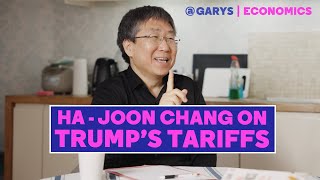 02:15
Ha-Joon Chang explains the child labour vs schooling analogy for infant industry protection
Watch at 02:15 →
02:15
Ha-Joon Chang explains the child labour vs schooling analogy for infant industry protection
Watch at 02:15 →
The key distinction Chang draws is between strategic, targeted protectionism aimed at developing specific industries, and the kind of broad, sweeping tariffs that Trump announced. One is a surgeon's scalpel. The other is more like a sledgehammer applied to the entire economy and hoping something useful comes out the other side.
What Is Infant Industry Protection and Does It Work?
The most historically successful use of tariffs is built on a concept called infant industry protection. The idea is straightforward: economically developing nations protect and nurture their young industries — through tariffs, subsidies, and other support — so those industries can grow strong enough to eventually compete with more advanced foreign firms.
Chang uses a memorable analogy to explain it. You could send a five-year-old child to work instead of school. In the short term, that saves money — no school fees, no childcare. But that child will never become a doctor, engineer, or architect. They'll be locked into low-productivity work forever. The same logic applies to industries. If you protect them while they're young and developing, invest in their growth, and eventually release them into competitive markets, you can build genuine long-term productivity. If you just expose them to full global competition from day one, they often never get the chance to develop at all.
05:40
Chang lists the countries that became rich using strategic tariffs and protectionism
Watch at 05:40 →
This isn't a fringe theory. It's the foundation of how many of the world's most successful economies were actually built.
Which Countries Got Rich Using Tariffs and Protectionism?
The list of countries that used strategic protectionism to industrialise is long and includes some surprising names. Britain, often held up as the birthplace of free trade ideology, was actually a heavy user of protective tariffs throughout the 18th and early 19th centuries — when Belgium, the Netherlands, and parts of Italy were technologically ahead of it. Britain used protection to catch up.
The United States maintained tariffs of 40–50% well into the 20th century, right up to World War II, shielding its industries from British and European competition. This strategy was actually formalised by Alexander Hamilton — the first US Treasury Secretary and the face on the $10 bill — whose ideas about protecting domestic industry became known as the American System.
Later, Germany, Sweden, France, Japan, South Korea, and Taiwan all used versions of the same playbook to build their industrial bases and transition from relatively poor, agricultural economies to high-income industrial powerhouses. South Korea is perhaps the most dramatic modern example — one of the very few genuinely poor countries to have become rich in the last 70 years, and it did it in large part through deliberate, state-directed industrial policy backed by targeted trade protection.
09:10
The 45-year-old son analogy — why Trump tariffs are not infant industry protection
Watch at 09:10 →
How Did the US Use Tariffs to Build Its Economy?
It's worth dwelling on the American case because it directly complicates the standard free-market story often told about US economic history. The US that emerged as the world's dominant industrial power by the mid-20th century was not built on free trade. It was built behind high tariff walls that gave American manufacturers the breathing room to develop, scale, and eventually outcompete the world.
Hamilton's argument was simple: Britain had a massive head start in industrial technology and capital. If the young United States competed freely against British manufacturing, American industry would be crushed before it could get started. Tariffs gave domestic producers the time and resources to grow. That strategy worked. By the early 20th century, the US was the most productive industrial economy on earth.
Why Won't Trump Tariffs Bring Manufacturing Back?
Here's where it gets complicated — and where Chang's analysis is most pointed. Trump's Liberation Day tariffs are not infant industry protection. They're not targeted at specific emerging sectors that the US is trying to develop from scratch. They're broad tariffs applied across the board to an economy that has already deindustrialised over 40 years.
Chang describes this as being like a parent suddenly deciding to protect a 45-year-old son who's not doing well. Infant industry protection only makes sense for industries that are young and have genuine growth potential. Applying it to industries that have been hollowing out for decades, in an economy that no longer has the industrial ecosystem to support them, is a fundamentally different and far less promising proposition.
There's also the question of industrial ecosystems. High productivity manufacturing doesn't just require a factory. It requires skilled workers, specialised infrastructure, supply chains, university research departments aligned with industry needs, and decades of accumulated knowledge. You cannot rebuild that with one plant here and one plant there. The tissue of support doesn't exist anymore, and it cannot be recreated in a two or three year political cycle.
Some foreign companies may engage in what's called tariff jumping — setting up US-based production facilities to avoid import costs, as Fiat and Ford did in Brazil in the 1960s and 70s when Brazil imposed high tariffs on car imports. Trump appears to be hoping for exactly this. Some of it will happen. But it won't come close to restoring American industrial capacity at any meaningful scale.
Will Trump Tariffs Raise Prices for Americans?
Almost certainly, yes — and this is where the politics get particularly difficult. Broad tariffs are effectively a tax on imported goods, and those costs get passed on to consumers. In the short to medium term, before any new domestic production comes online to offset them, Americans will simply pay more for a wide range of products.
Chang is clear that this inflation effect, combined with rising inequality, makes the current approach politically unsustainable. The people hardest hit by inflation are always those with the least financial cushion — lower-income Americans — which creates a sharp tension with the political coalition that supports these policies.
How Does Wall Street Undermine US Industrial Policy?
There's one more structural obstacle that Chang raises, and it's one most commentators miss entirely. Even if tariffs do generate extra profits for American companies, the US financial system is likely to drain those resources before they can be reinvested in productivity.
Over the last 25 years, top American corporations have returned something like 90 to 95% of their profits to shareholders — through dividends and especially through stock buybacks. The logic of shareholder primacy that dominates US corporate culture means that if you hand companies a windfall through trade protection, their shareholders will demand buybacks, not factories. The result would be higher stock prices and higher inequality, not a rebuilt industrial base.
This is a genuinely important structural point. The kind of industrial policy that worked in Japan and South Korea depended on companies reinvesting profits into long-term productive capacity. That required a financial system and a corporate culture oriented toward long-term growth. The US currently has neither.
So Will Trump's Tariffs Improve Living Standards?
The short answer, based on the analysis here, is no — at least not in any near-term timeframe. Rebuilding an industrial base that has been eroding for 40 years would take, at minimum, a couple of decades of sustained, targeted, well-designed industrial policy — not broad tariffs applied without a coherent plan for which industries to develop, how to build the workforce, or how to ensure corporate profits actually get reinvested.
The one note of cautious optimism Chang offers is that Trump has no fixed ideology. If the tariffs clearly aren't working, he may well change course. That flexibility, as uncomfortable as it is in other respects, at least leaves open the possibility of a policy reversal before the damage becomes permanent. Whether that reversal comes quickly enough to matter is another question entirely.