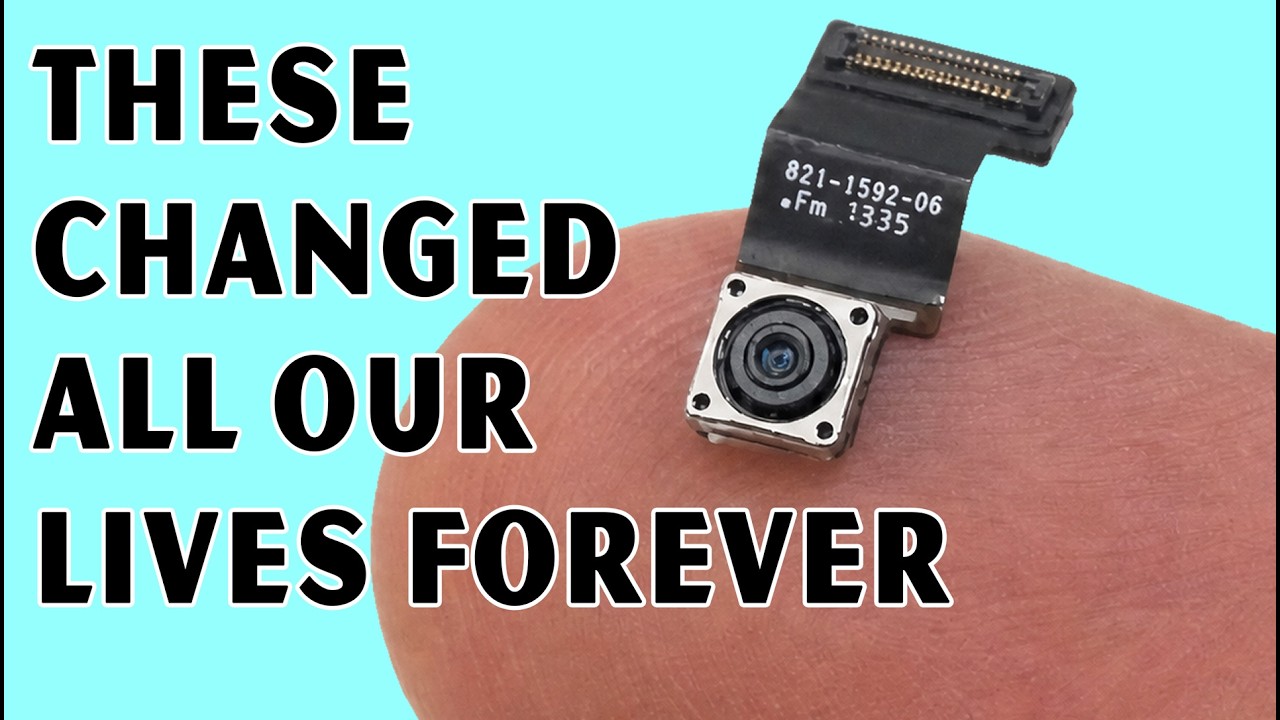

A single image or a single video can change the world forever — and that's using just one camera image sensor. In the last 15 years, over 75 billion CMOS camera sensors have been produced and embedded into everything from doorbells to drones, smartphones to satellites, pill cameras to moon missions. These tiny chips have fundamentally answered the question of how camera sensors changed the world: they gave vision to what was once blind, and in doing so, reshaped how we communicate, fight wars, monitor cities, and understand ourselves.
How Did Tiny Camera Sensors Change Everything?
The scale of what these sensors have enabled is almost impossible to comprehend. Consider YouTube alone: roughly 43.2 million minutes of video are uploaded every single day. If you tried to watch just one day's worth of uploads continuously, it would take you over 82 years — a literal lifetime. Almost all of it was recorded on a CMOS camera sensor of some kind.
 00:45
Overview of the 75+ billion CMOS sensors produced and the industries they now inhabit
Watch at 00:45 →
00:45
Overview of the 75+ billion CMOS sensors produced and the industries they now inhabit
Watch at 00:45 →
Before these sensors became widespread, cameras were single-purpose, bulky devices. You made a conscious decision to carry one. Film had to be developed over days. Video was recorded to tape and required conversion before uploading. Live streaming was the exclusive domain of professional news crews with satellite vans and thousands of dollars worth of equipment. For ordinary people, none of that was accessible. The CMOS sensor, combined with the smartphone, changed all of that almost overnight.
Low-cost image sensors created the TikTok generation, launched millions of cat videos into the cultural ether, brought the word selfie into everyday language, and made YouTube the largest broadcast network on Earth — where anyone, anywhere, can be a star. This is not just a technology story. It is a story about how one small piece of silicon rewired human civilization.
When Was the CMOS Sensor Invented and By Whom?
The modern camera-on-a-chip was first developed in 1993 at NASA's Jet Propulsion Laboratory by Dr. Eric Fossum and his team. The goal was originally to create smaller, lower-power imaging devices for spacecraft. What emerged was a technology that would eventually touch nearly every human being on the planet.
03:10
The Sharp J-SH04 — the first mass-market camera phone, launched in Japan on 1st November 2000
Watch at 03:10 →
However, the invention alone wasn't enough. It still took years before the CMOS sensor found its way onto a device that people carried with them everywhere. The transistor took time to change the world too — and like the transistor, the CMOS image sensor is arguably one of the greatest technological enablers in modern history. Without it, almost nothing in the digital visual world we inhabit today would exist.
How Did Camera Phones Revolutionize Photography?
The revolution began in Japan. On 1st November 2000, Sharp launched the J-SH04 — the first mass-market camera phone — with a modest 0.11 megapixel integrated camera. The image quality was basic by any standard, but the concept was transformative: for the first time, you had a camera built into the device you already carried everywhere.
Growth was rapid. An estimated 10 million camera phones sold in just the first nine months of 2002. By 2004, prices had dropped enough for serious mass adoption. By 2007, the first iPhone arrived and changed the game again. By 2011, camera-phone sales exceeded one billion units per year.
Smartphones didn't just make cameras convenient — they made the camera a core part of identity, communication, and social media. If something happened, you had the device to record it right in your pocket. You could share it with millions of people within minutes. As mobile networks evolved and 4G became standard in the early 2010s, video quality rivalled HD television, and platforms like YouTube and Facebook introduced live streaming to the masses — in 2011 and 2015 respectively. Ordinary people could now broadcast to the world. That had never been possible before.
07:25
How networked CCTV and AI facial recognition work across a city-wide surveillance system
Watch at 07:25 →
How Has Citizen Journalism Changed the News?
Before the smartphone era, the news was controlled by a relatively small number of broadcasters — the BBC, ABC, CBS, CNN — each with a limited number of camera crews who might be hours or even days away from a breaking story. That model has been fundamentally disrupted.
Major events are now often first recorded by ordinary people, not journalists. Protests, accidents, natural disasters, and armed conflicts can be documented in real time and pushed to millions of viewers around the world within seconds. Citizen war reporting, in particular, has shown the true, unfiltered face of conflict in ways traditional broadcast news never did or could. Despite attempts by some governments to suppress coverage, people consistently find ways to share footage through international networks and social platforms.
10:50
Low-cost camera drones in the Ukraine conflict — the moment hobbyist tech became a weapon of war
Watch at 10:50 →
The Ukraine conflict, which began in February 2022, demonstrated this with stark clarity — a conflict documented minute by minute by soldiers, civilians, and journalists alike using nothing more than a smartphone.
How Are Cameras Used in Surveillance Today?
The same scale of production that made camera phones cheap made surveillance cameras smaller, cheaper, and far more capable. The security industry had used cameras since the vacuum tube era, but the shift to digital CMOS sensors transformed it entirely. Signals became digital. Storage became networked. And the old limitations of VHS tape recordings vanished.
13:30
The OmniVision OV6948 — the world's smallest commercially available camera sensor, next to a grain of sand
Watch at 13:30 →
A simple example is the Ring Doorbell camera. It watches continuously, day and night, using built-in AI to recognise known faces and alert homeowners to movement. Footage is uploaded automatically to remote servers — technically yours, but stored on Amazon's infrastructure and accessible to law enforcement via court order.
But this is just the visible edge of a much larger system. Networks of CCTV cameras in towns and cities now merge camera ubiquity with high-speed networking and advanced AI facial recognition. Cameras can check almost every face in view against watchlists of wanted suspects, missing persons, or individuals with court orders. People can be tracked across wide areas — even across cities. Traffic cameras can read number plates on multiple vehicles simultaneously on multi-lane highways, check speeds, identify vehicle types, and even detect whether occupants are wearing seatbelts or using a phone. The latest systems have the resolution to perform live facial recognition of car occupants, though authorities in the UK, for example, say this capability is not yet deployed — at least, not officially.
How Have Camera Drones Changed Modern Warfare?
Not long ago, low-cost commercial drones with cameras were mostly a hobbyist technology — people filming their local countryside and uploading it to YouTube. That image has been shattered permanently by the conflict in Ukraine.
Since February 2022, low-cost camera drones have changed warfare forever. What were once dismissed as toys are now precision weapons — a hybrid between a sniper's rifle and an artillery strike. They are used for surveillance, targeting, and direct attack against individuals, vehicles, buildings, helicopters, and even other drones. The barrier to entry is low, the impact is devastating, and no military in the world can now ignore what a $500 drone with a small camera can do on a modern battlefield.
What Is the World's Smallest Camera Sensor?
At the other end of the scale from battlefield drones sits what is currently the smallest commercially available image sensor in the world: the OmniVision OV6948, which holds the official Guinness World Record for the title.
The sensor itself measures just over half a millimetre square and 0.23mm in length. Integrated into a complete camera module, it occupies roughly the same space as a single grain of sand, with a resolution of 200 x 200 pixels at 30 frames per second.
Designed primarily for medical use, it is integrated into disposable guidewires, catheters, and endoscopes, allowing surgeons to navigate the narrowest blood vessels and smallest anatomical structures without invasive equipment. But the implications reach well beyond medicine. Sensors this small could give vision to robotic insects, fly-sized drones, and machines small enough to sit on the tip of your finger. The era of invisible cameras is not science fiction — it is a near-term engineering reality.
What Does the Future of Camera Technology Look Like?
From dashcams that captured a meteor airburst over Chelyabinsk in 2013 — recorded by hundreds of ordinary drivers and used by scientists to reconstruct the asteroid's trajectory — to Tesla's multi-camera AI driving systems, to humanoid robots navigating the world using camera-based vision, the pattern is consistent: wherever cameras go, capability follows.
Working from home, normalised by the COVID-19 pandemic, was only possible at scale because of tiny, affordable webcam sensors. Video meetings are now a permanent fixture of professional life. The camera did not just change how we see the world — it changed how we work, how we fight, how we're governed, and how we remember.
These tiny chips are, in a very real sense, one of the greatest technological enablers since the invention of the transistor. The question is no longer whether camera sensors have changed the world. The question is: how far does it go from here?