What Was Project Horizon, the Army's Secret Moon Base Plan?
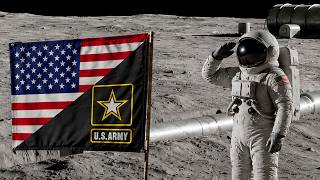
Project Horizon was a serious 1959 US Army proposal to build a permanent 12-man military base on the Moon by 1966 — a full three years before Apollo 11 landed just two men for a few days. This wasn't science fiction scribbled on a napkin. It was a detailed, classified report outlining nuclear reactors, underground living quarters, orbital refuelling stations, a brand-new equatorial launch site, and hundreds of rocket launches. And it was all meant to be operational before NASA had even put a single American into orbit.
To understand just how audacious this was, consider the context: when the Horizon report was written in June 1959, most early US rockets were still blowing up on the launchpad. The Mercury programme had barely begun. Yet the Army was proposing not just to reach the Moon, but to garrison it like a military outpost. As the saying goes — rockets are hard. Project Horizon was something else entirely.
 01:45
Overview of what Project Horizon proposed: a 12-man permanent military moon base by 1966
Watch at 01:45 →
01:45
Overview of what Project Horizon proposed: a 12-man permanent military moon base by 1966
Watch at 01:45 →
Why Did the US Army Want a Military Base on the Moon?
The short answer: the Soviets. The Cold War was at full intensity, and the fear of Soviet dominance — in ideology, technology, and now space — was driving some genuinely extreme thinking inside the US military establishment. The Horizon report explicitly stated that its purpose was to virtually claim the Moon for the United States, establishing presence by "first occupancy" before the Soviets could do the same.
And those fears weren't entirely paranoid. By the time the report was published in mid-1959, the Soviets had already achieved the first escape from Earth's gravity with Luna 1, scored the first lunar impact with Luna 2, and photographed the far side of the Moon with Luna 3 — all within months of each other. Meanwhile, the US had attempted 43 launches to the Soviets' 11, but suffered 25 failures compared to only 5 Soviet failures. The Americans were losing, badly, and everyone knew it.
There was also a specific political nightmare scenario being war-gamed: what if the Soviets celebrated the 50th anniversary of the October Revolution in 1967 from a base on the lunar surface? The propaganda value alone would have been devastating. A US military moon base, operational by late 1966, would pre-empt that entirely. This thinking wasn't happening in a vacuum either — it was the tail end of the Red Scare, the era of McCarthyism, and paranoia about Soviet influence had seeped into every corner of American institutions.
How Would 12 Soldiers Actually Live and Survive on the Moon?
This is where Project Horizon gets genuinely fascinating. The planners thought through the survival problem in serious detail, and some of their solutions are surprisingly sophisticated for 1959.
04:20
Diagram of the proposed underground cylindrical living quarters and nuclear power setup
Watch at 04:20 →
Underground Living Quarters
The base would be built underground — not for dramatic effect, but for survival. The lunar surface is bombarded by radiation and wild temperature swings, dropping as low as -40°C on the shadowed surface. The plan called for cylindrical metal tanks, roughly 3 metres wide and 6 metres long, buried beneath the regolith. These tanks would use a double-walled "thermos bottle" design, exploiting the Moon's own vacuum as insulation. The engineers believed that internal lighting alone might generate enough heat to keep the interior comfortable. Clever, compact, and genuinely practical.
Power: Nuclear From Day One
Forget solar panels — Project Horizon was going nuclear from the start. The base would be powered by two small nuclear reactors buried near the initial quarters, with two more added once the permanent base was complete. It's worth noting that the Army didn't even seriously consider solar as a primary power source. Partly because 1959 solar panel technology was far less efficient than today's, but also because nuclear just made more sense for a facility that needed to run continuously through the two-week lunar night.
Air, Water, and Food
The base atmosphere would be maintained using insulated tanks of liquid oxygen and nitrogen. Nitrogen would handle initial pressurisation and leak replacement; oxygen would be continuously consumed by the crew. Carbon dioxide and moisture would be scrubbed using chemical absorbents and dehumidifiers, with a later freeze-out CO2 system planned as the base matured.
Food would start as pre-cooked supplies, transitioning to dehydrated and frozen foods as water recovery systems improved. The report even floated the idea of hydroponic salad growing and closed-cycle food production — remarkably forward-thinking for a military document written before any human had left Earth's atmosphere.
08:55
The staggering launch schedule: 229 Saturn rocket firings needed to build the base
Watch at 08:55 →
Moon Suits With Metal Outer Shells
The Army's proposed Moon suits were unlike anything NASA eventually flew. Instead of flexible fabric, the Horizon suits featured a rigid metal outer surface. The Army was deeply concerned about fabric or rubberised suits being punctured by micrometeoroids, abraded by sharp lunar dust, or being difficult to sterilise between uses. Since the Moon's gravity is only one-sixth of Earth's, the extra weight of a metal suit was considered an acceptable trade-off for the added durability.
How Many Rocket Launches Would a Moon Base Actually Require?
This is where Project Horizon's ambition starts to look genuinely staggering. To get the base operational with 12 personnel by November 1966, the plan required 61 Saturn I launches and 88 Saturn II launches — roughly 5.3 launches per month, sustained over years. And the Saturn II didn't even exist yet; it was a proposed upgrade to the Saturn I that would eventually inform the development of the Saturn V.
During the first operational year alone (December 1966 through 1967), another 64 launches were scheduled, delivering an additional 120,000 kg of supplies to the lunar surface. By the end of 1967, the total manifest called for 229 Saturn vehicle firings, with 252 people transported to Earth orbit, 42 continuing to the Moon, and 26 returning home.
For comparison, if the Saturn V had been available from the beginning, the entire initial setup could have been accomplished in just 32 launches instead of roughly 150. That single number tells you everything about how the development of the Saturn V transformed what was actually possible.
The plan also required an orbital space station for rendezvous and refuelling — a concept that wouldn't become reality until the Soviet Salyut 1 in 1971 and the US Skylab in 1973. And it needed a brand-new equatorial launch site, with Brazil and Christmas Island identified as the top candidates, because existing US ranges in Florida and California were too far from the equator and already overloaded with weapons R&D.
How Did Project Horizon Compare to What Apollo Actually Did?
Apollo 11 landed two men on the Moon in July 1969 — three years after Horizon's target date for a 12-person permanent base. Apollo used the Saturn V (which Horizon's planners didn't have access to), the lunar orbit rendezvous technique (which Horizon hadn't fully adopted), and kept astronauts on the surface for hours rather than months. The contrast is stark.
Apollo's total cost ballooned from an initial $20 billion estimate in 1962 to $35 billion by 1963 — nearly four times the cost growth in just four years. Horizon's 1959 budget estimate was $6 billion (roughly $75 billion in today's money), and Horizon was a vastly larger, more complex programme. The real cost would almost certainly have been astronomical.
Why Was Project Horizon Cancelled Before It Ever Started?
Ironically, Horizon was killed not by technical failure but by organisational politics. NASA had been formed in 1958, and by the time the Horizon report was submitted in mid-1959, the writing was already on the wall: all US crewed space programmes were being transferred to civilian control. The Army was being deliberately cut out of the space business.
Any genuinely useful ideas within Horizon were quietly absorbed into future civilian space planning. The rest was shelved. The proposal had also wildly overestimated both US capability and Soviet intent — the Soviets never came close to landing on the Moon, running out of time and money by the late 1960s, and the political will to maintain a permanent lunar presence evaporated the moment Apollo proved the point.
Could the US Really Have Built a Moon Base Before Apollo 11?
Almost certainly not by 1966, and probably not before the early 1970s even with unlimited funding. Project Horizon required solving virtually every major challenge of spaceflight simultaneously and from scratch: translunar navigation, soft lunar landing, orbital docking and refuelling, long-duration life support, nuclear power in space, and sustained heavy-lift launch cadence — all before any human had left Earth's atmosphere.
The report itself insisted its approach was "conservative and not science fiction." In hindsight, that claim is almost charming. But it's also a reminder that the impulse driving Horizon — the fear of being beaten to a strategically important frontier by a geopolitical rival — never really goes away. Today, it's China that's being cited as the reason to return to the Moon permanently. The Cold War logic has new names, but the same urgency. Get your popcorn ready.