
The B-52 is still in service for a reason that surprises most people: it was never really about speed or stealth. The Air Force kept the B-52 flying for over 70 years because it solved a problem no other aircraft solved as cheaply or as flexibly — carrying enormous payloads over intercontinental distances and adapting to whatever weapons technology produced next. While newer and faster aircraft came and went, the B-52 quietly reinvented itself again and again. Today it remains a critical part of the US nuclear deterrent and conventional strike arsenal, and official plans have it flying past 2050.
But the B-52 did not survive alone. The B-1B Lancer — a swing-wing supersonic penetration bomber that entered service in the 1980s — is still flying alongside it, despite being stripped of its nuclear role and repeatedly cut in fleet size. To understand why both bombers coexist rather than one replacing the other, you have to understand why they were built in the first place, and what made each one irreplaceable in its own way.
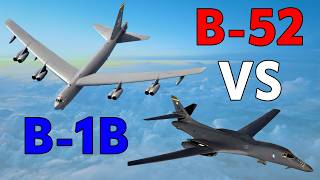 00:30
B-52 and B-1B side by side, showing the stark visual difference between the two aircraft generations
Watch at 00:30 →
00:30
B-52 and B-1B side by side, showing the stark visual difference between the two aircraft generations
Watch at 00:30 →
Why Is the B-52 Still Flying After 70 Years?
The B-52 Stratofortress entered service in 1955, and the last B-52H was delivered in 1962. That means the newest aircraft in the fleet is now 63 years old. By any normal measure, that should have been a museum piece decades ago. So why is it still flying?
The answer is that the B-52 was never locked into one way of doing things. It was originally designed to fly very long distances, carry nuclear weapons, and provide a manned strike option without depending too heavily on overseas bases. That core capability — vast range, enormous payload, flexibility — turned out to be more durable than any specific tactic.
When high-altitude bombing became suicidal after Gary Powers was shot down in his U-2 spy plane at 70,000 feet on 1 May 1960 by a Soviet surface-to-air missile, the B-52 adapted to low-level penetration below 300 feet. When cruise missiles like the AGM-86 arrived, the B-52 became their primary carrier. When precision conventional weapons became the focus after the Cold War, the B-52 carried those too. Its survival is a story of strategic flexibility, not performance superiority.
04:15
Operation Chrome Dome routes showing B-52s flying constant nuclear alert missions near Soviet borders
Watch at 04:15 →
Aircraft also do not age the way cars do. What matters is not the year they were built, but how many stress cycles the airframe has accumulated, how hard they were flown, and what condition the critical structures are in. The Air Force tracks fatigue in known weak points, inspects them constantly, and replaces specific structural elements before they fail. The B-52s that avoided the most punishing low-level flying preserved more structural life, and those airframes still have margin left. Add to that a major modernisation programme — new AESA radar, Rolls-Royce F130 engines (608 engines contracted in 2021), new communications and avionics — and the aircraft emerging as the B-52J is in many ways a new aeroplane built around a proven skeleton.
B-52 vs B-1B: What Is the Actual Difference?
Put the two aircraft side by side and they look like they belong to completely different theories of warfare — because they do. The B-52 is a long, high-wing subsonic aircraft built around endurance, payload and adaptability. The B-1B is a variable-geometry swing-wing aircraft built around speed, low-level penetration and a reduced radar cross-section.
The B-52 was designed from the start as an intercontinental heavy bomber. During Operation Chrome Dome, nuclear-armed B-52s flew 24 hours a day, seven days a week from November 1961 to January 1968, staying airborne near Soviet borders to guarantee a second-strike capability. Its strength has always been that it can carry a very heavy load a very long way and launch weapons from outside the danger zone. That makes it ideal in a world of long-range stand-off cruise missiles.
The B-1B was designed around a different problem entirely: getting through Soviet air defences by flying very fast and very low. It was built to penetrate defended airspace, not to loiter outside it. That difference still defines how each aircraft is used today. The B-52 operates from stand-off range as a weapons truck. The B-1B was built to go in closer, faster, and survive through speed and terrain masking rather than stealth or distance.
08:45
B-1B swing-wing system demonstrated in flight, showing the variable-geometry design that makes it maintenance-intensive
Watch at 08:45 →
Why Was the Original B-1A Bomber Cancelled in 1977?
The B-1's history is more complicated than most people realise, because there were effectively two different aircraft separated by a cancellation and a revival. The original B-1A was designed in the 1960s and 70s as a direct replacement for the B-52, built around low-level supersonic penetration of Soviet airspace. But the Carter administration cancelled it in 1977 for two converging reasons.
First, newly developed cruise missiles like the AGM-86 — which could be carried by the existing B-52 fleet — looked capable of providing much of the same deterrent at far lower cost. Second, and more technically significant, Soviet air defence systems were improving rapidly. Aircraft like the MiG-25 Foxbat were developing genuine look-down, shoot-down capability against low-altitude targets. The B-1A's entire survival logic — fly fast and low and they cannot catch you — was becoming less certain just as its cost was becoming harder to justify.
The Reagan administration revived the programme in 1981, but the aircraft that emerged — the B-1B Lancer — was meaningfully different. It traded some top-end speed for a smaller radar signature, better avionics, more internal payload and a stronger low-level penetration design that was better matched to the Soviet air defence environment of the 1980s.
Why Did the B-1B Lose Its Nuclear Mission in 1994?
The B-1B entered service in the 1980s as a nuclear bomber, but the United States removed its nuclear mission in 1994 as part of post-Cold War treaty commitments, with formal conversion to conventional-only status completed by 2011. That could easily have made it irrelevant — a supersonic penetration bomber with no penetration mission and no nuclear role.
Instead, it found a new purpose. In Afghanistan and Iraq, the B-1B proved genuinely useful not because it was dashing alone through Soviet-style air defences, but because its large internal payload, terrain-following radar, GPS-aided navigation and later digital connectivity upgrades made it an effective conventional strike platform. It could loiter, respond to changing targeting information, and deliver a large volume of precision-guided weapons. The Air Force records show the B-1B delivered a disproportionately high share of precision weapons relative to sorties flown during Operation Enduring Freedom and Operation Iraqi Freedom.
How Long Can the B-52 Actually Keep Flying?
The Air Force currently expects the B-52 to remain in service through 2050, and recent official statements suggest potentially beyond that. That would make it, comfortably, the longest-serving combat aircraft in history — nearly a century in service if it reaches 2050 and beyond.
The B-1B is in a different position. It was designed for 8,000 to 10,000 flight hours, but its sophisticated swing-wing design makes it maintenance-intensive and expensive to sustain. In 2021 the Air Force cut the active fleet from 62 to 45 aircraft so it could concentrate resources on the best-condition airframes. Some B-1Bs were so worn that restoration would have cost tens of millions of dollars each. The pivot pins and bearings of the swing-wing system are major structural items that require constant monitoring, and retired airframes are being torn apart to study fatigue patterns and inform how the remaining fleet is inspected and reinforced.
What Will Replace the B-52 and B-1B Bombers?
For the B-1B, the answer is relatively clear. The B-21 Raider is designed to incrementally replace both the B-1B and the B-2 Spirit, eventually becoming the backbone of the US penetrating strike force. The Air Force describes the B-21 as a dual-capable penetrating stealth bomber built for high-end threat environments — exactly the role the B-1B was originally designed for, but with genuine low-observable characteristics rather than just reduced radar cross-section.
What Is the B-21 Raider Designed to Replace?
The Air Force's stated future bomber force structure is built around two aircraft: the B-21 Raider and the modernised B-52J. The B-21 handles the high-threat penetration mission. The B-52J continues as a long-range stand-off carrier and nuclear platform. That means the B-52's successor may not be a single aircraft at all — it may be a combination of the B-21, increasingly long-range stand-off weapons, and future uncrewed or collaborative systems that extend the reach and survivability of the overall strike force.
The story of the B-52 and B-1B is ultimately a story about what problems actually matter in strategic air power. Speed, altitude, and penetration have all had their moment. But range, payload, adaptability and the ability to carry whatever the next generation of weapons turns out to be — those problems never went away. That is why a bomber designed in the 1940s is still flying, and why its replacement may not be one aircraft but a whole new way of thinking about strike warfare.