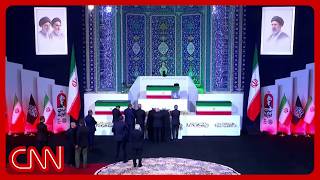
Ayatollah Ali Khamenei's funeral in Tehran drew what Iranian officials estimated to be up to 20 million people — potentially the largest funeral gathering in the country's history. Held at the massive Masala complex in central Tehran, the ceremony took place more than four months after Khamenei was killed in a U.S.-Israeli airstrike in late February, along with several family members. The event was as much a political statement as a moment of mourning, carefully choreographed to send a message of resilience and defiance to the world.
What Happened at Khamenei's Funeral in Tehran?
The streets of Tehran were packed with mourners as Iran held the state funeral for its longtime Supreme Leader. Security across the city was described as extremely tight, with billboards, posters, and even building-mounted statues bearing Khamenei's image lining the roads. Chants of "death to America" and calls for revenge against the United States and Israel echoed through the crowds.
 00:45
Crowds filling the streets of Tehran ahead of the funeral at the Masala complex
Watch at 00:45 →
00:45
Crowds filling the streets of Tehran ahead of the funeral at the Masala complex
Watch at 00:45 →
CNN's Fred Pleitgen was the only Western television journalist granted access inside the event — though CNN noted it operated with the permission of the Iranian government while maintaining full editorial control. Pleitgen reported that final preparations at the Masala complex were immense in scale, and that the emotional intensity on the streets was palpable.
Among the caskets lying in state was a particularly heartbreaking sight: a small coffin containing the remains of Khamenei's granddaughter, who was also killed in the airstrike. Iran's president, foreign minister, and chief negotiator were among the first political and military figures to pay their respects. The head of the Revolutionary Guards, Ahmad al-Bahidi — who had not been seen publicly since his appointment following Khamenei's death — also made a rare appearance at the ceremony.
02:10
Iranian citizens expressing rage toward the U.S. and Israel on camera
Watch at 02:10 →
Iranians on the streets were unambiguous in their anger. "Trump is the most bloodthirsty enemy in all the world," one woman told reporters. "All people should stand up — everyone should rise." A man nearby added, "We do not expect peace from the enemy. Our experience has proven this to us."
Why Is Iran's New Supreme Leader Missing in Public?
Perhaps the most glaring question surrounding the funeral was the complete absence of Iran's new Supreme Leader, Mojtaba Khamenei — the son of the slain leader. He was quickly named as successor after his father's assassination, but has not appeared in public since taking power and has communicated exclusively through written statements.
Former New York Times Iran correspondent Nazila Fathi called his absence "the most striking" element of the entire ceremony. "Even the head of the Revolutionary Guards, who had not been seen in public since his appointment, made an appearance," she noted. "How come he's not showing up for his own father's funeral?"
04:30
Nazila Fathi discussing the significance of Mojtaba Khamenei's public absence
Watch at 04:30 →
The implications are significant. A funeral of this scale — designed to project strength, unity, and a smooth leadership transition — loses much of its symbolic power without the new Supreme Leader present. Whether Mojtaba Khamenei's absence reflects security concerns, internal political tensions, or a deliberate strategic choice remains unclear. But analysts agree: the messaging is incomplete without him, and the world is watching closely.
Where Do US-Iran Peace Negotiations Stand in 2025?
Even amid the grief and fury on display in Tehran, behind-the-scenes diplomacy has not stopped. Iranian officials confirmed that any further negotiations with the United States would be paused until after the funeral ceremonies conclude following July 9th.
Before the funeral, U.S. envoys Jared Kushner and Steve Witkoff traveled to Qatar for talks. According to Fathi, both sides quietly reached an informal understanding: for roughly a week to ten days surrounding the U.S. Independence Day on July 4th and the Iranian funeral, neither side would take aggressive action — particularly in the Strait of Hormuz.
Mediators from Pakistan and Qatar are reportedly optimistic that the conclusion of the funeral could mark a turning of the page for Iran's new leadership, potentially unlocking more flexibility in negotiations. The theory is that once the formal mourning period ends, Mojtaba Khamenei's government may feel freer to engage diplomatically without appearing to compromise while the nation grieves.
However, Fathi was candid about her skepticism: "I have big question marks about this." The path to any lasting peace agreement remains riddled with uncertainty, distrust, and political pressure on both sides.
Will Iran Reopen the Strait of Hormuz After the Ceasefire?
One of the most consequential questions for global energy markets is what happens in the Strait of Hormuz once the ceasefire quiet period ends. Iran effectively shut down the critical waterway following the U.S.-Israeli strikes, sending shockwaves through global oil markets.
A shaky ceasefire is currently holding. Reports suggest that a new arrangement — described as a kind of hotline between the U.S. and Iran — has been established to de-conflict incidents in the Strait. But analysts are skeptical about whether this hotline will prove effective in practice.
The key question: will Iran resume targeting ships in the Strait of Hormuz after July 9th? If the answer is yes, the ceasefire collapses and negotiations become far more complicated. If Iran holds back, it could signal a genuine willingness to move toward a broader diplomatic resolution. For now, the world waits.
Which Countries Attended Khamenei's Funeral?
The list of nations sending delegations to the funeral was itself a geopolitical signal. As expected, China and Russia sent prominent representatives, underscoring their alignment with Tehran against Western pressure.
But the more surprising attendee was Saudi Arabia. Relations between Tehran and Riyadh have been deeply strained — Iran has launched some of its most intense attacks against Saudi targets in recent years. The presence of a Saudi delegation suggests either a diplomatic opening or at minimum a desire by Riyadh to avoid further escalation during an extraordinarily volatile moment in the region.
Fathi described the overall delegation lineup as "very choreographed" — a deliberate departure from previous Iranian state events. The careful curation of who was invited and how the ceremony unfolded reflects a new Iranian government acutely aware of the optics it is projecting internationally.
What Does the Shiite Symbolism at the Funeral Mean?
Beyond the politics, the funeral was steeped in heavy Shiite religious symbolism that carried deliberate meaning for the Muslim world. Most notably, Khamenei's coffin was draped in a flag bearing the inscription "Ya Hussein" — a reference to Hussein ibn Ali, the grandson of the Prophet Muhammad, who was killed fighting against injustice.
By invoking Hussein's martyrdom, Iran was drawing a direct parallel between Khamenei's assassination and one of the most sacred figures in Shiite Islam. The message was clear: Khamenei was not just a political leader — he was a martyr who died defending his people against oppressors, just as Hussein did centuries ago.
This framing serves multiple purposes. It elevates Khamenei's legacy within the Shiite religious tradition, it inflames the moral outrage of the faithful, and it positions Iran as the central hub and defender of Shiite Islam globally. For Iran's new leadership, connecting the late Supreme Leader to such a revered historical figure helps cement both religious legitimacy and political authority during a dangerously uncertain transition period.
What Comes Next for Iran?
The days following the funeral will be critical. With negotiations on pause, a new and publicly invisible Supreme Leader at the helm, and a ceasefire that both sides describe as fragile, the situation remains deeply unpredictable. Will Mojtaba Khamenei finally appear in public? Will Iran resume aggression in the Strait of Hormuz? Will Pakistani and Qatari mediators succeed in pushing talks forward?
What is certain is that Iran used this funeral to send an unmistakable message to the United States, Israel, and the world: the Islamic Republic is not broken. It is grieving — and it is angry. Whether that anger translates into further military escalation or, surprisingly, a negotiated peace may define the trajectory of the Middle East for years to come.