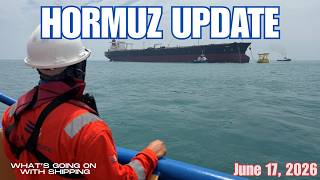
The US blockade of the Strait of Hormuz is technically still in effect as of June 17, 2026 — but it is showing serious cracks. At least five Iranian-flagged vessels, including three state-owned NITC crude oil tankers, have breached the US-enforced blockade line between June 16th and 17th, carrying an estimated 5 million barrels of oil into the open Arabian Sea. The US Navy insists the blockade remains active and enforceable, but with a landmark US-Iran memorandum of understanding on the verge of being signed in Switzerland, the entire situation is shifting by the hour.
Here is a full breakdown of everything that is happening right now, what it means for global oil markets, and whether commercial shipping will return to the Persian Gulf anytime soon.
Is the US Blockade of the Strait of Hormuz Still Active?
According to a June 15th advisory from the US Fifth Fleet, US Naval Central Command, and the Naval Cooperation and Guidance for Shipping (NCAGS), the blockade of Iranian ports remains in effect pending execution of a ceasefire agreement scheduled for June 19, 2026. The US Navy has confirmed that the blockade is enforceable through boardings or destructive fires.
 04:15
Marine Traffic AIS view showing Iranian vessels breaching the blockade line and appearing in the northern Arabian Sea
Watch at 04:15 →
04:15
Marine Traffic AIS view showing Iranian vessels breaching the blockade line and appearing in the northern Arabian Sea
Watch at 04:15 →
However, reality on the water is already diverging from the official position. Five Iranian vessels — a container ship, a bulk carrier, and three NITC crude tankers — have already slipped out of the Gulf region and into the Arabian Sea. They are not hiding along territorial waters. They are sitting in international waters, visible on AIS tracking systems, and carrying millions of barrels of oil.
The strategic irony here is notable. By breaking out of the Gulf before any agreement is formally signed, these Iranian ships have actually made themselves more vulnerable. With two US carrier strike groups, an amphibious ready group, and at least a dozen Arleigh Burke-class destroyers operating in the region, those vessels could be seized on the high seas if the Switzerland talks collapse. Sailing into the open Arabian Sea was a calculated gamble by Tehran.
What Is the US-Iran Memorandum of Understanding?
The US-Iran memorandum of understanding is a proposed interim peace deal that Bloomberg News reports is nearly finalized. A near-final draft reviewed by Bloomberg shows that Iran is set to receive sanction waivers allowing it to sell oil immediately, with other financial incentives deferred to later negotiations.
07:40
Macro Marine Traffic view showing Iranian-flagged vessels tracked by flag filter across the Arabian Sea and Indian Ocean
Watch at 07:40 →
The MOU is expected to open a two-month window for broader negotiations covering Iran's nuclear program and other outstanding issues. The formal signing ceremony is expected to take place in Switzerland within the next two days of this report. US Vice President J.D. Vance is expected to lead the American delegation, while Iran will be represented by its parliament speaker. President Trump is attending the G7 summit in France, where the Iran conflict has been a dominant topic.
France, the UK, and Italy have all indicated they are ready to assist with clearing the Strait of Hormuz of mines — though each country is proceeding cautiously given the residual dangers still present in the waterway.
What Is the Current JMIC Threat Level for the Hormuz Region?
The Joint Maritime Information Center has issued a significant downgrade of its threat levels across all three key maritime zones. Previously, the Strait of Hormuz was approaching a critical designation — the highest possible rating. As of the latest update, all three regions have been downgraded to substantial:
- Strait of Hormuz: Navigation interference persists, mine risk reporting remains relevant within and adjacent to the traffic separation scheme, and an attack is still considered a strong possibility. However, the overall risk has decreased following the announced US-Iran MOU. The potential for miscalculation remains due to continued Iranian activity in the area.
- Arabian Gulf: Residual kinetic risk remains, with potential for rapid escalation.
- Gulf of Oman: Historical projectile and unmanned aerial vehicle strike patterns continue to sustain the risk profile.
A downgrade from critical to substantial is meaningful — but it is not an all-clear. Mines have not been removed. Iranian forces are still active. And the MOU has not yet been formally signed.
Which Ships Breached the Blockade and What Are They Carrying?
According to Lloyd's List, the following Iranian-flagged vessels were confirmed to have transited out of the Gulf region between June 16th and 17th, breaching the US-enforced blockade line:
- Diona — crude oil tanker, outbound
- Bashat — Iranian container ship, outbound
- Hero 2 — crude oil tanker, outbound
- Gange — bulk carrier, outbound
- Sanyou 1 — tanker, outbound
- Herby — additional vessel departing
- Stream — additional vessel departing
Three of the five primary vessels are confirmed as state-owned NITC tankers. Combined, they may be carrying as much as 5 million barrels of crude oil. AIS tracking via Marine Traffic shows these vessels appearing openly in the northern Arabian Sea — a notable departure from the dark sailing tactics used in recent weeks.
11:55
Damage to the port side of the Hong Kong-flagged vessel Bochim Marengo following the June 14th strike in the Strait of Hormuz
Watch at 11:55 →
Most of these ships appear to have originated from the port of Chabahar and the anchorage off Jask on Iran's southeastern coast, rather than from the Persian Gulf itself.
How Has the Hormuz Crisis Crushed Global Oil Demand?
The International Energy Agency's June oil market report delivers a stark picture of how badly the Hormuz conflict has damaged the global energy economy. The IEA has sharply downgraded its global oil demand outlook, citing months of conflict centered on the strait as a fundamental disruptor of trade flows.
Key figures from the IEA report:
- Global oil demand is now expected to decline by 1.1 million barrels per day in 2026 — a downgrade of 700,000 barrels per day from last month's forecast.
- Global oil production is expected to fall by 3.9 million barrels per day this year, averaging 102.4 million barrels per day before rebounding in 2027.
- Soaring fuel prices and disruptions to refined product availability are cited as key demand destroyers.
Critically, the IEA cautioned that even a signed agreement will not produce an immediate recovery. Mines must be physically removed from shipping lanes. Supply chains require time to normalize. This is not a switch that gets flipped on Friday — it is a process that could take months.
When Will the Strait of Hormuz Reopen for Commercial Shipping?
Even if the MOU is signed in Switzerland, a full return to normal commercial shipping through the Strait of Hormuz is unlikely in the near term. Several overlapping obstacles remain:
- Mines: The traffic separation scheme is still considered a mine risk zone. Those mines must be cleared before commercial operators will risk their vessels and crews.
- War risk insurance: Even after mines are removed and an agreement is in place, war risk premiums will remain elevated. Shipping companies will pass those costs on to shippers and ultimately to consumers.
- The Iranian toll: Iran's so-called Strait of Hormuz toll, administered by the Persian Gulf Strait Authority under the Islamic Revolutionary Guard Corps, remains a live concern. Commercial operators fear being subjected to transit fees enforced by the IRGC.
- Confidence: Commercial shipping companies require sustained stability before routing valuable cargo and vessels back through a zone that has seen kinetic attacks as recently as June 14th, when the Hong Kong-flagged vessel Bochim Marengo sustained serious damage from what appears to have been an unmanned surface or aerial vehicle strike.
The bottom line: an MOU is a beginning, not an end. The path back to pre-conflict shipping volumes through the Strait of Hormuz will be long, expensive, and closely watched by every major shipping line, energy company, and naval force in the region.
What Is Iran's Strait of Hormuz Toll Booth and Who Controls It?
One of the lesser-discussed but commercially significant issues hanging over any return to normal shipping is Iran's unilateral imposition of a transit toll on vessels passing through the Strait of Hormuz. This toll authority, known as the Persian Gulf Strait Authority, operates under the Islamic Revolutionary Guard Corps — not a civilian maritime body.
For commercial shipping companies, this creates a profound dilemma. Paying the toll could be interpreted as legitimizing IRGC authority over an internationally recognized strait. Refusing to pay could invite harassment, boarding, or seizure. Until the status of this toll is resolved — either through the MOU negotiations or separate diplomatic channels — it will remain a significant deterrent to a full commercial shipping recovery.
The situation in and around the Strait of Hormuz is moving fast. Iranian ships are already in the Arabian Sea. A signing ceremony in Switzerland could happen within days. But between mines, insurance costs, military positioning, and unresolved political questions, the strait's future as a reliable commercial corridor is still far from certain. Stay tuned.