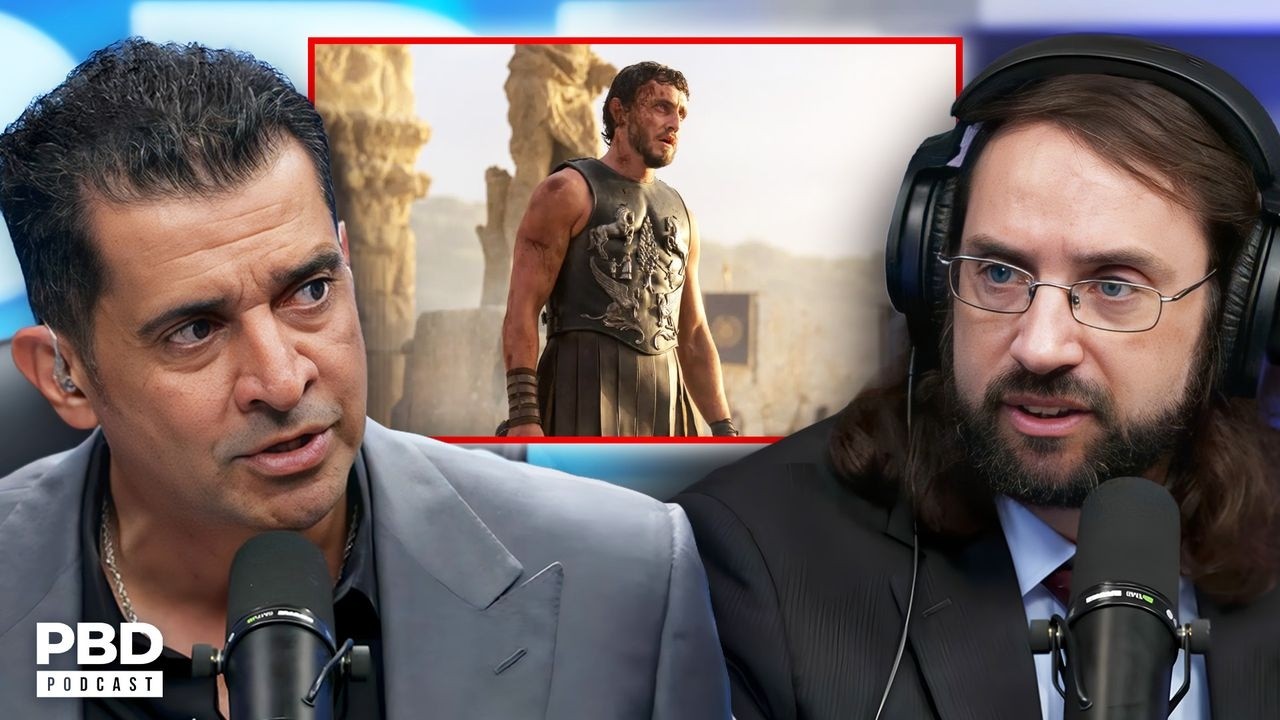

Twenty-six years after its release, Gladiator still airs on primetime television and commands a loyal streaming audience. Russell Crowe, who wasn't in the sequel at all, recently broke down exactly why — and his answer cuts to the heart of what Hollywood keeps getting wrong. It's not production budget, star power, or franchise recognition. It's moral core.
Russell Crowe's Fight to Protect the Film's Integrity
In a candid interview, Crowe revealed that he fought the studio during production of the original Gladiator to remove a sex scene. His argument was simple: this is a story about a man avenging the deaths of his wife and child. There cannot be a single moment on that journey where he stops and sleeps with someone, because that night destroys the entire journey.
 01:05
Clip of Russell Crowe explaining why he fought to remove the sex scene from the original Gladiator
Watch at 01:05 →
01:05
Clip of Russell Crowe explaining why he fought to remove the sex scene from the original Gladiator
Watch at 01:05 →
The studio pushed back. They sent him notes, argued their case. Crowe held firm. Director Ridley Scott — who, by Crowe's own admission, would have loved to film the scene — ultimately agreed that the decision was about the moral core of the film. That core, Crowe argues, is exactly why Gladiator is still being watched today. And by contrast, its absence is precisely why Gladiator 2 underperformed.
"They failed because they didn't understand why it was successful," Crowe said, visibly emotional. "It was successful because it had a moral core."
Ancient Archetypes and Why We Still Respond to Them
What makes the Gladiator conversation so striking is that it isn't really just about one film. The lines that still resonate — "My name is Maximus Decimus Meridius, commander of the armies of the north… father to a murdered son, husband to a murdered wife, and I will have my vengeance in this life or the next" — connect to something far older than cinema.
These are archetypes repeated throughout all of human history. The hero with a code. The man who fights not for power or survival, but for something. As one commentator in the conversation put it: people don't want to watch a movie where someone is fighting — they want to watch a movie where someone is fighting for something. Corrupt that, and you don't just lose their interest. You offend them.
This is why stories with genuine moral stakes — whether in ancient myth, classic literature, or modern film — continue to find audiences across generations and across languages. The same hosts noted that Rocky, Gremlins, and The Goonies landed with full emotional force even when watched dubbed in Farsi, in Iran, under authoritarian restrictions on foreign media. The story transcends the medium.
What Went Wrong in Hollywood
The broader diagnosis from this conversation is that something fundamental shifted in Hollywood in the early 2000s. The golden age of the 1970s, '80s, and '90s was defined by storytellers who understood emotional centers. What replaced it was a two-headed problem: message-first filmmaking and franchise laziness.
On one side, studios began prioritizing ideological messaging over narrative integrity. On the other, they discovered that sequels and franchise installments could be greenlit on brand recognition alone — regardless of what test screenings actually revealed. The machine, as one speaker put it, keeps rolling. The next Marvel character gets slotted in. Toy Story 5 gets commissioned. Nobody stops to ask whether the story is worth telling.
The distribution and marketing structure of Hollywood compounds this. Even independent filmmakers with genuine stories to tell — the Ben Affleck/Argo example was raised — struggle to get projects through the system without the studio reshaping them. And without distribution, a film cannot reach its audience no matter how good it is. The economics force compromise.
Men, Purpose, and the Stories We Need
There's a dimension to this conversation that goes beyond film criticism. The hosts observed that men in particular are navigating a cultural moment where purpose, identity, and value feel increasingly uncertain. Films — and the archetypal heroes within them — serve as reference points for how men orient themselves in the world.
When those heroes are corrupted, diluted, or stripped of moral stakes, something more than entertainment is lost. The audience doesn't just feel disappointed. They feel, as Crowe suggested, that something has been taken from them. The love people carry for Gladiator isn't nostalgia — it's recognition. They saw something true in it, and they still see it.
This is why Crowe got emotional. He didn't just make a successful movie. He made something that, 26 years later, strangers still feel protective of.
Signs of a Rebound
The conversation ended on a note of cautious optimism. The emergence of studios like A24 — which consistently backs films with strong narrative and emotional integrity over franchise safety — suggests the cycle may be turning. New creators working outside the traditional Hollywood machine are finding audiences hungry for exactly what the machine stopped providing.
Streaming data reinforces the point: catalog titles — older films — are outpacing new releases at roughly a 3-to-1 ratio. Old music dominates new releases at 75%. Audiences aren't rejecting new content out of nostalgia. They're voting with their attention for work that has something real at its center.
The lesson Russell Crowe offered isn't complicated. Give audiences a moral core and they will love it forever. Remove it, and no amount of spectacle will fill the gap. Hollywood has known this before. The question is whether it remembers in time.