
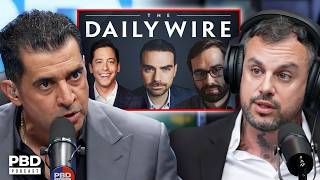
Daily Wire has spent the better part of 2024 taking hits — talent departures, subscriber erosion, and mounting criticism from across the political spectrum. Yet the company just moved to raise at least $100 million in new capital, reportedly in talks with Highmount Capital at a $750 million valuation, with bankers suggesting a $2 billion IPO could be achievable within 18 months. The move raises a pointed question: is this a business on the rebound, or a media company trying to cash out before the window closes?
The Numbers Behind the Headline
Daily Wire's financials tell a story of rapid early growth followed by a sharp plateau. The company posted $48 million in EBITDA last year — a genuinely respectable figure for a subscription-driven media outlet. But subscriber growth has effectively reversed.
 01:45
Chart showing Daily Wire subscriber and revenue growth rates from 2021 to present
Watch at 01:45 →
01:45
Chart showing Daily Wire subscriber and revenue growth rates from 2021 to present
Watch at 01:45 →
Subscription growth went from 151% in 2021, to 80% in 2022, to just 8% in 2023, and 10% in 2024 — before turning negative. Advertising revenue has similarly stagnated, swinging between modest gains and losses across the same period. Peak subscribership reportedly reached around 1.26 million before declining to roughly 852,000 and then 771,000. While 771,000 paying subscribers is not nothing, the trajectory is the wrong direction for a company pursuing a public offering.
Founders have reportedly fielded buyout offers above $1 billion but prefer to bring in minority investors rather than sell outright — a signal, some argue, that they believe there is still a viable path forward and are not looking for an exit.
The Valuation Problem
On traditional media multiples, the math is difficult. Digital media companies typically trade at 15x EBITDA in nominal terms; high-growth companies might command 20–35x. At $50 million in EBITDA and a declining subscriber base, Daily Wire does not qualify as high-growth. A $2 billion valuation implies roughly 40x — a figure that only makes sense as a venture-style bet on future potential, not a private equity assessment of current performance.
The minority investment structure reinforces this framing. The company is not being acquired at a PE multiple; it is raising growth capital at a venture valuation, similar to the kinds of headline-grabbing rounds seen in AI companies like Anthropic and Perplexity. Whether that bet pays off depends almost entirely on what happens to the underlying business over the next three to five years.
The Ben Shapiro Concentration Risk
The most consequential variable is one that does not appear on any balance sheet: Ben Shapiro himself. Estimates from those close to the business suggest Shapiro drives somewhere between 60% and 80% of the company's subscription value. If that figure is even approximately accurate, Daily Wire is not really a diversified media company — it is a personality-driven platform with some additional content around the edges.
This is a structural problem that money alone cannot fix. Other Daily Wire personalities — Matt Walsh, Michael Knowles — have meaningful audiences, but those audiences exist largely as downstream beneficiaries of Shapiro's reach. The analogy drawn in the discussion is instructive: when Oprah departed her network arrangement, ABC had spent years developing Dr. Phil and Dr. Oz as standalone assets capable of carrying weight independently. Daily Wire has not yet demonstrated it can do the same.
The departure of co-founder and CEO Jeremy Boring adds another layer of uncertainty. His replacement, Mike Richards — best known as the short-lived Jeopardy host — has not yet established a track record as a media operator at this scale. The comparison being made in investment circles is to MrBeast, who brought in Jeffrey Henhold, a former Shutterfly CEO and venture capitalist, to professionalize operations. Under that structure, MrBeast's business grew from roughly $400 million to $882 million in a single year, with Henhold helping the creator earn an estimated $300 million personally in 2025.
14:20
Forbes top content creator earners list showing MrBeast at number one with $300 million
Watch at 14:20 →
The lesson is not that Daily Wire needs a celebrity CEO — it is that talent-centric media businesses can scale when paired with serious operational leadership. Whether the current management structure provides that remains an open question.
Five-Year Scenarios
Asked to make a prediction, the analysts in this conversation landed in roughly three camps. The optimistic case: Daily Wire stabilizes its subscriber base at a lower foundational level, develops its secondary talent into genuine draws, and uses the new capital to build out production and diversify revenue — a playbook similar to what ABC ran post-Oprah. The pessimistic case: political commentary as a subscription product is a structurally declining category, Shapiro's audience ages or drifts, and the company cannot replace that gravity with anything else. The binary case: it either catches lightning in a bottle again or it does not survive the decade in its current form.
The market is clearly looking for a scaled conservative media alternative to Fox News. Daily Wire has the brand, the audience infrastructure, and now potentially the capital to compete for that position. But capital without the right operator and a credible plan to reduce Shapiro dependency may simply delay an inevitable reckoning rather than prevent it.
What Minority Investment Actually Signals
There is one genuinely encouraging data point embedded in this story: the founders want minority investors, not a buyout. Companies looking for an exit take the billion-dollar offer. Companies that believe they have runway take growth capital and stay in the driver's seat. Daily Wire is doing the latter — which at minimum means the people who know the business best think there is something worth fighting for.
Whether a $2 billion public market valuation can be justified in 18 months will depend on whether subscriber trends reverse, whether secondary talent can carry more of the load, and whether new operational leadership proves capable of running a complex media business under constant public scrutiny. Those are significant conditions. Right now, none of them are clearly on track.