
Ethiopia is building the world's most ambitious airport. Bishoftu Airport is a $12.5 billion mega-hub currently under construction about 35 kilometres from Addis Ababa, and it's designed to handle a staggering 110 million passengers every single year. That's more than Heathrow, more than Dubai International, more than Hartsfield-Jackson — the current title-holder for the world's busiest airport. If everything goes to plan, Bishoftu won't just be Africa's biggest aviation hub; it could become the busiest airport the world has ever seen.
This isn't a distant pipe dream either. Groundbreaking took place in January 2026, land clearance is already underway across 35 square kilometres, and the first phase is targeting an opening for 60 million travellers a year by 2030. So what exactly is being built, why here, and can Ethiopia actually pull it off? Let's break it all down.
 00:45
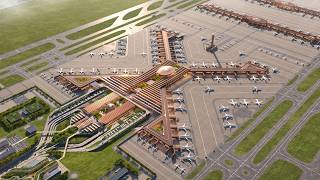
Aerial render showing the full 35 square kilometre Bishoftu Airport site in context alongside Addis Ababa
Watch at 00:45 →
00:45
Aerial render showing the full 35 square kilometre Bishoftu Airport site in context alongside Addis Ababa
Watch at 00:45 →
What Is Bishoftu Airport and Why Does It Matter?
Bishoftu International Airport is Ethiopia's answer to a continent-wide problem: Africa has no dominant global aviation hub. Think about it — North America has Hartsfield-Jackson, Europe has Heathrow, Asia leans on Dubai International, South America has Guarulhos, and Oceania uses Sydney Airport as its gateway. Africa, despite being home to over 1.4 billion people and one of the fastest-growing aviation markets on the planet, has nothing that comes close to those giants.
Right now, the continent's biggest hubs — Cairo International and O.R. Tambo in Johannesburg — handle around 20 to 30 million passengers a year. Impressive numbers in isolation, but nowhere near enough to serve as a true intercontinental connector. Only 19% of intra-African routes even feature direct flights. That means the vast majority of travellers moving around the continent are stuck with layovers outside of Africa altogether.
Bishoftu Airport is designed to fix all of that. The goal is to create a massive connection hub linking Africa, Asia, the Middle East and Europe — a genuine rival to Dubai and Istanbul on the global aviation stage. And critically, around 80% of passengers arriving at Bishoftu are expected to be transit travellers — people connecting through on their way somewhere else. That's the Dubai model, and it works.
03:10
Zaha Hadid Architects' terminal design showing the Great Rift Valley-inspired central spine connecting piers
Watch at 03:10 →
How Big Will Bishoftu Airport Actually Be?
Very, very big. The numbers here are hard to wrap your head around. The airport site covers 35 square kilometres of land. For context, Heathrow — one of the world's most famous and congested airports — is just 12 square kilometres. JFK International in New York covers around 21 square kilometres. Bishoftu is going to dwarf both of them.
The passenger terminal alone will cover an enormous footprint — nearly double the size of the terminal being built at New Manila International, which is already considered one of the largest single terminals ever constructed. The design, led by the celebrated Zaha Hadid Architects, draws deep inspiration from Ethiopia's landscape and culture. A central spine running through the terminal and piers references the Great Rift Valley, which cuts through the country near Bishoftu. It's not just aesthetic either — that spine is engineered to slash transfer distances between gates, which matters enormously when 80% of your passengers are rushing to make a connection.
Eventually, the airport will operate four Code 4E runways — the classification that means they're long enough to handle the largest commercial aircraft currently flying. And beyond passengers, Bishoftu has enormous cargo ambitions too. The plan is to process four million tons of cargo per year, which would place it inside the top five cargo hubs worldwide. Ethiopia is landlocked, so a dominant cargo operation could be genuinely transformative for the country's trade relationships.
Add to all of this a full airport city concept — hotels, retail spaces, offices, cargo processing facilities, and eventually a 38-kilometre rail link to Addis Ababa — and you start to understand the sheer scale of what's being attempted here.
05:22
Comparison graphic showing Bishoftu's planned capacity vs Heathrow, Dubai, and Hartsfield-Jackson
Watch at 05:22 →
When Will Bishoftu Airport Open and What Are the Phases?
Construction has been broken into phases to manage both the complexity and the cost. The first phase focuses on the core essentials: passenger facilities, support infrastructure, the airfield, road connections and cargo handling. The target is to have this phase operational and ready for 60 million passengers a year by 2030. Subsequent phases will add more runways, a second passenger terminal, and the rail connection to the capital.
Groundbreaking officially happened in January 2026, with land clearance across that massive 35 square kilometre footprint needing to be completed by December of the same year. The pace is aggressive, but Ethiopia has made clear this is a national priority.
Why Is Africa's Aviation Market Growing So Fast?
The short answer: demand, demographics, and deliberate policy. Between May 2025 and May 2026, airline capacity across Africa grew by 6.7% — equivalent to around 24 million additional seats. To put that in perspective, Southeast Asia grew by 1.7% in the same period, Europe managed 2%, and the global average was just 1%. Africa is lapping the field.
Over the next two decades, Africa's aviation market is forecast to grow by more than 4% year on year. Hundreds of millions of new passengers are expected to take to the skies, driven by a rapidly growing middle class, urbanisation, and a continent-wide push to make travel easier.
That last point connects directly to Agenda 2063, a 50-year blueprint to transform Africa into a global economic powerhouse. Among its goals: improved infrastructure and visa-free travel for African citizens moving around the continent. Several nations have already eased entry requirements significantly, and some no longer require visas from African passport holders at all. It's a similar approach to what the Schengen Area did for Europe — and the results in terms of travel growth are already starting to show. Bishoftu Airport is essentially being built to catch that wave.
Who Is Building Bishoftu Airport and What Does It Cost?
The total price tag sits at $12.5 billion — making it the biggest aviation project in African history. Ethiopian Airlines is contributing around $4.5 billion of that funding. The remaining $8 billion is still being finalised, with negotiations ongoing involving parties including the United States and China.
Yes, that means construction has started before full funding is secured. That's not unusual for projects of this scale — it happens regularly with mega-infrastructure builds around the world — but it does represent a genuine financial risk. Closing an $8 billion funding gap is no small task, regardless of how promising the early signs look.
The design is being handled by Zaha Hadid Architects, the firm behind some of the world's most striking buildings. Their involvement suggests a commitment to creating something architecturally significant, not just functional. Importantly, the Ethiopian government itself isn't directly funding the project — it's being structured as a private-led investment anchored by the national airline.
Why Not Just Expand Addis Ababa Bole Airport?
It's the obvious question, and the answer comes down to geography and physics. Addis Ababa Bole International currently serves more than 20 million passengers a year, which is solid — comparable to Budapest or Tampa. But it's projected to hit maximum capacity within the next couple of years. The problem? The airport is completely hemmed in by the city that's grown up around it. Expanding the footprint would require demolishing large swaths of urban Addis Ababa. Not exactly practical.
Bishoftu, 35 kilometres away, is far less densely populated and offers the kind of open land a mega-airport needs. There's also a performance advantage. Bishoftu sits at an elevation of around 1,900 metres — about 400 metres lower than Addis Ababa. Lower altitude means denser air. Denser air means jet engines can pull in more air molecules and generate more thrust, wings produce more lift, and aircraft burn less fuel. Ethiopian Airlines has confirmed that departures from Bishoftu will require less fuel than from Addis Ababa, which translates directly into better long-haul range — essential for any airport trying to become a global connection hub.
What Are the Biggest Challenges Facing Bishoftu Airport?
Bishoftu Airport faces real headwinds, and it would be naive to ignore them. The most immediate is the $8 billion funding gap that still needs to be bridged. Construction has started, but without full financial backing, delays or scaling-back become very real possibilities.
Then there's competition. Dubai International, Istanbul Airport, and Heathrow aren't going anywhere, and they have decades of established routes, airline relationships, and passenger familiarity behind them. Even within Africa, Egypt is planning to significantly expand Cairo International — potentially doubling its capacity to 60 million passengers. That's still well short of Bishoftu's ambitions, but it's competition for the same regional travellers.
There are also serious human concerns. Around 15,000 people are being displaced to make way for the new airport, including thousands of farmers whose land is being cleared. While Ethiopian Airlines CEO Mesfin Tasew stated that displaced farmers have already moved into new housing, reports from residents and outlets like Addis Standard suggest that compensation and resettlement support have been inadequate for some. These are the kinds of issues that can create lasting controversy around a project, regardless of its economic promise.
Still, the fundamentals are strong. Africa's aviation market is genuinely booming. The African Continental Free Trade Area — an agreement between more than 50 countries to reduce tariffs and simplify trade — creates real demand for exactly the kind of intercontinental connector Bishoftu is designed to be. Ethiopian Airlines is already one of the best-connected carriers in the world and is actively expanding its long-haul fleet to grow those connections further.
Bishoftu Airport is being built from scratch, with no aging infrastructure to work around, no awkward merges of old and new systems. It's a bespoke mega-hub, designed from day one for the volumes it's targeting. Whether it achieves its extraordinary ambitions remains to be seen — but don't be surprised if, in a few years, you find yourself sitting in a departure lounge in Bishoftu, waiting for your connecting flight.