The MSG Sphere is one of the most talked-about buildings on the planet — but is the MSG Sphere actually profitable? The short answer is: not yet. Despite generating over $1.2 billion in annual revenue and becoming the highest-grossing concert venue in the world in 2024, the Las Vegas Sphere still posted losses of more than $400 million in its first year. And yet, cities across the globe are lining up to build their own. So what's really going on here?
Is the MSG Sphere Actually Making Money?
On the surface, the numbers look impressive. The Las Vegas Sphere pulled in more than $1.2 billion in revenue and dominated headlines as the world's most exciting new entertainment venue. But dig a little deeper and the economics get complicated fast.
The Sphere cost approximately $2.3 billion to build, making it the most expensive entertainment venue ever constructed in Las Vegas. Despite the blockbuster revenue, it reported operating losses well into 2025. The core problem isn't demand — it's the cost structure.
The Sphere is not a traditional arena. It doesn't just host concerts and let promoters handle the rest. Instead, it requires entirely custom content — visuals, soundscapes, and productions built specifically for its 16K resolution wraparound screen and spatial audio system. That bespoke content can cost tens or even hundreds of millions of dollars to produce. Then there's the energy bill. The Exosphere — the massive LED outer shell — is the largest display surface ever built, and keeping it running costs millions annually.
In response, Sphere Entertainment has been pivoting toward an IMAX-style model: producing its own original content, retaining a larger share of revenue, and rotating shows to amortise production costs over time. It's a smarter approach — but it introduces new risks. The Sphere can only run one show at a time. If that show underperforms, revenue falls off a cliff while fixed costs stay brutally high.
Where Are New MSG Spheres Being Built?
Despite the financial uncertainty in Vegas, the Sphere is going global — and fast. Here's where things stand:
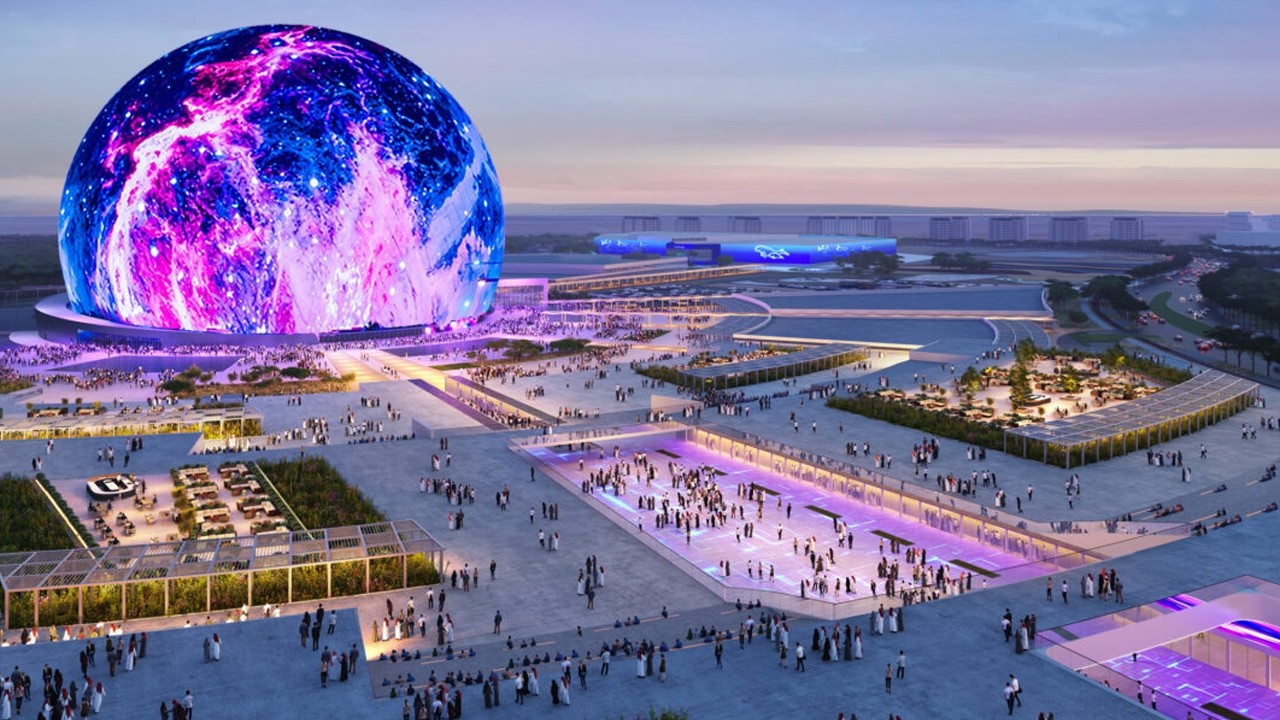
- Abu Dhabi: The only officially confirmed new Sphere. Planned for Yas Island, it will hold 20,000 people and is expected to be completed by 2029 as part of the UAE's Tourism Strategy 2030.
- South Korea (Hanam, near Seoul): Proposed as a centrepiece of K-Star World, a massive entertainment complex tied to South Korea's booming K-pop industry. The project remains unconfirmed and its feasibility is still being debated.
- Washington DC (National Harbor): A smaller "mini-sphere" with a capacity of around 6,000 seats — roughly one-third the size of the Vegas venue — is planned, with an estimated cost of over $1 billion and a target opening of 2030.
- Singapore: In early-stage conversations about hosting a Sphere as part of its broader push as a global entertainment hub.
- London: Proposed for Stratford in East London — but ultimately blocked. More on that in a moment.
How Much Did the MSG Sphere Cost to Build?
The Las Vegas Sphere came in at approximately $2.3–2.5 billion, cementing its place as the most expensive entertainment venue ever built in Vegas — and arguably the world. That price tag covers the steel lattice shell, the record-breaking LED Exosphere, the interior 16K screen, the spatial audio system, and the deep foundations required to support a structure weighing over 100,000 tonnes.
The Abu Dhabi Sphere is projected to cost around $1.7 billion — somewhat cheaper, partly because the licensing model shifts financial responsibility. The Washington DC mini-sphere still comes in at over $1 billion, despite being a fraction of the size. These are not budget projects. There is no cheap version of a Sphere.
What Is the MSG Sphere Franchise Model?
One of the most significant developments in the Sphere's global expansion is how it's being structured financially. Rather than funding and building new Spheres itself, Sphere Entertainment is licensing its technology and design to host cities. The city puts up the capital and carries the financial risk. MSG provides the proprietary systems: structural geometry, LED technology, immersive audio, and content infrastructure.
Think of it as architecture as a franchise. The host city gets the brand, the technology, and access to Sphere's content library. MSG gets licensing fees without absorbing construction risk. It's a clever pivot — and if it scales, it could be genuinely transformative for how major entertainment venues are developed globally.
The Abu Dhabi deal is the first real test of this model. If it works, you could see a network of Spheres spanning multiple continents, each running a mix of original Sphere content and locally produced shows.
What Is the Mini-Sphere Planned for Washington DC?
The National Harbor project near Washington DC represents a different kind of bet: a scaled-down Sphere designed to be more replicable. At 6,000 seats and roughly one-third the physical size of the Vegas venue, the mini-sphere is explicitly positioned as a more accessible model for cities that want the Sphere experience without the full $2.5 billion commitment.
Crucially, it will still feature an ultra-high-resolution interior display and full immersive audio. The spectacle is preserved. The footprint — and presumably the operating cost — is reduced. If successful, this format could allow the Sphere concept to scale in the same way IMAX did: from flagship venues to a truly global network. One size won't fit all, but the right-sized Sphere might fit a lot of cities.
How Is the MSG Sphere Actually Engineered?
From a pure engineering standpoint, the Sphere is one of the most remarkable structures built this century. Its form is not just aesthetic — it's structural genius.
The spherical shell works because a sphere is one of the most efficient structural forms in existence. Rather than fighting gravity the way a flat roof does, a sphere distributes loads evenly across its entire surface. The steel lattice that forms the Sphere's skeleton is made up of thousands of interconnected triangles — the strongest geometric shape in structural engineering — custom-fabricated and assembled in stages from a lower ring upward.
During construction, temporary internal steel towers support the shell as it rises, providing platforms for cranes and workers. Once the structure becomes self-supporting, those towers are removed, leaving a vast hollow sphere ready for seating, screens, and technology. The result sits on deep pile foundations and a multi-level concrete podium, all engineered to carry a structure weighing over 100,000 tonnes. The Las Vegas Sphere measures 112 metres tall and 157 metres wide — the largest spherical structure ever built.
Why Was the London Sphere Cancelled?
The proposed Stratford Sphere in East London came closer to reality than most people realise. It received initial approval from the local council and looked set to become a genuine go-ahead project — until London Mayor Sadiq Khan stepped in and blocked it in 2023.
The reasons had nothing to do with engineering or finances. The problem was the Exosphere. In Las Vegas, a constantly animated, brilliantly lit digital billboard on the exterior of a building blends into an environment already saturated with neon and digital advertising. In Stratford — a largely residential area — it would have been something else entirely.
Residents raised serious concerns about light pollution, the visual intrusion of a giant animated screen in a neighbourhood where people actually live, and the general incompatibility of the Sphere's attention-grabbing design with its surroundings. Those concerns won. The London Sphere was cancelled.
It's a telling moment. The Sphere isn't a universal solution. It works in environments built for overstimulation. It doesn't work everywhere.
Can the Global Sphere Rush Actually Succeed?
The cities racing to build Spheres aren't doing it purely for financial returns — and that's worth understanding. The Sphere is, above all, a symbol of technological ambition and cultural relevance. In an era where cities compete for global attention as aggressively as they compete for investment, a landmark like this carries real strategic value. Abu Dhabi isn't just building an entertainment venue. It's building a statement in its ongoing rivalry with Dubai and Riyadh.
Whether the economics ultimately work is still an open question. The Las Vegas Sphere has proven there is demand for the experience. The franchise model is an intelligent attempt to spread risk. The mini-sphere concept could unlock genuine scalability. But the path to profitability remains long, expensive, and uncertain.
The Sphere conquered Las Vegas. Whether it can win in an entirely different game — across different cities, cultures, and cost structures — is the defining question of the next decade in live entertainment architecture.