
A political ad ran in Texas showing a U.S. Senate candidate sitting in a chair, looking into the camera, reading his own old tweets aloud. It looked completely real. The problem: the candidate never filmed it. He never sat in that chair. He never said those words. The entire video was generated by artificial intelligence — and it ran to millions of voters with a disclosure so small most people never noticed it. This is not a hypothetical future. It is happening right now. And a French philosopher writing in 1962 predicted exactly how it would unfold.
The Scale of the Problem
When you look at individual deepfake stories in isolation, each one seems like a discrete incident. Stack them together and a very different picture emerges.
The National Republican Senatorial Committee created an 85-second deepfake of Democratic Senate nominee James Talarico, using AI to have him read his own real tweets — then adding commentary he never actually said, including phrases like "oh, this one is so touching." The only disclosure was three seconds of tiny text in the corner. A peer-reviewed study has found that most people cannot distinguish deepfake videos from real ones, and that their opinions measurably shift based on what they see, even when it is entirely fabricated.
In Georgia, a Republican congressional campaign deepfaked sitting Senator John Ossoff saying he had voted to keep the government shut down. In the Texas Republican primary, Ken Paxton's campaign ran AI ads showing a rival senator dancing with a Democratic congresswoman. The opposing campaign responded with its own AI clips. One of those ads carried zero disclosure at all. This is not a partisan issue — it is a full-scale propaganda arms race in which AI is the weapon.
 01:45
Clip of the AI-generated Talarico deepfake ad shown to viewers
Watch at 01:45 →
01:45
Clip of the AI-generated Talarico deepfake ad shown to viewers
Watch at 01:45 →
The White House has been producing AI-generated videos and memes to disparage protesters, promote foreign policy positions, and push political narratives. Elon Musk's AI tool Grok, built directly into X, was generating over 6,700 sexually explicit deepfake images of real people every single hour — 84 times more than the top five deepfake websites combined, with an estimated 2% depicting minors. The UK government threatened to ban X entirely. France raided X's Paris office. OpenAI shut down its video tool Sora after it became a deepfake factory.
And then there are the grandmother calls. One in four Americans received an AI voice-cloning scam call in the past year — typically an AI replica of a grandchild's voice calling an elderly relative asking for money. One woman described how her 90-year-old mother, after receiving such a call, refused to answer the phone for months. She was terrified. That is not an election issue. That is someone's grandmother afraid to pick up her own phone.
Jacques Ellul: The Man Who Predicted All of It
Most discussions of propaganda point to Edward Bernays — the nephew of Sigmund Freud who weaponized psychology to sell wars, manufacture consumer demand, and invent the field of public relations. Bernays understood propaganda as a tool. There was always a person behind it: a client, a campaign, a puppet master pulling strings. That framing is useful, but it is incomplete.
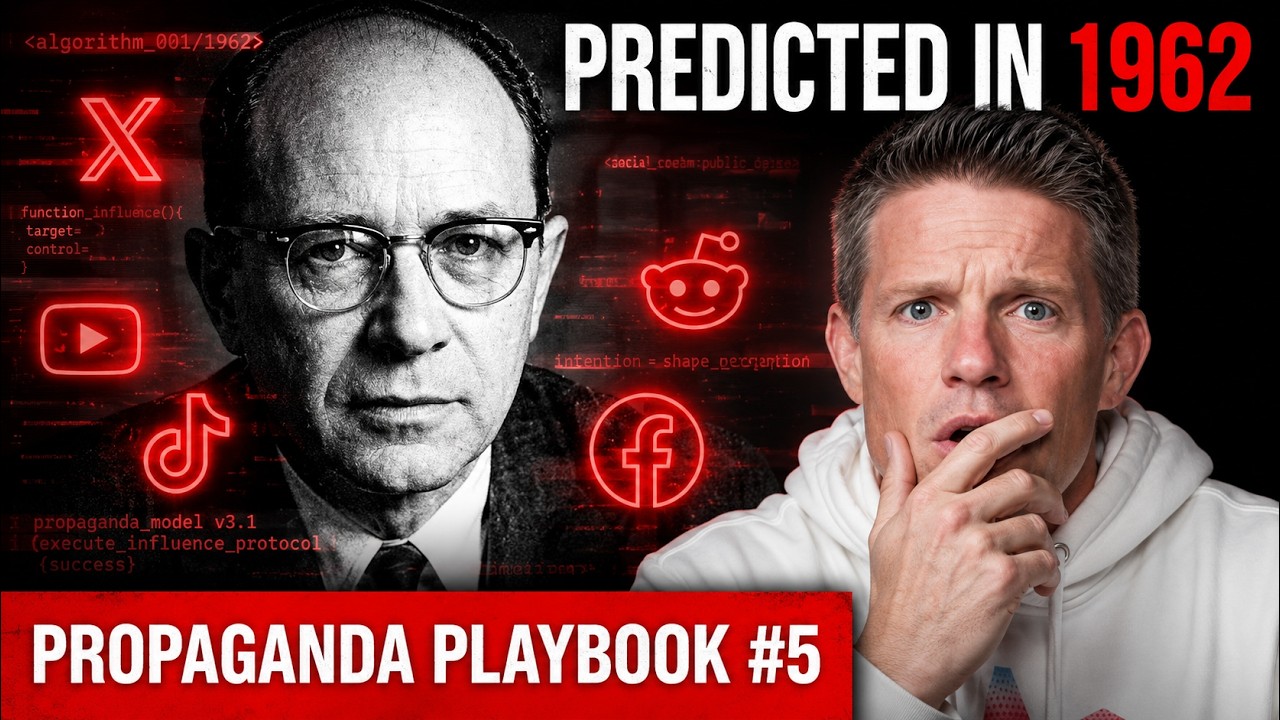
In 1962, a French philosopher named Jacques Ellul published a book simply called Propaganda. Where Bernays described how individuals use propaganda, Ellul identified something far more dangerous: propaganda that is so deeply embedded in technology, culture, and information systems that it stops feeling like propaganda at all. He called it sociological propaganda.
14:20
Cover of Jacques Ellul's 1962 book 'Propaganda'
Watch at 14:20 →
Ellul argued that the most effective propaganda is not a discrete campaign with a beginning and an end. It is an environment — always on, invisible by design, shaping not just political opinions but entertainment preferences, shopping behavior, relationships, and personal identity. He described propaganda becoming total (targeting every dimension of life), continuous (never switching off), and invisible (so normalized it simply feels like reality).
Writing before the internet, before social media, before smartphones, before AI, Ellul made a statement that reads today like a direct description of algorithmic feeds: "Propaganda is no longer the work of a propagandist. It's built into the system. The system itself becomes the propaganda."
There is no longer a puppet master. The machine is the puppet master. It runs 24 hours a day, learns what moves you, what frightens you, what makes you click and buy, and adjusts in real time at a scale no human team could match. As strategist Tom Billy framed it: you do not need to control everyone to control the outcome. You just need to nudge 100 million micro-decisions per day — what people notice, what they ignore, what they fear, what they laugh at — and you achieve macro control without ever appearing to have taken it.
The proof that this already works is not theoretical. In 2014, Facebook ran an emotional contagion experiment on 689,000 users by adjusting what appeared in their feeds. It measurably changed what those users posted afterward — their moods, their expressed emotions, their behavior. That was 2014, before the AI we have today. The same mechanism now operates on billions of people simultaneously, learning and adapting in real time.
A Personal Experiment — and Where the Line Is
This is not an abstract concern for anyone building a business with AI tools. Testing it directly reveals where the ethical boundary actually sits.
Two AI advertising experiments illustrate the distinction clearly. In the first, an AI-generated replica of the creator — matching face, voice, and manner — was used in ads. To cold traffic, people who had never encountered the real person, it performed well. The AI version was polished, on-script, and people bought. But when the existing audience — people who had attended events, watched hundreds of hours of content, and knew every mannerism — encountered the same ad, they caught it immediately. Something was off about the eyes, the timing, the hand movements. They felt deceived. The backlash from the most loyal audience members was significant.
In the second experiment, an obviously AI-generated cartoon character version was used instead. The warm audience found it hilarious, shared it, tagged friends, and engaged more deeply. Cold traffic ignored it entirely — without an existing relationship, a cartoon of an unknown person means nothing.
22:10
Side-by-side of realistic AI Russell ad versus cartoon baby Russell ad
Watch at 22:10 →
Those two experiments define the line: trust. The cartoon was a creative expression built on top of a real relationship. The realistic deepfake borrowed trust that had not been earned — using a face and voice to manufacture false familiarity with strangers. The technique used in that ad is structurally identical to what political campaigns are doing with candidate deepfakes. The context differs; the mechanism does not.
A Framework for Ethical AI Use
Every entrepreneur deploying AI should work through three questions before publishing AI-generated content.
The Amplification Test
Is the AI amplifying a real message or fabricating a false one? Using AI to write better copy, edit faster, test more headline variations, or brainstorm ideas is amplification — your voice and ideas, delivered more efficiently. Using AI to create a version of yourself saying things you did not say, making promises you did not make, or presenting a persona that does not exist is fabrication. It does not matter whether you are selling a course or running for Senate. The technique is identical.
The Disclosure Test
If your audience found out AI was involved, would they feel betrayed? If the answer is yes — if the AI needs to be hidden for the thing to work — that is the signal you have crossed the line. The cartoon experiment passed this test because the AI involvement was obvious. Nobody thought it was real. Disclosure was built into the concept. The realistic AI replica failed because it was designed to make the audience believe it was genuine when it was not.
The Relationship Test
Does this content build trust or borrow it? AI used creatively with a warm audience deepens an existing relationship. AI used to simulate familiarity with strangers manufactures a relationship that does not exist. Borrowed trust, like borrowed money, must eventually be repaid — usually with interest, and usually at the worst possible moment.
The Question That Has No Clean Answer
Ellul's warning was that the most dangerous propaganda is the kind that gets built into the system itself, because once it becomes the environment, people stop noticing it. That is precisely what is happening now — AI embedded into political advertising, marketing, phone calls, children's education, and the mechanisms by which people decide what is true.
With Bernays, there was always a person making conscious choices. You could point to the individual who decided to run the campaign. With AI, there is no single decision-maker. There is an algorithm optimizing for engagement and conversion without intent, without conscience, and without any mechanism for caring whether what it produces is true or false.
Bernays had a conscience he chose to ignore. The AI has no conscience at all. That distinction — between a human who chooses to deceive and a system that simply optimizes — may be the defining ethical question of the next decade. Ellul saw it coming. The rest of us are only now beginning to understand what it means.