
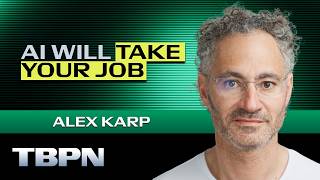
Will AI take white collar jobs? According to Palantir CEO Alex Karp, the honest answer is yes — and the people most at risk are exactly the ones who think they're safe. In a wide-ranging outdoor conversation that covered everything from dead hangs to geopolitics, Karp made the case that the AI disruption isn't coming — it's already here, and most educated professionals are sleepwalking into it.
Will AI Actually Take White Collar Jobs?
Karp didn't mince words. If you're what he calls "lawyer 14506" — a mid-tier white collar professional doing repeatable, learnable work — you have a real problem. The tools that used to make those jobs valuable: low-end coding, routine legal analysis, boilerplate reading and writing — are being commoditized at speed.
 04:15
Karp explains why neurodivergent thinkers are uniquely positioned to thrive in an AI-driven economy
Watch at 04:15 →
04:15
Karp explains why neurodivergent thinkers are uniquely positioned to thrive in an AI-driven economy
Watch at 04:15 →
"These technologies are going to take your job," Karp said flatly. "Especially if you're white collar."
But he drew a sharp distinction. If you're neurodivergent, high-agency, and highly educated, the same shift that hurts everyone else might actually be a tailwind for you. Karp described the current moment as something almost cosmically ironic for people who struggled in traditional academic environments: the skills schools trained everyone to have are now the least valuable ones, and the skills schools punished — creative thinking, pattern recognition, the ability to approach problems differently — are exactly what AI can't replicate.
"Odin came down and made the whole world just right for a dyslexic," he said, half joking, entirely serious.
Should You Still Learn to Code With AI Agents?
This is one of the most searched questions in tech right now, and Karp's answer is nuanced. Low-end coding — the kind that most boot camps teach and most entry-level developer jobs require — is being automated away. That's not a maybe, it's a when.
12:40
Karp breaks down the two archetypes he believes will survive AI disruption
Watch at 12:40 →
But the question isn't really "should I learn to code." It's "what kind of thinker do I need to become?" Karp frames the two surviving archetypes clearly:
- Vocational expertise: Real, hands-on, technical skills that AI cannot fully replicate — the kind that requires physical presence, institutional knowledge, or human judgment in complex systems.
- Neurodivergent high-agency thinking: The ability to see what others don't, build something unique, and operate outside the boundaries of conventional instruction.
If you fall into neither category, Karp's message is blunt: the future is going to be hard, and pretending otherwise isn't doing anyone any favors. The coding agents matter less than the question of whether you can direct them toward something genuinely valuable.
What Skills Will Actually Matter in the AI Economy?
Karp is essentially arguing for a complete inversion of how we value human capital. The traits that got you a good grade, a good SAT score, and a good job offer in 2010 are increasingly table stakes that a language model can perform for pennies.
What's rising in value, according to Karp:
21:05
Karp describes how Palantir's forward-deployed engineer model creates value competitors can't replicate
Watch at 21:05 →
- Artistry and originality — the ability to produce something that can't be reverse-engineered from a training dataset
- Institutional knowledge — understanding how organizations actually work, not how they say they work
- Pattern recognition under uncertainty — the kind of thinking tier-one military operators use, and that Karp says is massively underappreciated in civilian life
- The ability to extract and encode tribal knowledge — turning what experienced practitioners know implicitly into something a system can act on
He pointed to elite military operators as an unexpected model. They don't look like movie soldiers. They're selected for a specific kind of intelligence that doesn't show up on traditional tests, and they've spent years learning what actually works in real environments — not what's supposed to work according to doctrine.
Will AI Kill Traditional Enterprise Software?
Karp thinks the so-called "SaaS apocalypse" narrative is broadly correct — but the mechanism is more interesting than most people realize. It's not just that AI agents can do what legacy software does. It's that AI makes it harder to lie about whether software is creating value.
"Nobody really believes all software companies actually create value," he said. The famous joke in enterprise tech — that a software company's job is to give the client the feeling they're getting value while actually extracting it — is about to become untenable. When AI can surface what's actually happening inside an organization, the gap between perceived value and real value collapses fast.
Legacy SaaS companies with lock-in but no genuine innovation are, in Karp's framing, the most exposed. And the businesses that will win are the ones that combine software, human expertise, and institutional knowledge into something that can't be easily replicated — which is precisely what he says Palantir has been doing for years while getting mocked for it.
How Does Palantir Actually Create Value for Clients?
For years, critics argued Palantir wasn't a real software company — it was a consulting firm with a good story. Karp has always pushed back on that framing, and now he thinks the market is finally catching up.
The way he describes Palantir's model is as a concatenation of things most tech companies don't do:
- Select the right client and the right starting point
- Innovate in places the client wouldn't accept or expect innovation
- Encode the institution's tribal knowledge — its rules, regulations, informal logic — into systems that AI can then extend
- Deploy what he calls "forward-deployed engineers" (FDEs) who live inside the client's environment and manage the complexity in real time
"You transformed my business in three months. It would have taken three years and probably never would have happened." That's what clients care about, Karp says — not the elegance of the codebase.
The companies that used to ridicule this model are now scrambling to build FDE capacity and discovering it's harder than it looks. You need the people, the deployment infrastructure, the relationships, and the products that augment human judgment. That's not a monolithic codebase. It's something much harder to copy.
What Should America Do About AI Disruption?
Karp isn't optimistic that America will handle this well by default — but he does think there's a viable path. His prescription is pointed and, by the standards of most tech CEO commentary, remarkably specific:
- Dramatically expand vocational education — Germany has three high schools, two of which are vocational and highly technical. BMW and Airbus are built by people who never went to college but came out of world-class trade programs with no debt. America needs that.
- Reform how we test aptitude — current testing systems were designed for the industrial revolution. They systematically filter out the neurodivergent, the builders, and the visual thinkers — exactly the people who will thrive in an AI-augmented economy.
- Have honest conversations about career paths — some fields are not going to have jobs. Telling young people otherwise is cruelty dressed up as encouragement.
- Control immigration thoughtfully — not as a culture war issue, but as a labor market stabilizer while the economy reconfigures.
The risk of not doing these things, in Karp's view, isn't stagnation. It's radicalization. He believes there's a real movement forming to nationalize AI companies, and that it will gain strength fast if the economic disruption isn't addressed with real policy — not handouts, not PR, but structural reform.
Is the US Winning the AI Race Against China?
Karp is direct about the geopolitical stakes: this is a two-player game, and the outcome will determine the world order. He frames it not as aggression toward China but as a straightforward observation — there are currently two places on earth where frontier AI is being developed and deployed at scale, and one of them will set the terms for everyone else.
America's advantages, in his view, are real but not permanent. The combination of military technology, 20 years of operators learning what actually works in the field, and a culture of unconventional problem-solving gives the US an edge that's genuinely hard to replicate. But it requires continued investment, continued deployment, and a willingness to use these tools in ways that make some people uncomfortable.
"A lot of people who want to hurt America on the battlefield end up dead because of our ability to aggregate and figure out what's going on before they can figure out what we're doing," Karp said. That's not abstract. That's the current state of play — and it requires maintaining the kind of AI edge that only comes from actually deploying the technology, not debating whether to.
The bottom line from Karp: America is at an inflection point that it cannot afford to sleepwalk through. The good outcome is achievable — AI-enhanced manufacturing, rebuilt infrastructure, the best military in the world — but it requires honesty about the costs, urgency about the reforms, and a willingness to tell people things they don't want to hear. Including, apparently, that their dead hang time is a more accurate predictor of their future than their college degree.