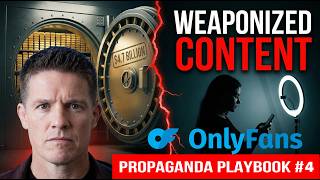
When Leonid Radvinsky, the owner of OnlyFans, died at 43, headlines called him a pioneer, a visionary, a hero of the creator economy. He was worth $4.7 billion. The average woman on his platform made $180 a month. And the technique he used to make that gap invisible — to make exploitation feel like liberation — was invented over a century ago by a man named Edward Bernays. Same playbook, same target, same lie, different century.
Who Really Built OnlyFans
Most obituaries glossed over the biography. Radvinsky was Ukrainian-born, raised in Chicago, and graduated valedictorian from Northwestern with an economics degree. What they left out: while still a student, he launched a pornography referral website. His next venture was MyFreeCams, a platform where men paid to watch women perform on camera. This was not a tech visionary who stumbled into adult content. This was someone who started in pornography from day one and methodically figured out how to make it mainstream.
In 2018, Radvinsky purchased 75% of OnlyFans from its original British founders. At the time, the platform hosted fitness trainers, musicians, and cooking channels. Within years of his ownership, it became — in the media's own words — a hive of pornography. That transformation was intentional. It was his business model.
The numbers reflect the scale of what he built. Revenue grew from $59 million in 2019 to $1.4 billion by 2024. Creators on the platform expanded from 350,000 to 4.6 million. Radvinsky personally collected over $1.8 billion in dividends since 2021, including $701 million in 2024 alone.
The Numbers They Don't Put in the Headlines
Behind those growth figures is a different set of statistics. The average OnlyFans creator earns $180 a month. The top 1% of creators capture 33% of all platform revenue. In surveys of creators, 34% reported negative mental health consequences — anxiety, depression, shame, and fear. Six percent disclosed that traffickers helped them create and market their content. Eleven percent said they were personally aware of minors on the platform.
One man made $700 million in a single year. The average woman on his platform made $180 a month. And the word used to describe this arrangement was empowerment.
 08:45
Video clip of a woman describing dissociation and emotional difficulty while creating OnlyFans content, visibly distressed
Watch at 08:45 →
08:45
Video clip of a woman describing dissociation and emotional difficulty while creating OnlyFans content, visibly distressed
Watch at 08:45 →
That word did not come from the women. It was planted there — by a propaganda technique with a very specific history.
The Real Stories Behind the Reframe
The actual accounts from creators follow a pattern that the platform's marketing carefully obscures.
The Boundary Erosion Trap
One creator wrote a first-person account of signing up because she needed money and believed it would be simple. What happened instead: subscribers made requests. The degrading ones paid more. Every boundary she set dissolved when the financial pressure arrived. She ended up doing things for $20 and $50 that she never imagined she would do. Her summary: I was not free or empowered. I was a slave to the dollar and to my subscribers. After leaving, she found career doors closed and personal relationships damaged. She noted that she could only see the harm clearly once she was out — while inside, she described it as being under a spell.
The Identity Collapse
A second creator published an essay in early 2026, just days before Radvinsky's death was announced, describing what the platform did to her sense of self. After her first $10,000, she wrote, the line I am an OnlyFans creator became her entire identity — not a daughter, not a friend, not a woman with goals, just a creator. When she left, she described the recovery process like sobriety. Like getting clean. She rebuilt her identity from scratch. In her entire essay, she never used the word empowerment. The word she used was freedom — and she meant freedom from OnlyFans, not freedom because of it.
The Escalation Spiral
A third creator told Business Insider she started with mild content at age 18. The algorithm rewards more explicit material. Subscribers pay more for more extreme content. The pressure to escalate is structural, built into the platform's incentive system. One line becomes the new baseline. Then it gets crossed again. A survivor of the sex industry described it as a spiral: more hardcore content for less money, eventually turning to escorting just to survive. The content — unlike a cigarette — cannot be discarded. It lives on the internet permanently, often scraped and resold to other sites without the creator's knowledge or consent.
The Collateral Damage
The harm radiates outward. High school students bullied because classmates found their mother's account. Partners secretly spending thousands on custom content instead of family savings. Organized networks of subscribers buying content and reselling it to pornography sites the creator never agreed to. And woven throughout: the 6% trafficker disclosure rate, the 30% of creators who received messages from suspected traffickers offering to manage their accounts, the 11% aware of minors with content on the platform. These are not edge cases. They are features of the business model.
The Torches of Freedom: A 100-Year-Old Blueprint
In 1929, American tobacco companies faced a problem. Women didn't smoke in public. It was socially taboo — which meant the industry was losing half its potential market. They hired Edward Bernays, Sigmund Freud's nephew and the inventor of modern public relations.
Bernays didn't run cigarette ads. He hired a psychoanalyst who told him that cigarettes symbolized male power. If smoking could be linked to women's liberation — to fighting oppression and demanding equality — women wouldn't merely tolerate it, they'd demand it.
Bernays hired a group of young women, positioned them in the New York Easter Parade, and at his signal they lit cigarettes and marched down Fifth Avenue. He told every reporter present that these women were lighting torches of freedom — a protest against male oppression. Overnight, smoking became an act of feminism. American tobacco made billions. Millions of women got lung cancer.
28:10
Side-by-side comparison graphic: Bernays 1929 cigarette campaign language versus OnlyFans marketing language
Watch at 28:10 →
The parallel to OnlyFans is not approximate. It is exact.
- 1929: Cigarettes are torches of freedom. 2020s: Pornography is creator empowerment.
- 1929: Smoking is a woman's right. 2020s: Selling explicit content is owning your body.
- 1929: Lighting up fights oppression. 2020s: Posting content is financial independence.
- 1929 result: Lung cancer. 2020s result: Depression, trafficking, permanent digital exposure.
- 1929 profiteer: American Tobacco. 2020s profiteer: Leonid Radvinsky, $4.7 billion.
Same technique, same target, same reframe, same lie — one century apart.
Huxley's Warning: Controlled by Pleasure
There is one way OnlyFans exceeded what Bernays accomplished, and it makes the story darker. Bernays had to manufacture consent. He staged a parade. He planted newspaper stories. He had to work to trick women into smoking.
OnlyFans didn't have to trick anyone. The reframe — empowerment, independence, your body, your choice — was so effective that 4.6 million women volunteered. Neil Postman, writing in 1985, anticipated exactly this dynamic in Amusing Ourselves to Death. Postman drew a distinction between Orwell's nightmare and Huxley's: in Orwell's 1984, people are controlled by inflicting pain. In Huxley's Brave New World, they are controlled by inflicting pleasure. Orwell feared what we hate would ruin us. Huxley feared that what we love would ruin us.
OnlyFans is Huxley's version. Nobody was forced. The propaganda was simply that effective. The pleasure was that appealing. The illusion of freedom was that convincing.
The Line Between Marketing and Propaganda
The reframe is not inherently evil — it is the single most powerful tool in marketing. Every great business runs on one. The difference between ethical use and exploitation comes down to whether the reframe reveals a genuine truth or conceals a genuine harm.
Three questions every entrepreneur can use to check themselves:
- The full-information test: If your customers knew everything about your product — the good and the bad — would they still buy? If yes, your reframe is honest. If no, you're hiding something.
- The promise test: Does your reframe make a true promise or a false one? Bernays promised freedom and delivered cancer. OnlyFans promised empowerment and delivered depression, exploitation, and permanent digital exposure. What does your reframe promise, and does the product actually deliver it?
- The mom test: If your mother saw your marketing — the full picture, not just the highlight reel — would she be proud? If the answer is no, it's time to rethink what you're selling or how you're selling it.
Bernays needed torches of freedom to cover up what he was selling. Radvinsky needed empowerment to cover up what he built. If you need a reframe to make your business sound ethical, your business isn't ethical. Build something that doesn't need the spin.
When Hugh Hefner died, the headlines called him a legend. When Radvinsky died, they called him a pioneer. Calling the man who built this a visionary is the same as calling a tobacco executive a visionary in the 1950s while people were dying of lung cancer. The technique is brilliant. The intent is what we should be judging. And the damage — to the women who averaged $180 a month while he collected $701 million in a single year — does not disappear because we have found a more flattering word for it.