
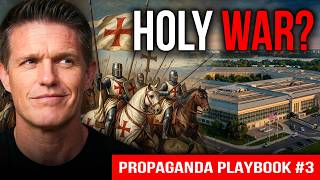
A U.S. military commander recently told his troops that President Trump had been anointed by Jesus to light the signal fire in Iran and bring about Armageddon. That statement didn't come from a church — it came from a combat readiness briefing. The Military Religious Freedom Foundation has since received over 200 complaints from more than 50 installations across every branch of the armed forces. What's happening inside the Pentagon right now is a textbook application of a propaganda technique that is over 130 years old — and once you understand how it works, you'll see it everywhere: in wars, in movements, and in every business that has ever turned customers into true believers.
The Holy War Framing Inside the U.S. Military
The current conflict began when the U.S. and Israel launched strikes on Iran. Eight U.S. servicemen are dead. Over 1,200 Iranian civilians have been killed. Oil has surpassed $110 a barrel. And the White House has offered no clear strategic rationale for the war.
Into that vacuum, military commanders across every branch have introduced religious language — framing the war not as a geopolitical conflict but as a divinely ordained crusade that will bring about the return of Jesus Christ. Defense Secretary Pete Hegseth has hosted monthly Christian prayer services inside the Pentagon Auditorium, broadcast on the Pentagon's internal TV network. He has invited a pastor who publicly advocates repealing women's right to vote and converting America into a Christian theocracy. Hegseth himself has a Jerusalem cross — a symbol of the medieval Crusades — tattooed on his chest.
His office released a video of him reciting the Lord's Prayer, intercut with footage of fighter jets launching, missiles in flight, paratroopers jumping from planes, and an American flag.
 03:45
Video of Defense Secretary Pete Hegseth reciting the Lord's Prayer intercut with military combat footage and the American flag
Watch at 03:45 →
03:45
Video of Defense Secretary Pete Hegseth reciting the Lord's Prayer intercut with military combat footage and the American flag
Watch at 03:45 →
As a piece of technical craft, that video is masterful — not morally, but mechanically. It fuses two identities into one: soldier and believer. Once those identities merge, questioning the war becomes indistinguishable from questioning God. That is the technique. And it has a name.
Gustave Le Bon and the Psychology of Sacred Propaganda
In 1895, a French social psychologist named Gustave Le Bon published The Crowd: A Study of the Popular Mind. Le Bon identified something no one had articulated before: when individuals form a crowd, they lose individual rationality and become susceptible to three things — images, symbols, and sacred words. Not arguments. Not logic. Not evidence.
His most important observation: "The masses have never thirsted after truth. Whoever can supply them with illusions is easily their master. Whoever attempts to destroy their illusions is always their victim."
Le Bon's central insight was that the most powerful propaganda technique ever devised is to give a cause the character of a religion — because religious belief operates below logic. It operates at the level of identity. And once something becomes part of someone's identity, no quantity of facts or arguments will change their mind. You are no longer arguing with their brain. You are arguing with their soul.
Edward Bernays — the man who invented modern public relations — read Le Bon before he read Freud. Le Bon was the foundation everything else was built on. Hitler studied Le Bon. Mussolini studied Le Bon. Every mass movement leader of the 20th century studied this man. The same playbook is now running out of the Pentagon in 2026.
From the Crusades to Cable News: The Technique in Action
In 1095, Pope Urban II faced a nearly impossible task: convincing thousands of European farmers, blacksmiths, and ordinary men to leave their families, march thousands of miles, and die in a desert for a city most of them had never seen. No logical argument could accomplish this. So he didn't make one.
At the Council of Clermont, he told the crowd: Deus vult — God wills it. The crowd chanted it back. Thousands of men enlisted on the spot, sewing crosses onto their tunics. The identity shift was instantaneous. You were no longer a farmer going to war. You were a soldier of God on a sacred mission. Death wasn't a risk — it was a reward. That is Le Bon's playbook in its purest form.
In World War I, both sides claimed divine endorsement. German soldiers wore belt buckles engraved with Gott mit uns — God with us. Allied propaganda framed the war as a crusade against barbarism. Bernays contributed the phrase "make the world safe for democracy" — not policy, but a sermon. A moral absolute. You're either for it or against it.
The same framing is visible in contemporary media coverage of the Iran conflict.
14:20
Cable news clip of a U.S. senator describing the conflict as 'a religious war' and framing it as setting the course of the Middle East for 'a thousand years'
Watch at 14:20 →
When a sitting U.S. senator says this conflict will "set the course of the future of the Middle East for a thousand years" — that is not policy. That is prophecy. Le Bon predicted it precisely: in times of crisis, leaders who speak in absolute moral terms will always defeat leaders who speak in nuance.
The Identity Stack: How Ethical Movements Use the Same Psychology
The psychology that turns a war into a crusade is the same psychology behind every movement-based business ever built. The difference is intent, not mechanism. When ClickFunnels launched, there were dozens of competing marketing automation platforms. Most competed on features — integrations, analytics, page templates. That is a policy debate. Le Bon told us 130 years ago that logic loses to identity every single time.
So instead of selling software, a movement was built around an identity: the Funnel Hacker. Everything was designed so that buyers weren't purchasing a tool — they were joining a tribe, becoming something. The parallels to what the Pentagon is doing are uncomfortably precise. Here are the five elements, what can be called the Identity Stack:
- The Sacred Text. Every religion has a foundational document that the belief system is built on. For ClickFunnels, it was three books — DotCom Secrets, Expert Secrets, and Traffic Secrets. The community didn't just read them; they studied, highlighted, and brought them to events. Not a sales page — a manifesto.
- The Rallying Cry. The Crusaders had Deus vult. ClickFunnels had You're just one funnel away. A rallying cry must be short enough to chant and deep enough to mean something. It is not a slogan — it is an identity statement.
- The Gathering. Every religion has a pilgrimage. Funnel Hacking Live became that event — not a software conference, but a revival. Attendees fly in from around the world, wear their shirts, bring their books, and cry when someone walks across the stage to collect their Two Comma Club award for crossing a million dollars in sales.
- The Visible Commitment. The Crusaders sewed crosses onto their tunics. Funnel Hackers put stickers on their laptops, wear branded T-shirts, and hang plaques on their office walls. That is not branding — that is identity. It tells the world: this is who I am.
- The Enemy. Every movement needs something to fight against — not a competitor, but a broken system. ClickFunnels wasn't positioned against Leadpages or Infusionsoft. It was positioned against the traditional website itself. Websites are dead. Funnels are the future. That is a crusade, not a feature comparison. People don't join feature comparisons.
28:10
Footage from Funnel Hacking Live showing attendees crying and celebrating onstage during the Two Comma Club award presentation
Watch at 28:10 →
Nobody cries about drag-and-drop page editors. They cry because they became something — they found their tribe and proved to themselves they could do it. That is Le Bon's crowd psychology producing a genuinely positive outcome.
The Question That Doesn't Have a Clean Answer
Le Bon wrote that the masses have never thirsted after truth — they thirst after illusions, and whoever supplies those illusions becomes their master. That raises an uncomfortable question for anyone building a movement with these tools: when people tattoo your logo onto their bodies, cry at your events, and organize their professional identity around your brand — are you giving them truth, or a very compelling illusion?
When military commanders tell troops that a war in the Middle East is God's divine plan to bring about the end times, is that psychologically different from building a business movement where identity trumps logic? Or is it the same psychology pointed in a different direction?
The line between a movement that changes lives and a crusade that destroys them may be thinner than any of us are comfortable admitting. The technique is neutral. The intent is everything — and intent is the one variable Le Bon's playbook never controls for.