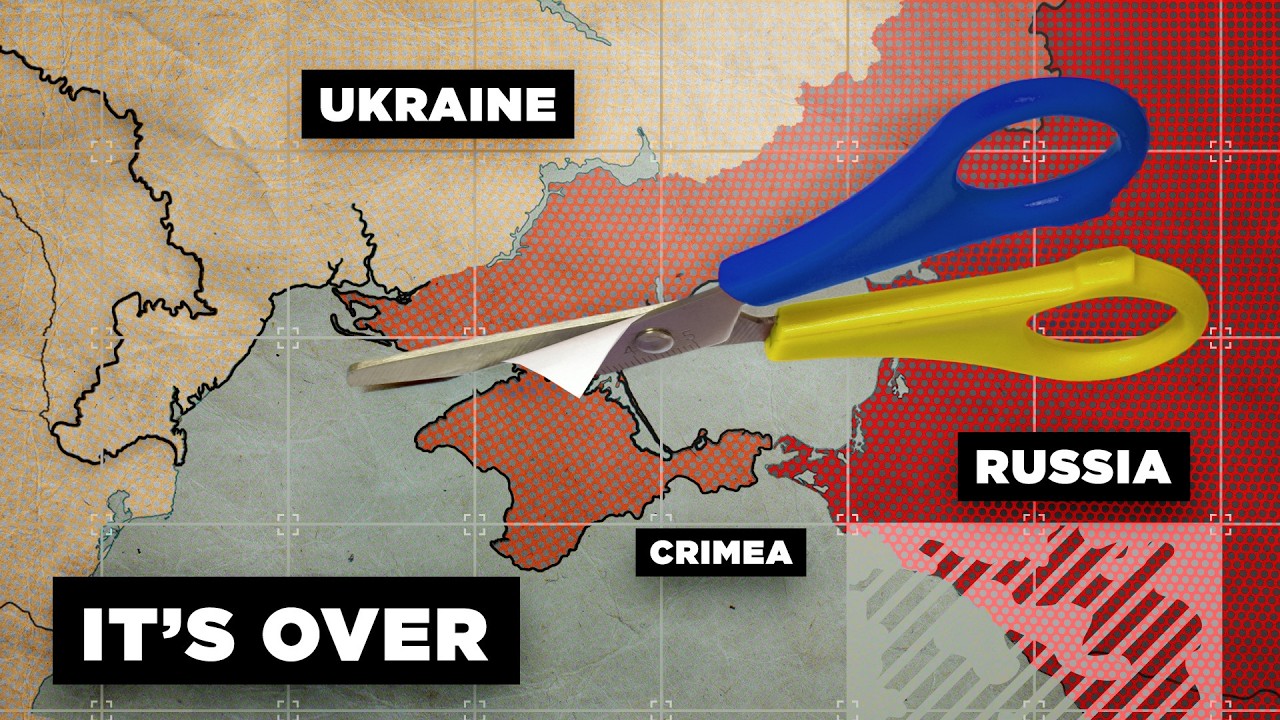

Ukraine's logistics lockdown strategy in Crimea is exactly what it sounds like: a systematic drone campaign designed to sever every single supply route feeding the peninsula, effectively turning it into a military and civilian island. Announced near the end of May, the strategy deploys mid-range explosive drones to strike warehouses, fuel depots, bridges, highways, and ferry services at operational depth — not the front line, but the arteries that keep Crimea alive. The results have been stunning. Within weeks, Russian military cargo traffic along the main supply highway crashed by 71%, fuel was rationed, and civilians faced an 8-hour wait at gas stations.
What Is Ukraine's Logistics Lockdown Strategy in Crimea?
Ukraine's defense minister described the goal simply: transform Crimea into an island. And geography is already doing half the work for them. The Crimean Peninsula is naturally almost an island to begin with. Its only land connection to continental Europe is the Isthmus of Perekop in the north — a strip of land just 5 to 7 kilometers wide. The rest of Crimea's northern edge is bordered by the Sivash, a labyrinthine network of shallow lagoons, salt marshes, and wetlands nearly impossible to cross at scale.
 02:14
Map showing the three narrow land corridors and the Crimean Bridge as Crimea's only logistical connections to Russia
Watch at 02:14 →
02:14
Map showing the three narrow land corridors and the Crimean Bridge as Crimea's only logistical connections to Russia
Watch at 02:14 →
That leaves only three narrow land corridors through which roads and railways can realistically pass: through the Isthmus of Perekop in the west, through Chongar in the center, and across the Arabat Spit in the east. Add Russia's $4 billion Crimean Bridge across the Kerch Strait and a handful of ferry routes, and you have the complete picture of every logistical lifeline keeping Crimea connected to Russia. Ukraine's new strategy targets all of them simultaneously.
Why Is Crimea So Strategically Important to Russia?
To understand why this strategy is so devastating, you have to understand what Crimea means to Russia — both militarily and politically. After Russia seized the peninsula in 2014, it poured billions into militarizing it: new naval bases, radar stations, airfields, missile launcher sites, and garrisons that gave Moscow a powerful base of operations across the entire Black Sea region.
When Russia launched its full-scale invasion of Ukraine in 2022, Crimea served as the launchpad. It's been the rear base supporting Russian offensives across the southern front ever since. Establishing a direct land corridor to Crimea through the occupied regions of Donetsk, Zaporizhzhia, and Kherson was one of Russia's primary stated objectives — precisely because Crimea's near-island geography made it logistically vulnerable without that overland connection.
08:45
Satellite image of the damaged Chongar bridge in central Crimea captured in mid-June
Watch at 08:45 →
Beyond the military math, Crimea is Vladimir Putin's greatest political trophy. The bloodless annexation in 2014 was sold to the Russian public as proof of restored imperial greatness. It gave Putin enormous domestic legitimacy. Watching that symbol deteriorate under relentless drone attack is, for the Kremlin, a political crisis as much as a military one.
What Has Ukraine Done to the Crimean Bridge?
The Crimean Bridge — Russia's $4 billion engineering showpiece spanning the Kerch Strait — has been a persistent Ukrainian target since the war began, though with mixed results. A truck bomb in October 2022 collapsed two road sections and disrupted vehicle traffic for months, though rail traffic was restored within days. In July 2023, Ukrainian naval drones brought down another section, again halting road traffic while rail recovered quickly. A third operation in June 2025 involved secretly planted underwater explosives, but the damage was minimal and traffic resumed within hours.
The bridge hasn't been destroyed, but the cumulative pressure forced a significant Russian policy change: trucks carrying more than 1.5 tons were banned from using it entirely, effectively redirecting the bulk of heavy freight toward the land bridge through occupied southern Ukraine and ferry crossings instead. That redirection made those alternative routes the new priority targets — and Ukraine noticed.
12:30
Satellite image showing thick smoke from burning oil storage tanks in Kerch on the Crimean side of the Kerch Strait, June 22nd
Watch at 12:30 →
What Is the R280 'Highway of Death' in Ukraine?
The R280 highway is the main overland artery connecting the Russian mainland to Crimea through the occupied cities of Mariupol, Melitopol, and Chongar. Russian occupation authorities branded it the Nova Russia Highway. Ukrainians now call it the Highway of Death — and the name has earned itself.
Since April, Ukrainian forces have launched hundreds of mid-range drone strikes against Russian trucks hauling fuel, ammunition, and supplies along this route. But strikes alone aren't the only weapon. Drones have also been dropping 500-gram magnetic and motion-sensor landmines directly onto the highway surface, triggering delayed explosions that destroy additional trucks hours or even days later.
15:10
Smoke-generating vehicles driving onto the Crimean Bridge during a drone attack to obscure it from aerial cameras
Watch at 15:10 →
By June, Ukraine's Third Special Battalion claimed full aerial control over the stretch between Melitopol and Chongar, backing the claim with footage of dozens of burning Russian trucks. The Chongar bridge itself — the crossing point from the highway into Crimea — was struck at least three separate times in June alone, forcing Russian logistics to divert through a nearby pontoon bridge. Around 50 trucks rerouted through the Perekop Isthmus were then struck again on June 11th as they attempted to cross through Armiansk. There was nowhere safe to run.
How Are Ukrainian Drones Reshaping the War in Crimea?
What makes this campaign genuinely new is its systematic, simultaneous pressure on every single entry point at once. Ukrainian drones struck bridges over the North Crimean Canal in the northwest, the Chongar bridge in the center, the Henichesk bridge leading to the Arabat Spit in the east, and the full length of the R280 in between. On June 21st, drones hit three of the five Russian vehicle ferries crossing the Kerch Strait, setting them ablaze and effectively shutting down the ferry service. Oil depots on both sides of the strait at Kerch and Kavkaz were also targeted — fuel storage that Russia had historically relied on to supply the entire southern front.
Satellite imagery confirmed the scale of the damage across the Chongar bridge, the Henichesk bridge, and the Stavky bridge over the Crimean Canal. Even Russia's improvised countermeasure — smoke-generating vehicles deployed onto the Crimean Bridge to obscure it from drone cameras during attacks — was captured on satellite, a telling sign of just how outmatched Russian defenses have become.
The Starlink-connected, AI-assisted drone fleet that Ukraine has developed means these are not random attacks. They are precision logistics interdiction at a scale that wasn't possible even two years ago.
Is Crimea Running Out of Fuel and Supplies?
Yes — and the civilian consequences are already severe. By mid-May, gasoline rationing had begun in Crimea, producing miles-long lines at fuel stations. Russian tourists arriving from the mainland began bringing their own jerry cans. One tourist reported to the Washington Post in mid-June that queue times at some gas stations exceeded eight hours.
Then, in late June, the Russian occupation authorities took a dramatic step: they banned all civilian fuel sales entirely, reserving remaining stocks exclusively for the military and essential services. The day after that announcement, Sevastopol's occupation governor imposed additional restrictions — public transport shut down after 10 p.m., large shops and cafes closed after 8 p.m., street lights switched off to conserve energy. Residents were urged to turn off air conditioning despite temperatures approaching 30°C. Energy blackouts began disrupting water supplies. Nighttime use of mopeds and motorbikes was banned. All children's sports events, summer camps, and competitions were cancelled through September 1st.
The timing couldn't be worse for Russian optics. Crimea's summer tourism season, which attracted nearly 4 million visitors as recently as last year, is collapsing. Tourist bookings for June fell 50% compared to May. July and August bookings are already down more than 30% year-on-year. When a state of emergency was formally declared across the peninsula on June 26th, a 15-kilometer traffic jam formed on the Crimean Bridge as tourists and residents scrambled to leave simultaneously — one of the most visible mass exodus moments of the entire war.
What Does Crimea's Crisis Mean for Peace Negotiations?
Ukraine almost certainly cannot retake Crimea by military force anytime soon. But that may not be the point. By making Russian control over Crimea increasingly unviable — for the military, for civilians, for the economy — Ukraine is building enormous negotiating leverage for any future peace talks.
The longer the logistics lockdown holds, the weaker Russia's military operations in occupied Kherson and Zaporizhzhia become. Stretching a supply route by even 80 to 100 kilometers reduces daily cargo capacity by roughly 30%, which directly translates into fewer Russian assaults along the front. Russia's mobile air defense teams in Crimea are reportedly rationing their own fuel, meaning drone attacks are becoming progressively harder to stop.
Putin faces a brutal trilemma: escalate, negotiate, or watch the jewel of his imperial restoration project wither away under a swarm of Ukrainian drones. For a leader whose domestic legitimacy has been built in no small part on the story of Crimea's triumphant return to Russian control, that last option may be the most politically unbearable of all. And for now, Ukraine seems content to keep turning up the heat — one drone strike at a time.