
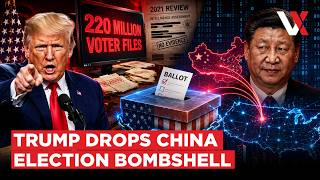
Did China steal 220 million American voter files? That is the explosive claim President Donald Trump made in a primetime address to the nation, unveiling what he described as newly declassified intelligence documents exposing the largest compromise of election data in history. But here is what makes this story complicated: a 2021 intelligence review conducted under Trump's own director of national intelligence, John Ratcliffe, concluded that while China considered election interference operations, it ultimately decided against carrying them out — and found no evidence the voter data was ever used to alter a single vote.
With November midterms on the horizon, the release of these documents is not happening in a vacuum. The political stakes are enormous, and the gap between Trump's claims and existing intelligence assessments is sparking fierce debate about what these documents actually prove — and what they don't.
 00:45
Trump addresses the nation in primetime, unveiling newly declassified documents on Chinese election interference
Watch at 00:45 →
00:45
Trump addresses the nation in primetime, unveiling newly declassified documents on Chinese election interference
Watch at 00:45 →
Did China Really Steal 220 Million US Voter Files?
According to Trump's declassified documents, China carried out what the administration is calling the largest compromise of election data in history, illicitly acquiring 220 million US voter files over a period of years starting during the 2020 election cycle. The stolen data allegedly includes names, home addresses, phone numbers, political party affiliations, and other sensitive personal information.
Trump claimed China even established a dedicated data exploitation unit specifically to manage this trove of stolen voter information, and that the data was being actively used for what he described as "nefarious activities."
However, the intelligence picture is more nuanced. The 2021 Office of the Director of National Intelligence review acknowledged that Beijing had been collecting publicly available information on American voters dating back to at least 2008. But the assessment drew a clear line: there is no verified evidence that this data was used to change votes or materially affect the outcome of the 2020 election. Critics argue Trump's framing upgrades a documented data collection effort into an active weaponized attack — a distinction that matters enormously when debating election security policy.
03:20
Trump details the five major areas covered by the declassified intelligence documents
Watch at 03:20 →
What Did Trump's Declassified Documents Actually Reveal?
Trump's primetime address laid out five major areas covered by the newly declassified material:
- Chinese voter data acquisition: The alleged theft of 220 million voter files, described as an unprecedented election security threat.
- Deep state suppression: Trump accused members of the intelligence community of actively working to suppress and downplay information about China's election meddling.
- Corporate influence operations: Claims that China used its relationships with major American corporations to turn US business leaders against Trump.
- Journalist payments: Allegations that Beijing identified US journalists who had written critically about Trump and paid them to produce more negative coverage.
- Non-citizen voter registration: A Department of Homeland Security review purportedly identifying approximately 278,000 non-citizens registered to vote in federal elections.
China's Foreign Ministry had not issued a formal response at the time of the address. However, Liu Chang, spokesperson for the Chinese Embassy in Washington, stated clearly: "China has never and will never interfere in the presidential elections of the US."
Did China Pay US Journalists to Write Against Trump?
One of the more striking allegations in Trump's address was that the Chinese government specifically identified American journalists who had reported negatively on his presidency and paid them large sums of money to write additional negative articles. Trump claimed Beijing "didn't care what they said" as long as the coverage damaged his standing ahead of the 2020 election.
Trump connected this to his belief that China wanted him to lose re-election because of his aggressive tariff policies and military buildup. "They knew I was wise to them," he said. "Charged them billions and billions of dollars worth of tariffs."
07:15
Chinese Embassy spokesperson Liu Chang's denial of election interference allegations
Watch at 07:15 →
No independent verification of these journalist payment claims has emerged publicly, and no named journalists or specific publications were identified in the portions of the address made public.
Are 278,000 Non-Citizens Really Registered to Vote?
Trump also used the primetime address to renew one of his long-standing claims: that non-citizens are illegally registered to vote in large numbers. Citing a Department of Homeland Security review of state voter rolls and public records, he put the figure at approximately 278,000 non-citizens registered in federal elections.
Trump was careful to add a caveat — because Democratic-leaning states refused to share their voter files with federal investigators, he argued the true number is "much higher." Independent election researchers and state election officials have consistently found that non-citizen voting is extremely rare, and existing safeguards catch most registration errors before votes are ever cast. The DHS methodology behind the 278,000 figure has not been made fully public for independent review.
What Is the Save America Act and Will It Pass?
Trump used the moment to once again push Congress to pass the Save America Act, legislation designed to introduce stricter voter identification requirements, proof-of-citizenship rules, and expanded federal oversight of state election systems. The Republican-controlled House has passed versions of the bill multiple times.
The obstacle is the Senate. The bill currently lacks the 60 votes needed to overcome a Democratic-led filibuster, leaving it stalled despite repeated House passage. Trump's primetime address and the newly declassified documents appear designed in part to build public pressure on Senate Democrats ahead of the November midterms — making election integrity the defining issue of the campaign season.
Are China and Russia Secretly Training Each Other's Troops?
Separate from the election interference story, a significant new disclosure emerged from Ukraine's military intelligence agency, known as HUR. According to HUR, more than 550 Chinese soldiers have completed internships at Russian military institutions, while more than 180 Russian military personnel completed training at Chinese military academies in November 2025 alone.
The bilateral program reportedly spans infantry, armored warfare, aviation, engineering, and air defense disciplines — suggesting the cooperation goes well beyond symbolic joint exercises.
This disclosure echoes earlier reporting. Reuters, citing European intelligence sources, had previously reported that around 200 Russian troops received military training in China, with some later deployed to the front lines in Ukraine. The Institute for the Study of War reported in September 2025 that Chinese firms were contributing to Russia's production of long-range drones, and a Bloomberg report in April 2026 reached similar conclusions. The two countries also announced a joint naval drill in the Pacific — dubbed Joint Sea 2026 — to be conducted near Qingdao.
Is China Actually Neutral in the Ukraine War?
China has publicly insisted it is a neutral party in the Russia-Ukraine conflict. That position is becoming increasingly difficult to defend. Western governments and Ukraine's own intelligence services argue that Chinese exports of dual-use technology have materially helped sustain Russia's military production capacity throughout the war.
Norwegian Prime Minister Jonas Gahr Støre has been among the most direct European voices, urging Beijing to use its considerable leverage over Moscow to push for a negotiated peace settlement. He warned that Europe-China relations will remain fundamentally constrained as long as Beijing maintains deep strategic ties with Russia.
Neither Moscow nor Beijing has publicly responded to Ukraine's latest claims about the scale of the bilateral military internship program.
What Does This All Mean Heading Into Midterms?
Two major threads are running simultaneously through this news cycle: a domestic election integrity battle built on explosive but contested intelligence claims, and a deepening China-Russia military partnership that Western governments are only beginning to fully map.
For American voters, the core question is whether Trump's declassified documents represent a genuine national security reckoning — or a carefully timed political maneuver designed to make election integrity the dominant issue of the midterm cycle. The 2021 intelligence community assessment under Trump's own appointee offered a more measured picture than the primetime address suggested.
What is not in dispute: China has been collecting American voter data for years, Russia and China are deepening their military ties, and November is getting closer by the day.